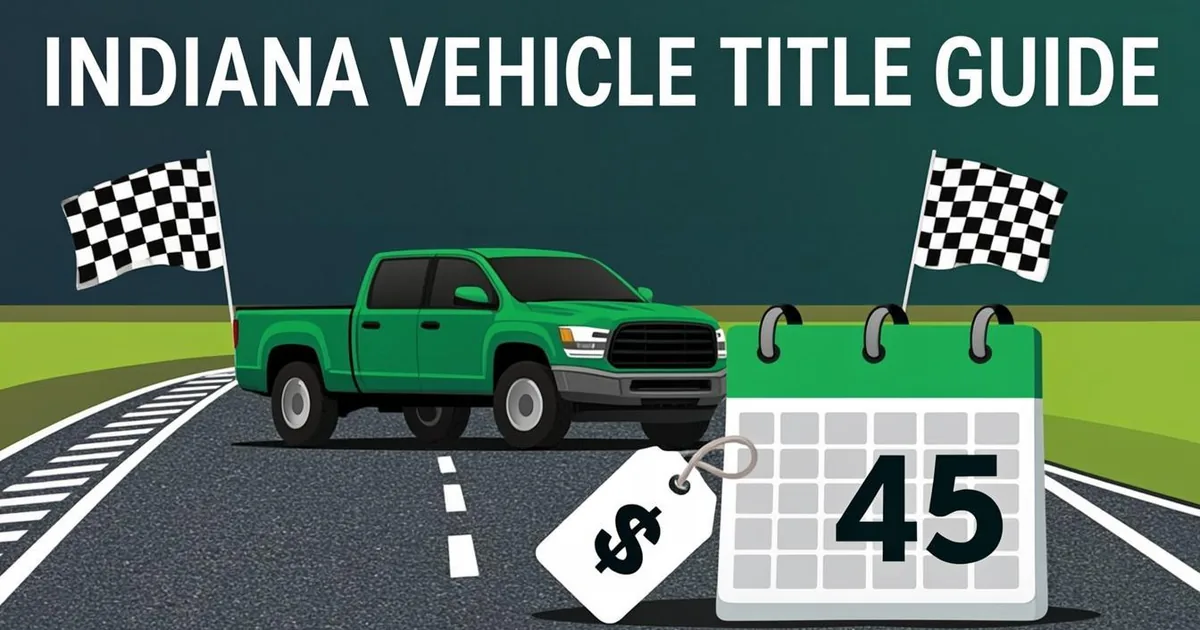
An Indiana vehicle title costs $15 — a third of what neighboring Illinois charges — and the state's 45-day transfer window is double most of the Midwest. The Indiana BMV runs everything centrally: one $15 fee covers originals and duplicates, a $25 speed title jumps the queue, and a $30 penalty lands on late transfers.
Indiana's system is paperwork-light but deadline-real. This guide covers the 2026 fee table, the State Form 205 title application, the 45-day rule with its $30 bite, and the watercraft title path most Midwest boaters discover only at the lake launch.
How Indiana Titles and Registration Work
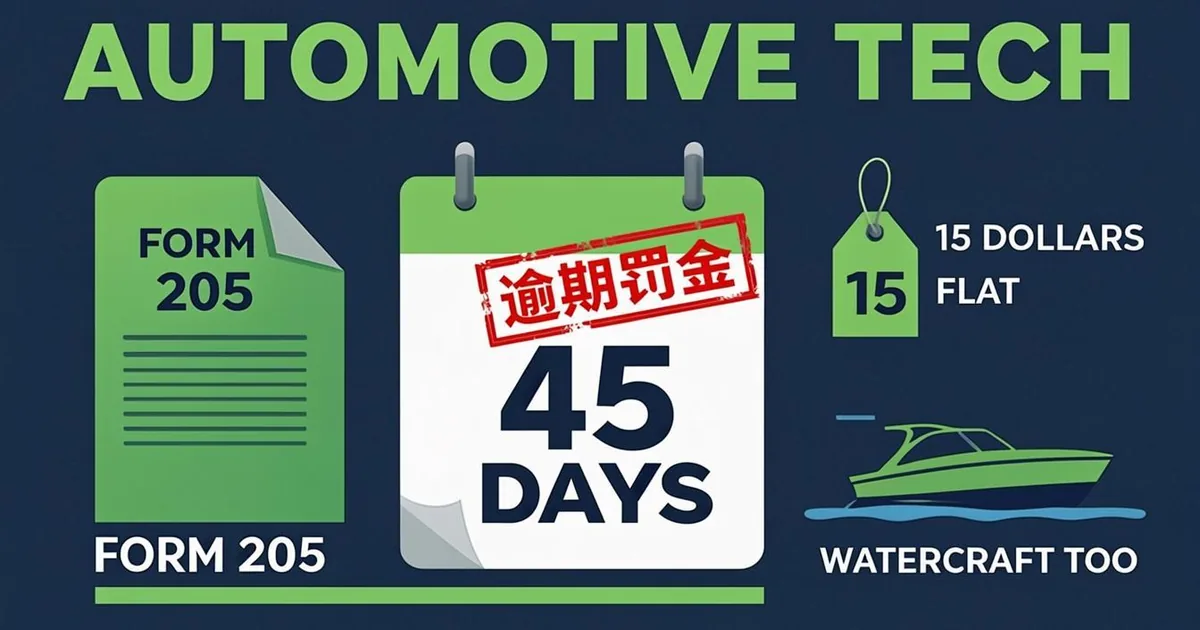
The Bureau of Motor Vehicles handles titles statewide through its branch network and mail-in processes. Applications land on the Application for Certificate of Title for a Vehicle — State Form 205, revised as recently as 2026 — and the same BMV transaction issues plates at the counter. No county variation complicates the fees, unlike Wisconsin's county wheel taxes or Hawaii's island system.
Indiana also titles watercraft through the BMV on a dedicated form, and non-traditional vehicles like reconstructed or assembled units carry their own inspection-backed paths. The BMV title forms page lists the current versions of every document.
Indiana Title Fees for 2026
The BMV fee chart is short and predictable. These are the official figures.
| Item | 2026 Fee | Note |
|---|---|---|
| Original, duplicate, or replacement title | $15 | Same fee for all three |
| Speed title (expedited) | +$25 | Moves application to front of queue |
| Late-title administrative penalty | $30 | Applied after the 45-day window |
| Sales/use tax on purchases | 7% of price | Collected at title time |
| Seller's notary/service fee | Up to $5 | Optional private-seller charge |
The flat $15 across original, duplicate, and replacement transactions is the standout. Most states charge more to replace a lost title than to issue an original — Indiana prices them identically, so losing the paper costs only the reissue wait.
Replacing a Lost Indiana Title
Lost titles go through the BMV's Duplicate Title Application with the $15 fee. Apply at any branch or by mail with a check payable to BMV, and online ordering runs through the BMV's customer portal for eligible owners.
- Get the Duplicate Title Application from the BMV duplicate page or any branch.
- Complete the vehicle section: VIN, title number if known, and owner details as recorded.
- Sign as the owner of record. All recorded owners sign, matching the national two-name rule.
- Pay $15 — or $40 total with the $25 speed-title add-on when a sale is pending.
- File at a branch or by mail. Standard processing runs about two weeks; speed titles cut it to days.
Liens change the destination, as they do everywhere: an active lienholder appears on the duplicate, and some lenders hold the paper until payoff. Settle the release sequence from lost title with an active loan before applying, or expect the duplicate to route to the bank.
Buying or Selling: The 45-Day Rule
Indiana gives buyers 45 days from acquisition to apply for the title — generous against the 20- and 30-day windows in neighboring states. The application is State Form 205 with the assigned title, the bill of sale, and payment covering $15 plus the 7 percent sales tax on the purchase price.
Sellers complete the assignment fully: buyer name, price, odometer for vehicles under 20 model years old, and signatures. Indiana's plate practice matches most states — plates stay with the seller, who can transfer them to a replacement vehicle within the state's window or surrender them. The buyer leaves the deal with assigned paper and a deadline, not plates.
The 45-day window is a hard stop, not a suggestion. Day 46 brings the $30 penalty automatically, and unregistered driving in the gap invites standard enforcement. Buyers with immediate driving needs complete the title-and-registration in one branch visit — Indiana issues both together, which is the practical cure for the plate gap.
A Worked Example: Buying a Silverado in Indianapolis
Real numbers make the deadline real. Say you buy a 2017 Silverado from a private seller in Marion County for $22,000 on June 1.
- At signing: the seller completes the title assignment — your name, the $22,000 price, the odometer reading, the date — and keeps the plates. You photograph every page before driving off.
- Within the week: you complete State Form 205, pull your insurance card, and confirm the seller's title has no active lien line.
- By July 16 (day 45): the packet hits a BMV branch — the assigned title, Form 205, bill of sale, ID, and payment for $15 plus 7 percent tax ($1,540 on this deal) plus registration.
- At the counter: Indiana issues the new title in your name and your plates in the same visit, closing the driving gap the same day.
- Afterward: the seller transfers their plates to their next vehicle or surrenders them — Indiana plate rules, not yours.
Total state-side cost: about $1,555 plus registration, overwhelmingly the 7 percent tax. The $15 title underneath it is almost a rounding error — which is why Indiana paperwork battles are about deadlines, never about fees. File by day 45 and the transaction is boring; miss it and the same boring transaction carries a $30 surcharge and a lecture.
Selling Your Indiana Car: The Seller's Side
Sellers carry three duties that protect them after the keys leave. Complete the assignment at signing, remove and keep the plates, and file the certificate of plate transfer or surrender so your liability record ends cleanly.
The assignment is where sellers create future problems. Blank price lines, missing dates, and unrecorded odometer statements all survive to haunt sellers when the buyer never files — Indiana's enforcement systems chase the last recorded owner for tickets, tolls, and taxes on a car that legally still belongs to them. The assignment, filed promptly by the buyer, is what cuts the cord; if the buyer delays, your signed copy and the plate surrender receipt are your defense.
Financed sales need the lender's release in hand before the signing table. An assignment on a title that still shows a lien creates a gap the BMV will flag, and the deal stalls mid-escrow. The payoff-first sequence at lost title before transfer shows the clean order of operations, and sellers whose paper has already gone missing start at the duplicate process above — Indiana's $15 and two-week turnaround makes that fix cheaper here than almost anywhere.
Watercraft Titles: The Form 38529 Lane
Indiana titles watercraft through the BMV using the Application for Certificate of Watercraft Title — State Form 38529. Boats falling under the titling rules need that certificate before sale or transfer, and operating an untitled-but-titlable boat is unlawful under the BMV's own guidance.
The watercraft lane matters at the lake more than at the branch: private marina sales and out-of-state purchases routinely skip the step, and the new owner discovers the gap at registration renewal. Buyers should confirm the watercraft title exists before paying — the same pre-purchase discipline as any car, covered in what is a car title.
Lost watercraft titles follow the same duplicate process and $15 fee as vehicles, and out-of-state boats arriving in Indiana bring their ownership papers into the BMV's intake like any new resident's car. The federal overlay for documented vessels — which no state titles — is covered in lost boat title replacement.
Salvage, Rebuilt, and Assembled Vehicles
Indiana brands salvage history through the BMV with an inspection gate. A vehicle declared a total loss carries a salvage certificate until it passes reconstruction inspection, after which a rebuilt brand clears it for standard registration. Assembled vehicles — ground-up builds and kit cars — follow the same inspection lane with additional documentation on component origins.
Buyers should price rebuilt brands, not just read them. Insurance options narrow, resale drops, and some lenders pass entirely. The brand itself is honest information — the failure mode is a branded car marketed as clean, which the BMV's title history surfaces at the next transfer anyway.
Fleet buyers and rebuilders moving volumes through Indiana auction lanes should calendar the inspection queue, which stretches in spring when dealer inventories turn. The inspection certificate is the gate to every downstream transaction, so booking it early protects every deadline behind it.
New Residents and Out-of-State Vehicles
Indiana gives new residents 60 days to register after establishing residency — one of the longer windows in the country. The packet at the branch: out-of-state title, proof of Indiana insurance, identification, and payment for the $15 title, 7 percent use tax where applicable, and registration.
Vehicles carrying liens from out-of-state lenders take the coordination lane: the BMV records the lien on the new Indiana title, and lenders transmit electronic releases through the ELT framework. Arrivals should call the lender early so any held paper title ships before the 60-day clock closes.
VIN verification is handled through the standard intake for most vehicles, but salvage-history and bonded-title arrivals face additional review. Bring the full ownership file — prior registrations, lien releases, and the bill of sale — and the branch processes the intake in one visit.
The Fast Lane: Speed Titles and When They Pay
The $25 speed-title add-on exists for exactly the moments standard processing cannot serve: a buyer's lender demanding title proof, an out-of-state sale closing this week, a registration deadline colliding with a lost certificate. Speed titles move to the front of the BMV queue, cutting a two-week wait to days.
The math is situational. A $25 add-on against a delayed $30,000 vehicle sale is nothing; the same $25 to replace paper nobody needs for months is a waste. Standard duplicates at $15 with a two-week tail serve most owners fine.
Compared regionally, Indiana's expediency pricing sits mid-pack: Illinois guarantees next-business-day printing through its expedited channel on a $165-title base, and Idaho sells rush handling for $26 on a $14 title. The service exists everywhere the Midwest; only the price differs.
Mistakes at Indiana Counters
The BMV's clean fee schedule fails only on human error. These are the recurring ones.
- Filing on day 46 of the 45-day window — the $30 penalty is automatic.
- One of two owners missing from the duplicate application.
- Skipping the watercraft title on a qualifying boat, discovered at registration.
- Sellers signing the odometer line blank on newer vehicles.
- Mail applicants forgetting the $15 check payable to BMV.
None of these survive a prepared visit. Indiana's system rewards owners who read the 45-day rule once and calendar it — the state's paperwork is short enough that the deadline is the only real trap.
For a contrast in structure, Hawaii splits the same work across four county offices with island-specific fees, and Illinois centralizes everything at eleven times Indiana's fee. Indiana's flat $15 with a predictable clock is the quiet argument for standardization — and the reason Hoosier paperwork rarely makes anyone's worst-list.
Registration Costs and Plate Logistics
Registration in Indiana prices by vehicle class and adds the excise-tax style charges Hoosiers know from renewal notices. Passenger vehicles renew annually, plates transfer between vehicles the owner already holds, and specialty plates carry their own fees stacked on the base. The BMV's online estimate tools price a specific plate-and-vehicle combination before the branch visit.
Plate logistics after a sale follow the transfer-or-surrender pattern: keep the plates if a replacement vehicle is coming, and file the transfer within the state's window to keep the credit. Surrendered plates end the liability clock, which matters for sellers whose buyers are slow to file. Either way, the receipt belongs in the same folder as the title copy — the pair is what untangles any future ticket that follows the old plate.
Estate and Inherited Vehicles in Indiana
Inherited vehicles reach the BMV through estate paperwork rather than plain assignments. Small estates use the state's small-estate affidavit route, letting survivors transfer a vehicle without opening full probate; larger estates ride the court order. Bring the death certificate, the estate document, and the current title — or start with a duplicate if the paper went missing in the estate shuffle, since the $15 reprint is the cheapest step in the whole sequence.
Multi-heir situations need every heir's signature or a document appointing one representative, which is where most family title work stalls. Sorting signatures before the branch visit turns a three-trip process into one. The full inheritance walkthrough, including out-of-state estates, lives at lost title for an inherited vehicle.
Indiana's combination — flat $15 fees, a generous 45-day window, same-visit plates — makes it one of the easiest states in the country for ordinary title work. The traps that remain are deadlines and signatures, both visible on the form itself. Read once, calendar the window, and the BMV transaction takes care of itself.