Montana's title system is run by the Motor Vehicle Division under the Department of Justice. Processing happens through the county treasurers. The system carries two reputations that occasionally collide.
In-state, it is known for practical rural service and one of the lower fee schedules in the country. Nationally, it is known as the state where out-of-staters register RVs and exotic cars for the tax advantages.
This guide is for the first audience: Montana owners and new residents dealing with real Montana title work. That means replacement through Form MV7 and transfers at the county treasurer. It covers the rules that actually govern daily life with a vehicle here.
One structural fact to know upfront: Montana titles and registers at the county level. The county treasurer's office is the counter for everything.
The state's light-touch system means fewer verification steps than populous states. That speed holds provided the documents are complete from the start.
Table of Contents
- When Montana Requires a Title
- Replacing a Lost Title (Form MV7)
- Montana Title Fees and Taxes
- The Private-Sale Transfer
- Moving to Montana With a Vehicle
- Montana Edge Cases Worth Knowing
- The County Treasurer Is the System
- The Out-of-State Buyer Question
- Montana Winters Shape the Paperwork
- The Short List Is the Whole List
- Where the Fees Sit Nationally
When Montana Requires a Title
Montana titles motor vehicles from the mid-1980s onward for on-road use. Some vehicle classes carry older cutoffs, and vehicles that never see public roads are exempt. The pre-cutoff antiques trade on bills of sale.
Everything current needs a title to change hands. The title anchors the registration that Montana renews annually at the county.
One Montana quirk shapes the whole system. The state's vehicle fleet includes an enormous population of light vehicles: pickups, SUVs, and older work trucks. Their paperwork crosses generations of families.
Titles signed over informally decades ago surface at sale time with the gaps our sibling guides cover. The county treasurers have seen every version of that story.
Replacing a Lost Title (Form MV7)
The replacement runs on the Certificate of Title Replacement Application—Form MV7. File it at your county treasurer's office or by mail. The state's fee is $10.30 for standard vehicles.
The form captures the vehicle and owner details already in the state's records. A current registration makes the verification instant, and the replacement typically processes in a couple of weeks.
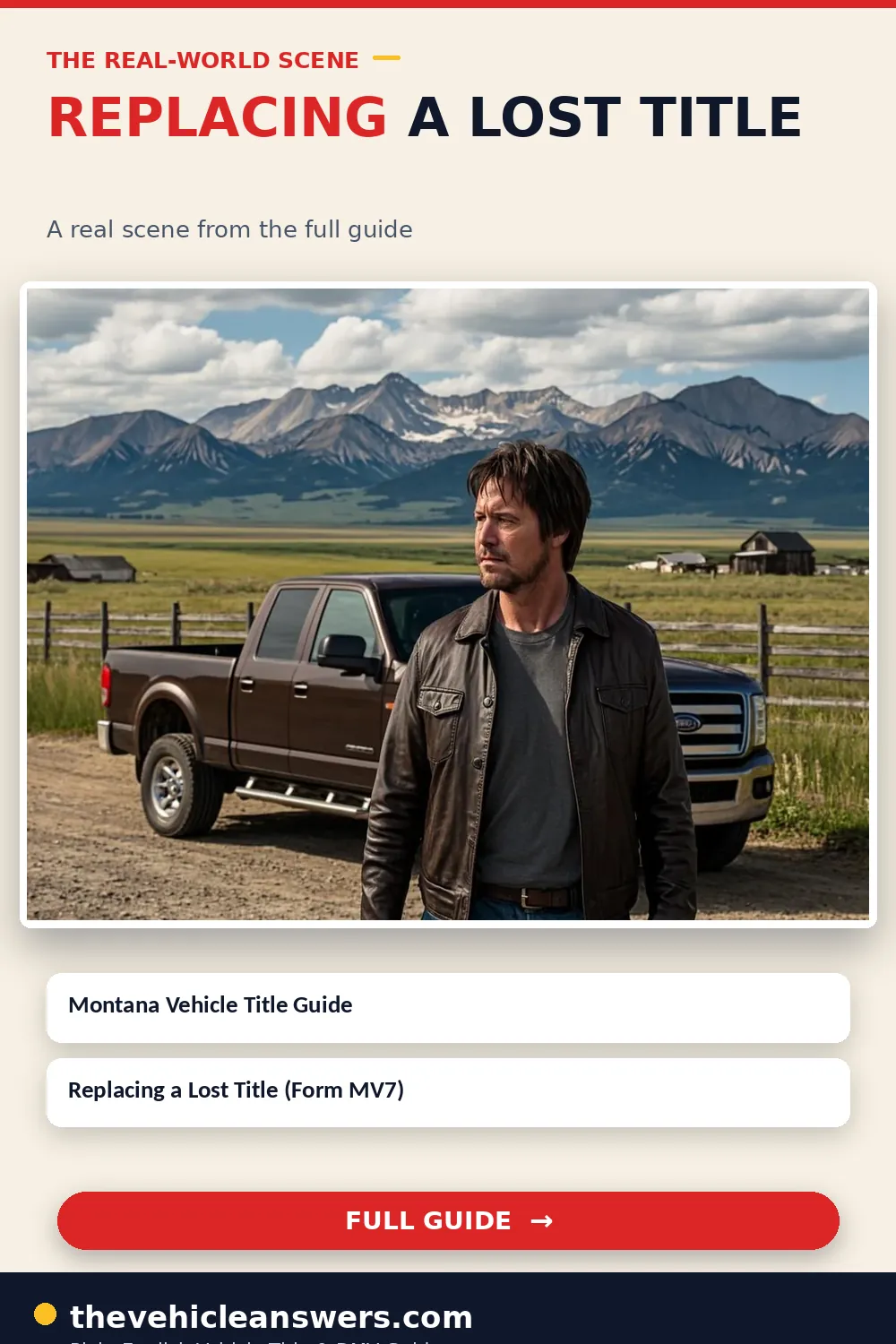
- Get Form MV7 from the MVD site or the county treasurer.
- Complete owner and vehicle details exactly as the records show them.
- Pay the $10.30 fee — checks to the state, or payment at the county counter.
- Handle any lien entry first. If the record shows a lender, the replacement routes through the lien's release; the county confirms at filing.
- Receive by mail in roughly two weeks, addressed to the owner of record.
Where the application adds a new security interest—a refinancing situation—a higher fee applies than the plain replacement. As everywhere, fix address mismatches between the record and reality at filing rather than after.
The replacement mails to the address of record.
Montana Title Fees and Taxes
| Item | Cost | Notes |
|---|---|---|
| Replacement title (Form MV7) | $10.30 | Standard vehicles; higher with new lien |
| Title fee (new/transfer) | ~$12 and up | County-counted; vehicle age affects it |
| Registration (light vehicle) | Varies by age/value | Annual; older vehicles pay less |
| County option taxes/fees | Varies | Local add-ons differ by county |
Montana's headline is what it does not have: no general state sales tax. That means no sales-tax line on vehicle purchases. It is the reason the state appears in national registration-strategy articles.
The county-level registration fees scale with vehicle age and value. That scaling is kind to the older work trucks that dominate Montana driveways.
The official fee schedules and forms live with the MVD at dojmt.gov. The county treasurer adds the local layer on top.
The Private-Sale Transfer
Montana's transfer process is deliberately light. The seller signs the title over: buyer, price, odometer, and date. The buyer takes it to the county treasurer within 40 days of the transaction for standard transfers.
There the buyer titles and registers the vehicle. No notarization is required on the assignment, which makes Montana handoffs simpler than its southern neighbors'. Buyers crossing state lines should skim the out-of-state title transfer guide before the drive, because the seller's state keeps paperwork duties for one trip.

A bill of sale remains good practice for both sides' records. The buyer's filing needs the assigned title, ID, proof of insurance, and the fees.
Insurance is required for registration, and the fees cover title plus registration scaled to the vehicle. Because there is no state sales tax, the total counter cost is frequently the pleasant surprise.
Sellers keep their dated file. Until the buyer registers, the record associates the vehicle with the seller.
Montana's rural traffic stops and agricultural exemptions all resolve faster with documents present.
Moving to Montana With a Vehicle
New residents convert their out-of-state title and registration promptly. The working guidance is within 60 days of establishing residency for standard vehicles. That is one of the more generous windows in the country.
The conversion runs at the county treasurer. The out-of-state title, insurance proof, ID, and the fees produce a Montana title and registration. Financed vehicles convert with the lender recorded.
Vehicles from title-optional situations may need ownership evidence built. Examples include older antiques and some out-of-state registrations that never involved titles. The county treasurer walks applicants through the evidence list.
Our guides on bills of sale as ownership evidence cover the documents that satisfy it. Leaving Montana, the title travels with the vehicle and the registration simply lapses.
Montana does not require plate surrender rituals in most counties, though returning plates closes the record cleanly. The destination state's conversion window is the binding deadline, and it is on the guides hub.
Montana Edge Cases Worth Knowing
Rural and agricultural vehicles dominate the edge cases. Think light trucks used seasonally and farm-plated equipment that crosses public roads occasionally. Add the older vehicles whose titles passed through three generations of a family.
Each works fine when the paperwork chain is complete. Each also surfaces its gaps at the worst moment.
That is why the state's ownership-evidence processes exist: affidavits, and bonded titles for the unfixable cases. Our guide on sorting ownership paper before a transfer covers the cleanup sequence.
Salvage and rebuilt vehicles follow Montana's branded-title process with inspection requirements before returning to road use. That matters given the state's long winters and the hail events that total whole parking lots.
Buyers should read the brand before negotiating.
For the neighboring paperwork, Wyoming and the Dakotas sit in our state guides hub. So do the national processes—duplicates, liens, estate transfers—that every Montana county treasurer applies in some local variation.
The title explainer covers the underlying document logic that makes all of them run.
The County Treasurer Is the System
The county-treasurer system deserves a longer appreciation than a fee table gives it. Montana's structure is genuinely different from the state-office model most guides assume. The treasurer's office is the county's financial hub.
It collects property taxes, processes vehicle titles, and sells hunting licenses. It knows the difference between your pickup and your neighbor's by sight. That consolidation means vehicle questions get answered by people who process hundreds per week.
They see the county's vehicles as a community ledger rather than anonymous rows. The practical consequences are real. Records questions resolve in one call, and corrections happen at the same counter that made the filing.
The office hours follow county rhythms rather than state mandates. Owners moving to Montana should identify their treasurer's office in the first month. Treat it as the vehicle relationship it is: the state's rules are the law, but the treasurer is the experience.
In Montana, the experience is the part that works.
The Out-of-State Buyer Question
The RV-and-exotic-car phenomenon mentioned in the opening deserves its honest paragraph. Montana owners encounter it at every used-vehicle sale. The tax-advantage registration strategies that make headlines are legal in their mechanics and complicated in their consequences.
The vehicles registered here by out-of-state owners still follow Montana's titling rules. The county treasurers process them like any other filing. The complications arise in the owner's home state, not here.
Montana sellers meet the phenomenon as buyers-from-afar whose addresses do not match their insurance cards. The practical guidance is the same as for any buyer. Verify who is actually signing, and confirm where the vehicle will actually live.
Let the buyer's own state answer the tax questions. The paperwork that crosses your counter is Montana paperwork either way.
And Montana paperwork, this guide exists to establish, is the simple part.
Montana Winters Shape the Paperwork
The final note belongs to the winters, because the season shapes the system. Registration renewals, inspection culture, and title timing all bend around a Montana calendar. The county office may be a snow-drive away, and the vehicle may be in the barn until spring.
Renewals can often be processed by mail in the counties that offer it. Deadlines have practical flexibility at the local level. The treasurers' offices plan their busy seasons around the same weather everyone else does.
Owners new to the state learn the rhythm quickly. Do the paperwork when the roads are clear, and keep the receipts where the plow cannot reach them. Ask the county office what the deadline actually is rather than assuming the website's worst case.
Montana's system assumes its residents are practical, and it is. The paperwork rewards the same quality.
The Short List Is the Whole List
The honest closing note is that Montana's system asks less paperwork of its owners than most. The asking matters accordingly: fewer requirements mean each one carries more weight. The county treasurers enforce the short list with the confidence of offices that see everything.
Bring the complete document, pay the modest fee, and keep the receipt. Store the title somewhere the winters cannot reach. It is the same advice every state gives.
Here, the system actually leaves you time to follow it. The owner who does the minimum well in Montana has done everything.
The owner who does less than the minimum discovers that the short list was already the whole list. The repair runs through the same treasurer's counter with a little more explaining. Montana's paperwork culture is best read as an invitation.
Meet the short list, and the state meets you at the counter with unhurried competence.
Where the Fees Sit Nationally
One fee note closes the loop with the national picture. Montana's $10.30 replacement fee sits at the low end of a national spread. That spread runs from free exchanges for damaged documents to $30-plus duplicates in the fee-heavy states.
The state's title-fee structure carries the same modesty. For owners who moved here from states where a counter visit required budgeting, that modesty means something. Fewer fees, shorter forms, and a county office that processes the whole thing without an appointment.
The savings are small per transaction and real over a lifetime of vehicle ownership. That trade is, in the end, the Montana pitch in miniature.