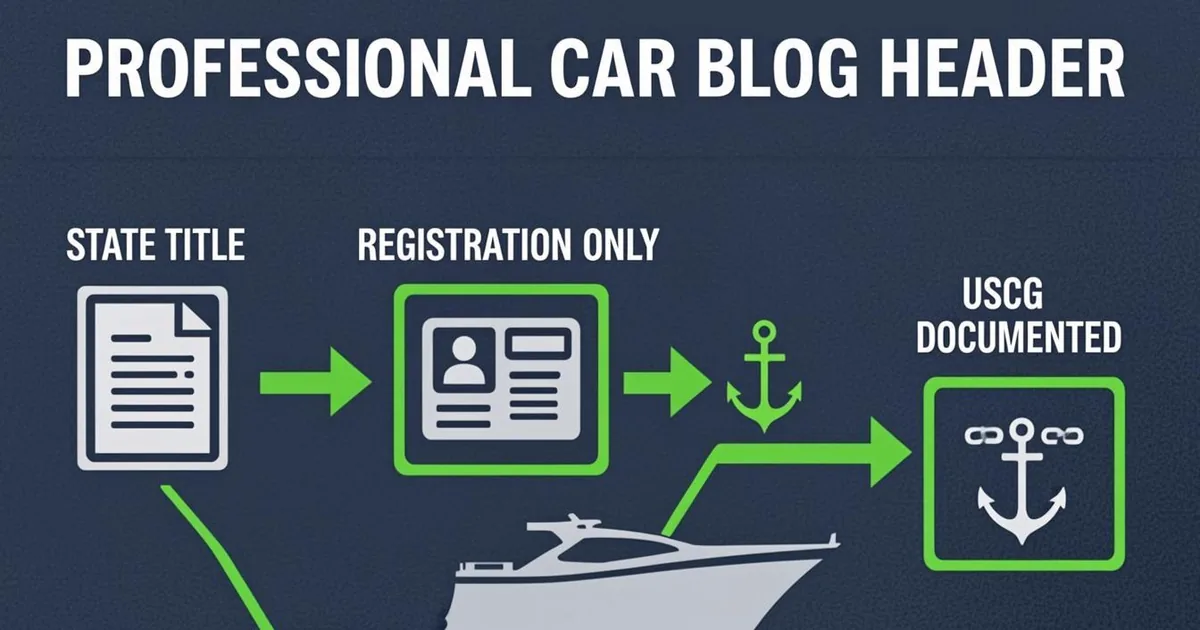
A lost boat title has three possible fixes, and picking the wrong one wastes weeks. Some states never title boats at all — those owners just replace a registration. Titled states issue duplicates much like cars. And federally documented vessels answer to the Coast Guard, which no state office can touch.
The first move is figuring out which system holds your boat's ownership record. This guide walks all three lanes with 2026 fees, the HIN lookup that anchors every application, and the interstate wrinkles that catch boaters who buy in one state and dock in another.
Which System Holds Your Boat's Ownership Record?
All 50 states register motorized boats, but titling is a different question. A large share of states require titles for at least some vessel classes, while a smaller group relies on registration records, bills of sale, and title-like ownership certificates instead. The rules within titling states also vary — length thresholds, model-year cutoffs, lien status, and whether outboard motors count.
States commonly cited as registration-only or no-separate-title jurisdictions include Arizona, Colorado, Delaware, Kansas, North Dakota, and Tennessee, with categories of Mississippi and New Hampshire vessels also outside standard titling. North Carolina treats titles as optional. Where your boat sits on that map decides whether you file for a duplicate title or simply re-register.
The fastest diagnostic: look at your paperwork. A state certificate of title means the state lane. A Certificate of Documentation with an official number on the hull means the federal lane. Only a registration card and a bill of sale usually means a registration-only state.
Replacing a Coast Guard Certificate of Documentation
Documented vessels — typically those five or more net tons, commercial vessels, and many large pleasure boats — carry ownership records at the National Vessel Documentation Center. The NVDC issues replacements for lost, damaged, or destroyed Certificates of Documentation directly.
- Confirm the documentation status. The official number painted on the hull is the identifier; a current COD lists it plainly.
- Request a replacement COD through the NVDC. The center processes initial, replacement, and exchange certificates, and paid third-party services exist but add cost without adding authority.
- Update ownership records if they changed. A sale that never updated the COD leaves the federal record stale, and the replacement process surfaces those gaps.
- Keep state registration current regardless. Most states still require documented boats used on their waters to register locally, even though no state title exists.
Documentation also carries an Abstract of Title — the vessel's federal ownership history. Buyers of larger boats routinely order it during purchase due diligence, and owners replacing a COD sometimes order the abstract at the same time to verify nothing unexpected haunts the record.
Replacing a State-Issued Boat Title
Titled states process boat duplicates through the same agencies that title cars — often the DMV, sometimes a wildlife or natural-resources department. The forms mirror vehicle duplicates: owner identification, hull identification number, fee, and lien handling.
Texas processes replacement titles through Parks and Wildlife, with one restriction worth knowing: vessels or outboard motors carrying a recorded lienholder are not eligible for replacement titles online. Lien cases go through the paper route instead.
Idaho titles vessels through the same ITD system as cars — a lost boat title there uses the same affidavit and $14 fee described in the Idaho vehicle title guide. Agencies that title boats alongside vehicles generally reuse the vehicle duplicate workflow wholesale.
States that run boats through wildlife agencies price them gently. North Carolina's wildlife resources commission, for instance, handles vessel records through its registration system, where a duplicate registration runs $9 and the title itself stays optional. The lesson: find the agency first, because boat paperwork lives under a different roof than car paperwork in a third of the country.
- Identify the issuing agency — DMV, wildlife agency, or natural resources department varies by state.
- Gather the HIN and registration. The 12-character hull identification number anchors the record the way a VIN anchors a car.
- Complete the duplicate application with every recorded owner's signature.
- Handle liens first. Recorded lenders receive duplicates or block them in several states; bring the release letter when the loan is paid.
- Pay the fee and apply. Boat duplicate fees typically run $5 to $30, with some states charging less than their car rates.
Living in a Registration-Only State
If your state never titled the boat, the ownership record is the registration card plus your purchase paperwork. Losing the registration is a same-day fix at the issuing agency — North Carolina, for example, processes duplicate registrations for $9 through its wildlife resources commission — see NC Wildlife.
Build the ownership file deliberately in these states. Keep the bill of sale, prior owner's registration copy, and any manufacturer statement of origin together in one folder, photographed digitally. That pairing — registration plus bill of sale — is what marinas, insurers, and law enforcement accept as proof of ownership. The habit matches the advice in lost title with a bill of sale, and it costs nothing today while saving a purchase tomorrow.
Trailered boats add a second document: the trailer itself usually has its own title or registration. Losing the boat's paper and the trailer's paper are separate problems — the trailer follows the state rules covered in lost trailer title replacement.
The HIN: The Number That Unlocks Everything
The hull identification number is a boat's fingerprint — 12 characters assigned by the manufacturer, molded or plate-mounted on the starboard stern, with a hidden duplicate somewhere in the hull for theft checks. Every replacement application, insurance binder, and registration runs through it.
Boats built before the 1972 federal HIN standard may carry no number at all, or a manufacturer's own serial. Those older hulls need a state-assigned HIN before most paperwork will process — the same inspection-and-assignment concept used for homemade trailers. State agencies or marine patrols conduct the verification, then the assigned number enters the record.
Buying, Selling, and Moving Boats Between Systems
Boat deals fail on paperwork more than price. Sellers should clear the ownership record before listing: pay off recorded liens, replace lost titles, and update documented vessels. Buyers should verify the HIN on the hull matches the paperwork, confirm the seller's name on the record, and get a dated bill of sale signed by every recorded owner.
Moving a boat from a registration-only state into a titling state is the classic gap. The new state may demand a title the old state never issued, and the fix is the new state's bonded-title or assigned-title process built on the ownership file. Bring everything: old registrations, bills of sale, the manufacturer statement, lien releases, and the marina's storage receipts if the history is thin.
Conversely, a titled boat moving to a registration-only state simply surrenders nothing — the old title stays valid history and the new registration proceeds. Owners selling across this divide should photograph the signed title before it leaves, since the buyer's new state may take months to issue its own paper.
Insurance, Financing, and Why Water Paper Matters More
Boats carry ownership stakes that cars rarely touch. Marina slips, insurance claims, and marine financing all demand proof of ownership, and unlike a car in your driveway, a boat sits on property someone else controls. Marinas can and do refuse slip assignments to owners who cannot document the vessel.
Insurance claims amplify the gap. A total-loss claim on a storm-damaged or sunk boat requires the ownership paper, and adjusters match the HIN against policy records. Owners who lost the title years ago discover the gap at the worst possible moment — mid-claim, when every week of delay is a week the boat is unusable and the storage bills stack.
Marine lenders are stricter still. Financing a boat triggers title searches in titled states and documentation searches for federally documented vessels, and a missing paper stops funding flat. Sellers planning a spring listing should replace the title the previous fall — winter is when every marine office in the country is fast.
Theft, Stolen Boats, and Title Brands
Boats are stolen more often per dollar of value than cars, and the paperwork record is the recovery tool. A stolen-boat report runs off the HIN, and law enforcement matches recovered hulls against state registration files and the federal documentation database. Owners with missing paper during a theft claim face the double problem of proving the boat was theirs to insure.
Title brands follow boats the same way they follow cars — salvage from storm losses, rebuilt after structural repair, and manufacturer buyback recalls. Buyers should read brands before purchase and price them honestly. Sellers should fix a branded record's paperwork before listing, because branded boats with clean files attract the exact scrutiny that unravels casual deals.
The reconstruction path for a wrecked boat mirrors the car process: repair, inspection, rebuilt brand, and a fresh certificate reflecting the history. Skipping the inspection to keep the old paper alive creates a record mismatch that surfaces at the next sale or claim anyway.
What Replacement Costs in 2026
Boat paperwork is cheap compared with cars in most states. These anchors cover the common situations.
| Situation | Typical 2026 Cost | Where |
|---|---|---|
| State boat title duplicate | $5 to $30 | State DMV / wildlife agency |
| Duplicate registration (no-title states) | $5 to $15 | Example: North Carolina $9 |
| Replacement COD (documented vessels) | Federal fee schedule | NVDC |
| State-assigned HIN verification | $10 to $50 | State marine board or patrol |
| Abstract of Title (federal history) | Federal fee schedule | NVDC |
The state duplicate is the cheapest item on most boaters' lists — the real costs arrive when a missing title stalls a sale or an insurance claim. Replace paper promptly, and most of this table never applies to you.
Boat Paperwork Mistakes That Strand Owners
Marine files fail in familiar ways. Avoid this list and the duplicate process stays boring.
- Applying with a transom number that no longer matches the record's HIN.
- Ignoring a recorded lien — several states mail duplicates to lenders or refuse online requests entirely.
- Confusing the trailer's paperwork with the boat's — two records, two applications.
- Assuming a documented boat needs a state title, or a titled boat needs federal paperwork.
- Letting a sale transfer the registration while the title stayed in the seller's name.
- Storing the only ownership copies on the boat itself, where they sink or burn with it.
Boaters juggling multiple craft — a fishing boat plus an RV plus the tow rig — should keep each unit's ownership file separate and photographed. The multi-vehicle coordination traps are the same ones covered in lost RV title replacement, and the cure is the same filing discipline.