An Illinois vehicle title costs $165 — the priciest standard title fee in the Midwest — and the state is mid-transition to electronic paperless titles in 2026. The Illinois Secretary of State posts the fee plainly: applications go in with $165 for the title, and the paperwork runs on one central form, the VSD 190.
Illinois rewards people who read the rules. A corrected title costs $15 if you submit the current certificate, but $50 if you lost it. Expedited service guarantees next-business-day printing. And 2026's mandatory electronic lien transition changes how payoffs and duplicates work for every financed car in the state.
How Illinois Titles and Registration Work
The Secretary of State's office runs titles centrally from Springfield — no county counter issues titles, unlike Wisconsin or Iowa. Everything flows through the Application for Vehicle Transaction(s), the VSD 190, whether you are titling, duplicating, correcting, or transferring. Dealers file electronically; private parties file by mail or through Secretary of State facilities.
Registration rides alongside the title transaction. A standard passenger plate runs $151 per year, renewed with a sticker. Chicago-area drivers add the state's emissions testing cycle every two years, enforced at renewal time rather than at title time.
Illinois Title Fees for 2026
Illinois charges real money for title work, and the fee differences between situations are bigger than most states. Budget from this verified table.
| Transaction | 2026 Fee | Form |
|---|---|---|
| Original title or transfer | $165 | VSD 190 |
| Duplicate title (lost or stolen) | $50 | VSD 190 |
| Corrected title (with current certificate) | $15 | VSD 190 + current title |
| Expedited processing | Next-business-day printing | VSD 190 expedited channel |
| Passenger registration | $151 per year | Renewal notice or VSD 190 |
The corrected-versus-duplicate gap is the interesting one. Submitting your existing certificate with a correction request costs $15 — the cheap lane. Losing that certificate moves the same transaction to the $50 duplicate lane. Keeping the paper safe is literally worth $35 in Illinois.
Replacing a Lost Illinois Title
Lost titles use the VSD 190 marked as a duplicate request with the $50 fee. Illinois processes these by mail and through Secretary of State facilities, and the state quotes multi-week standard turnaround.
- Get a VSD 190. Download it from ilsos.gov, pick one up at a facility, or order by phone at (800) 252-8980.
- Complete the duplicate section. You need the VIN, current owner details, and plate number if registered.
- Every owner signs. Illinois requires all recorded owners on duplicate applications, matching most states' rules.
- Pay the $50 fee. Checks go to Illinois Secretary of State.
- Mail or file it. Standard processing runs weeks; the expedited channel guarantees next-business-day printing when received by the noon cutoff.
Illinois enforces two waiting rules most states skip: no duplicate issues within 15 days of an original title's issuance, and none within 30 days of a prior duplicate. Fresh transfers cannot instant-reprint — the state assumes recent paper is still findable. Timing around those windows matters for quick flips and recent moves. The official duplicate titles page spells out both windows verbatim.
If the payoff recently cleared a loan, confirm the lien release posted before applying. Illinois's electronic lien transition means the release posts as a record update; a duplicate ordered too early prints with the lender still attached. The post-payoff sequence is covered in lost title with an active loan.
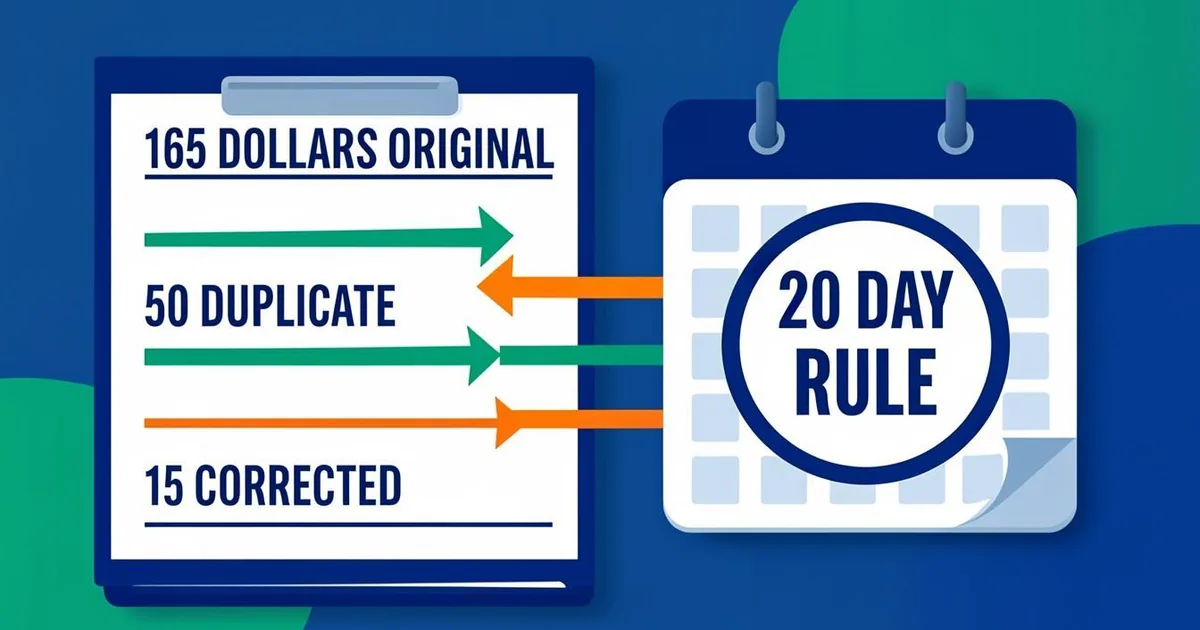
Buying or Selling: The 20-Day Rule
Illinois expects a buyer to complete title and registration within 20 days of the sale date under the Vehicle Code. Miss it and late penalties stack onto the $165 title fee at filing. Sellers face their own duties: sign the assignment, complete the odometer disclosure, keep the license plates, and file the seller's report of sale.
Plates stay with the seller in Illinois — a genuine quirk among states. The buyer cannot legally drive on the seller's plates; dealers issue temporary permits, and private buyers need the title transaction to reach registration before regular driving. Sellers reuse plates on their next vehicle or return them for a sticker refund credit.
Private-party purchases owe use tax on a flat schedule set by the vehicle's age — newer vehicles owe more, older ones less — filed through the Department of Revenue's RUT-1 within 30 days. The tax posts at title time when filed together, which is why the county DMV-style facilities collect it with the $165.
A Worked Example: Buying a Civic in Naperville
Numbers make the fee structure real. Say you buy a 2018 Honda Civic from a neighbor for $15,000 on March 1.
- At signing: the seller completes the assignment — price, odometer, date, signatures — hands you the certificate, and keeps the plates. You photograph everything before parting ways.
- Within days: you complete the VSD 190 as buyer, calculating the flat use tax for a 2018 vehicle from the RUT schedule, and gather your insurance card and license.
- By March 21 (day 20): the title-and-registration packet reaches a Secretary of State facility or the mail — $165 title, the use tax, and $151 registration.
- Plates: you get Illinois plates issued in your name; the seller's old plates left with the seller at signing.
- Emissions: your first renewal lands in the DuPage County test cycle, so you calendar the test a month early.
Total for this transaction: roughly $465 to $500 in state charges before county-level add-ons, dominated by the $165 title and the flat use tax. Same car across the state line in Indiana would owe a $15 title. The Illinois premium buys a system that is centralized and predictable — but never cheap.
Selling Your Illinois Car: The Seller's Duties
Sellers carry legal obligations that protect them long after the buyer drives away. Illinois assigns them clearly, and skipping any of them leaves liability hanging on your insurance and your mailbox.
Complete the assignment fully at signing: buyer name and address, price, odometer, date, and your signature exactly matching the title's printed name. Keep the plates — remove them before the buyer leaves. File the seller's report of sale, and notify your insurance carrier the same week so coverage on the sold vehicle ends cleanly.
Sellers of financed vehicles owe the lender coordination first: the payoff and lien release must clear before the buyer can title. When the paper title itself has vanished before a sale, fix the duplicate first using the sequence in lost title before transfer — buyers' lenders will not fund against a missing certificate.
Salvage, Rebuilt, and Flood Vehicles
Illinois brands titles that carry total-loss history, and the branded paths run through inspection. A salvage vehicle — one declared a total loss by an insurer — must pass reconstruction inspection before it returns to the road with a rebuilt brand. Flood-damaged vehicles, a recurring Midwest story, follow the same rebuilt lane with additional scrutiny on electrical systems.
Buyers should treat any rebuilt brand as a pricing event, not a footnote. Insurance options narrow, resale values drop sharply, and some lenders decline financing. Verify brand history before purchase rather than after — the title status check through the Secretary of State shows what the record carries.
Owners junking a vehicle entirely surrender the title for a junk certificate through salvage processors. Donating to charity runs the same surrender path with a tax receipt instead of cash. Both routes end the title's life cleanly — which is exactly what you want, because half-dead titles linger as liabilities in parking tickets and tolling systems.
New Residents: The 30-Day Window
Moving into Illinois starts a 30-day clock for registration, and the title transaction rides with it. The packet: out-of-state title, proof of insurance, ID, the $165 fee, use tax per the RUT rules, and registration for $151.
Financed arrivals should line up lender paperwork first. Illinois records the lien on the new title, and out-of-state lenders transmit lien details electronically through the ELT system. Where the out-of-state lender holds a paper title, that original usually gets surrendered to Illinois with the application — call the bank before the facility visit so the title arrives on schedule.
VIN verification is generally handled through the standard paperwork rather than a separate inspection lane, but vehicles with bonded titles, salvage history, or VIN discrepancies face additional review. Bring everything — prior registrations, bill of sale, lien release — in one folder.
Emissions Testing and Registration Cycles
The Chicago and east-central Illinois emissions programs test vehicles every two years, tied to the registration renewal month. A failed test blocks the sticker renewal, which then blocks the legal operation the title supports. The test is separate from any title transaction — new titles do not require it, but the first renewal will.
Drivers transferring from no-emissions states sometimes meet the program for the first time at renewal. Testing stations publish the model-year exemptions, and newer vehicles get longer initial windows. Plan the test before the renewal month, not during it.
Liens, ELT, and the 2026 Paperless Shift
Illinois announced mandatory electronic lien and titling for 2026, following the AAMVA ELT framework that more than 40 states already run. For owners, three practical effects: lien releases post electronically to the title record, paper titles become verification documents rather than the system of record, and duplicate requests increasingly serve as the way to "print" an electronic record into paper.
Private sellers should still demand the paper certificate when it exists and verify the electronic status when it does not. The Secretary of State's title status systems let owners confirm lien and title standing before a sale — five minutes that prevents the classic bought-a-car-with-a-hidden-lien disaster described in lost title before transfer.
Owners who never received a promised title in the mail — a known failure mode in every paper state — should request the duplicate rather than waiting out another cycle. The mail-loss playbook at lost car title in mail, never received covers the escalation order.
When You Need the Title This Week
Illinois's expedited lane is the answer to closing deadlines, out-of-state sales, and lender demands. Applications received through the expedited channel by the 12 p.m. cutoff print the next business day — a guarantee, not an estimate — and the document ships immediately after.
The channel makes sense whenever time has a price. A private buyer's bank wanting title proof, a dealer deal collapsing on paperwork delays, a registration deadline three days out: all of these cost more than the expedite. Standard processing quotes stretch into weeks during busy seasons, so the expedite is often the difference between making and missing a transaction.
Pair the expedite with a clean application. Expedited packets with missing signatures or wrong VINs fail at the same speed they print — instantly rejected. Run the checklist twice before the packet leaves your hands, and confirm the fee schedule the same morning you mail, since Illinois revises fees more often than most states.
Snowbirds and Multi-Car Households
Illinois winters push thousands of vehicles south for months, and the paper trail needs care in both directions. An Illinois-registered car driven to Florida for the winter stays Illinois-titled and insured under the owner's garaging disclosure — insurers just want the truth about where the car actually lives most of the year.
Multi-car households planning a permanent half-half split should not split registrations; a vehicle garaged predominantly in Illinois keeps Illinois plates. What snowbirds must not do is let the Illinois registration or emissions test lapse while away — both block legal return driving, and the emissions test requires a physical trip to an Illinois station.
Owners selling an Illinois-titled car from out of state can still run the whole transaction remotely: sign in front of a notary where the buyer's state requires it, mail the certificate, and file the seller's report by mail. It moves at mail speed, but it works from any snowbird ZIP code.
Family Transfers and Gift Paperwork
Illinois taxes private transfers through the flat use-tax schedule, and family gifts get their own reduced treatment with the proper affidavit. Parent-child and spouse transfers file the state's gift forms alongside the VSD 190, and the tax drops accordingly. The affidavit mechanics and relationship rules are covered in family title transfers.
The $15 corrected-title lane also handles name changes — marriages, divorces, and typo fixes — when the current certificate gets submitted. At $15 versus $165, running the correction with the certificate in hand is one of the few bargains in the Illinois fee schedule.
Mistakes That Cost Money at Illinois Counters
Illinois's fee structure punishes the unprepared. These are the expensive ones.
- Losing the certificate and paying $50 instead of $15 for what should be a correction.
- Ordering a duplicate inside the 15/30-day fresh-issuance windows — rejected outright.
- Missing the 20-day title deadline after purchase, stacking late fees on $165.
- Skipping the RUT-1 use tax filing within 30 days of a private purchase.
- Seller surrendering plates instead of transferring them to the next vehicle.
- Applying for a duplicate before an electronic lien release posts.
Compare Illinois with its neighbors before a big transaction: Indiana charges $15 titles with a $25 speed option, and Idaho runs $14 with rush service — the same certificate costs eleven times more depending on the state line.