
A family vehicle title transfer skips the sales tax in most states — but only when you file the right affidavit. Texas waives its motor vehicle tax down to a flat $10 on a proper Form 14-317. Massachusetts kills the 6.25 percent sales tax outright for parents, spouses, and siblings on Form MVU-26.
Skip that form and the DMV taxes the transfer like a retail sale, using blue-book value whether money changed hands or not. This guide covers the federal gift-tax side, the state exemption paperwork that actually saves money, and the step-by-step sequence for 2026. The paperwork rules come from state revenue departments and the IRS, not from forum threads.
Why Family Transfers Are Treated Differently
States tax vehicle sales to catch evaders, so a transfer between strangers gets valued automatically. Family transfers get a different lane because nobody profits — the state revenue departments recognize that taxing a parent for handing a sedan to a college student collects nothing but resentment. Every state that charges sales tax carves out some family path.
The carve-out is conditional, though. It demands an affidavit proving the relationship, signatures from both parties, and sometimes a notary. Bring none of those and the clerk taxes the car at book value as if it were a dealership sale.
The Federal Gift Tax: Almost Never a Problem
Federal gift tax sounds scary and almost never applies to cars. The IRS annual exclusion lets any person give up to $19,000 per recipient in 2026 without filing a gift-tax return. Married couples who split gifts can double that to $38,000 per recipient.
Since most family hand-me-downs are worth far less than $19,000, federal filing is a non-event. A parent giving a $22,000 truck to one child also clears the bar — only the amount above the exclusion counts toward the lifetime exemption, which sits at $15 million for 2026. Nobody writing a check to the IRS over a family car is the realistic bottom line.
Federal rules do touch the transfer one way: the odometer disclosure. Vehicles 20 model years old or newer require a federal mileage statement at any ownership change, gift or sale, under NHTSA regulations. Leave that box blank and the DMV bounces the packet.
State Tax Exemptions: The Paperwork That Saves Real Money
State sales taxes run from about 2.9 percent to more than 7 percent, so a skipped exemption form can cost thousands on a newer vehicle. These verified examples show how differently states handle the same gift.
| State | Form | What It Does | Who Qualifies |
|---|---|---|---|
| Texas | 14-317 Affidavit of Motor Vehicle Gift Transfer | Cuts tax to a flat $10 gift tax | Eligible family donors per Comptroller list |
| Massachusetts | MVU-26 | Exempts the 6.25% sales tax | Spouses, parents, children, siblings — not grandparents |
| Idaho | ST-133GT | Use-tax exemption for gifts | Vehicles, vessels, campers, trailers, RVs by gift |
| Pennsylvania | Affidavit of Gift | Exempts sales/use tax on family gifts | In-state titles and qualifying out-of-state gifts |
| Florida | Exemption claimed on title application | Removes sales tax at transfer | Qualifying family relationships with proof |
Massachusetts draws the relationship line tightly. Its exemption covers transfers between spouses, parents, children, and siblings, but a car given by a grandparent does not qualify for the same treatment. Texas walks the other direction — its $10 gift tax applies to a generous eligible-donor list, and a vehicle gifted from an out-of-state donor still owes the $10 when it enters Texas.
Idaho's form covers nearly everything with wheels, which matters for mixed households. The same ST-133GT exempts the boat, the camper, and the family car in one visit. Pennsylvania's affidavit works even when the gifted vehicle was titled in another state, a rare cross-border courtesy.
Step-by-Step: Transferring a Title Within the Family
The sequence is simple once you know the state form. Most families finish in a single DMV visit when they arrive prepared.
- Clear any loan first. A lienholder owns part of the title, and most states will not transfer ownership while a lien shows. Pay off the balance and get the release, following the steps in lost title with an active loan.
- Fill out the assignment on the title. Both parties sign, the odometer gets recorded for newer vehicles, and the sale-price box either shows the gift amount or the word "gift" per state convention.
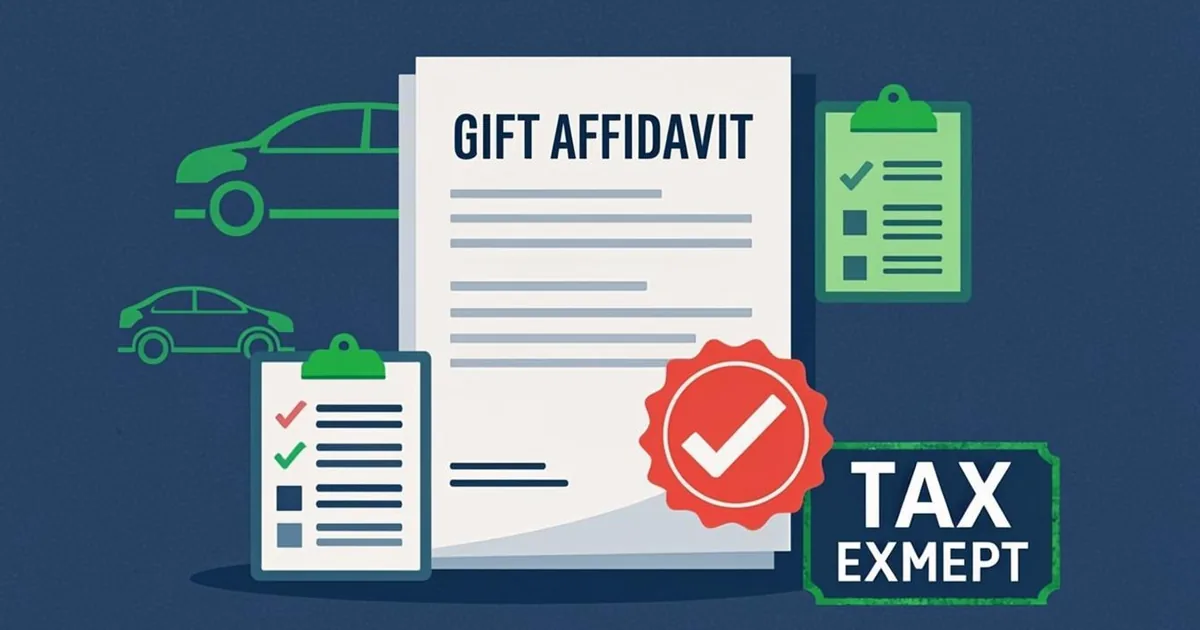
- Complete the gift or exemption affidavit. This is Form 14-317 in Texas, MVU-26 in Massachusetts, ST-133GT in Idaho, and the equivalent elsewhere. Notarize if the form demands it.
- Gather relationship proof if required. Some states accept the affidavit alone; others want birth certificates or marriage licenses for the file.
- File at the DMV with the fee. The recipient pays the title fee, any gift tax like Texas's $10, and registration on their own policy.
- Move the insurance the same day. The donor cancels or removes the vehicle from their policy only after the recipient's coverage is live — never leave a gap.
Photograph the signed title before it leaves anyone's hands. Counties lose paperwork, and a dated photo ends most disputes about who signed what and when.
Why "Selling" for $1 Backfires
Families sometimes draft a $1 bill of sale to dodge tax paperwork. It fails in every state that audits these transfers. The DMV compares declared prices against book value, and an implausible $1 sale gets taxed at full market value anyway — often with a penalty added for the attempt.
The gift affidavit route is cheaper than the failed $1 trick in every scenario. Texas charges exactly $10 for a clean gift. A detected sham sale risks the full sales tax plus penalties that some states stack at 10 to 50 percent of the underpaid amount.
Special Situations: Minors, Estates, and Divorce
A few family transfers do not fit the standard form. Knowing which lane you are in prevents a wasted trip.
Transferring to a minor is possible in most states, but the teen usually cannot register or insure the vehicle alone until the state's age threshold. Parents often co-title instead, which keeps insurance simple. The full mechanics, including state age limits, are covered in transferring a title to a son or daughter.
Transfers from a deceased owner's estate follow probate rules, not gift rules. Survivors need death certificates, small-estate affidavits, or court orders before any title moves. That process has its own guide at lost title for an inherited vehicle, and it applies even when the title itself went missing with the owner's papers.
Divorce splits are another distinct lane. Community-property states handle spousal splits with their own exemptions, and a divorce decree often substitutes for the gift affidavit. See title transfer between spouses for the community-property details and the survivor paperwork when a spouse has died.
Registration, Insurance, and Plate Logistics After the Gift
The title is only the first domino. Three follow-ups close out a family transfer properly, and skipping them creates liability leaks that surface months later.
Registration moves to the recipient with the title in nearly every state, so budget for plates at the same visit. Personalized or specialty plates usually stay with the donor unless the state says otherwise, and the recipient starts fresh with standard plates. Registration fees reset on the recipient's own cycle.
Insurance transfers before the keys do. The recipient needs a bound policy in their name before driving away, and the donor should notify their carrier of the ownership change the same week. Donors who keep paying for a car they no longer own discover the error only after a claim gets denied.
Taxes on the donor side are limited to the gift-reporting edge cases already covered. Property taxes and registration-based fees stop being the donor's problem the day the title records, which is also the day to remove the vehicle from tolling accounts and parking permits.
How the Biggest States Compare for 2026
Family movers and multi-state households should see the states side by side. These notes focus only on the family-transfer angle, not general titling.
| State | Family Gift Cost | Key Watch-Out |
|---|---|---|
| Texas | $10 gift tax + title fee | Form 14-317 needs both signatures; out-of-state donors still trigger the $10 |
| California | Use-tax exemption on qualifying family transfers | Statement of Facts must accompany the title; see the California guide |
| Florida | Sales-tax exemption with proof | Exemption claimed on the title application itself; Florida guide covers the fee stack |
| Georgia | Family rate on the one-time title tax | 0.5% TAVT family rate versus 7% standard; details in the Georgia guide |
Georgia deserves special mention because its family rate is a discount rather than a full exemption — 0.5 percent of value instead of the standard 7 percent Title Ad Valorem Tax. That is still a real saving on a $20,000 crossover: $100 instead of $1,400. Every state's math differs, which is exactly why the affidavit forms exist.
Mistakes That Turn a Free Gift Into a Taxed Sale
Clerks see the same failures weekly. Avoid this list and the family transfer costs only the title fee.
- No affidavit — the clerk taxes book value by default.
- Wrong relationship for the state's list, like the grandparent gap in Massachusetts.
- Lien still showing because the payoff release never made it to the DMV.
- Blank odometer box on a vehicle under 20 model years old.
- Insurance canceled before the recipient's policy started.
- Signatures missing from one of two co-owners on the donor side.
One county visit with the right forms beats three visits fixing rejections. When the title itself has gone missing in an estate or a move, the fix starts at how to replace a lost car title, then comes back here for the exemption step.
Timing the Transfer Around Renewal Dates
Smart families pick the transfer month on purpose. Registration cycles reset when the title moves in most states, so gifting a car two months before its plates expire either saves or wastes a renewal payment depending on who owes it. Check the plate month before you schedule the DMV visit.
Inspection and emissions calendars matter too. Several states tie emissions checks to the registration month, and a transfer can pull a vehicle into a test it just passed under the donor. A quick call to the county office tells you whether the new owner walks in clean or books a test the same week.
End-of-year transfers deserve a note for the federal side. Large gifts near the $19,000 exclusion line are counted per calendar year, so a December transfer followed by a January cash gift to the same person can straddle two exclusions legitimately. Families planning something that elaborate should talk to a tax preparer first, but the ordinary car hand-me-down never gets near the line.
Keeping a Paper Trail That Protects Both Sides
Family deals run on trust, which is exactly why they generate the ugliest disputes when records are thin. A few dated copies prevent every common fight.
- Photograph the assigned title the day both parties sign.
- Keep the stamped affidavit copy the clerk returns — it is proof the exemption applied.
- Note the odometer reading in a text message or email between the two of you.
- Save the insurance binder showing the coverage switch date.
- Log tolling-account removals and parking permit cancellations with dates.
The paper trail pays off years later. Toll authorities chase the last registered owner by default, insurance companies ask who drove the car on a specific date, and estates eventually need to show when ownership actually moved. Ten minutes of copies settles all three questions without a single argument.