
Maine splits its vehicle paperwork between two offices. Knowing which one owns your problem saves a wasted trip.
Your town office collects the excise tax and handles registration. The state Bureau of Motor Vehicles (BMV) owns titles.
Titles cost $33, and Maine titles model year 1995 and newer. Most transactions finish in a week or two.
This 2026 guide walks the whole system. It covers the town-vs-BMV division and replacing a lost title.
Then comes the 5.5% sales tax on transfers and the new-resident steps. The antique-vehicle rules matter in a state where classic trucks outnumber electric cars.
Table of Contents
- How Maine Titling Works
- Replacing a Lost, Stolen, or Damaged Title
- Private Sales and the Sales Tax
- Moving to Maine
- Liens and Electronic Records
- Excise Tax Deep-Dive
- Seasonal Plates, Storage, and the Coastal Calendar
- Antiques, Trailers, and Coastal Cases
- The Recovery Companions
- The Pre-1995 Lane: Registering Without a Title
- BMV Branches, Mail, and the Augusta Rhythm
How Maine Titling Works
Maine's structure is the town-first model. Before any registration, the municipal office assesses the annual excise tax.
Maine bases it on the manufacturer's price and the vehicle's age, with rates stepping down over six years. That excise payment is a prerequisite for registration, and town offices keep the revenue locally.
Titles, however, are state business. The BMV, under the Secretary of State, issues certificates for model year 1995 and newer vehicles.
Older vehicles register without titles, which surprises arrivals from title-everything states. A 1993 pickup legally changes hands with a bill of sale and registration alone in Maine.
Replacing a Lost, Stolen, or Damaged Title
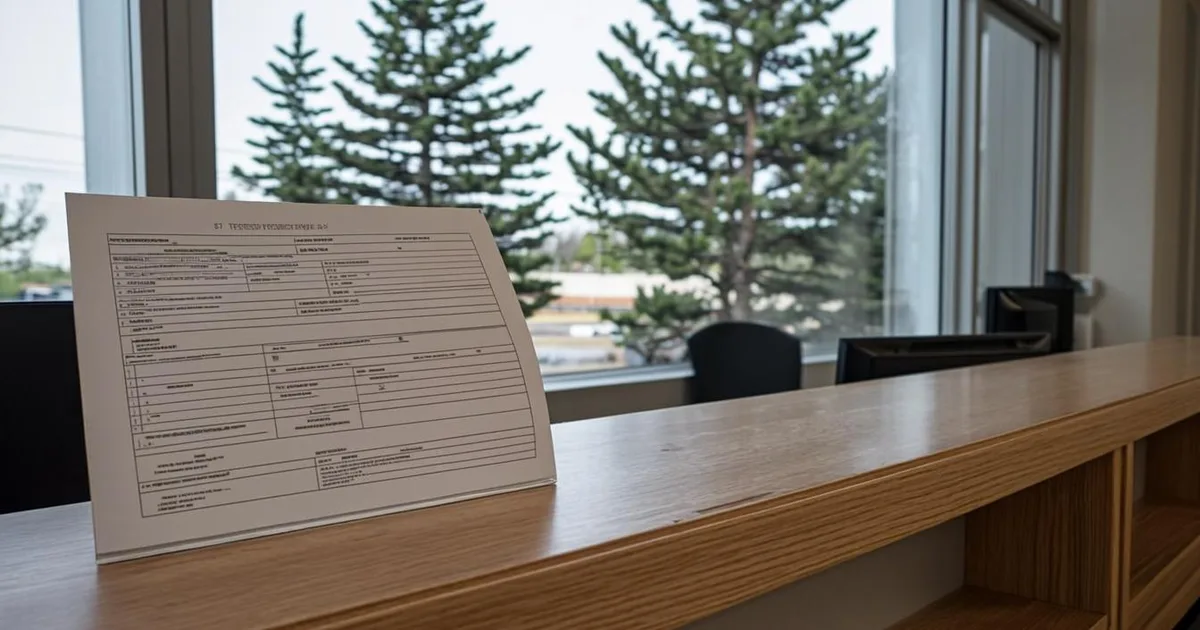
The duplicate process runs through the BMV's application (Form MVT-8) with a $33 fee. File by mail or at a BMV branch.
The replacement prints with the current owner and lien information from the state's record. It typically arrives within one to two weeks.
- Complete MVT-8 with the VIN, year, make, and your legal name exactly as the BMV records show them.
- State the reason — lost, stolen, mutilated, or never received — and sign. All owners listed on the record sign the application.
- Include the $33 fee and mail to the BMV's title unit in Augusta or visit a branch. Branch visits can issue same-day in some cases.
- Handle liens first. An active lien prints on the duplicate. If the loan is paid but unreleased, clear it with the steps in our lien release guide before applying.
- Check the return mail carefully. A wrong address or misspelled trust name on the new certificate restarts the process, so verify every field on arrival.
Private Sales and the Sales Tax
Maine private sales need the assigned title (for 1995-and-newer vehicles), a bill of sale, and the sales tax payment. The 5.5% tax is due at registration time.
The tax bases on the purchase price, with the BMV comparing against book values to prevent creative under-declaring. The buyer pays tax and fees at the town office or BMV when registering.
Sellers of pre-1995 vehicles skip the title entirely. The bill of sale carries the transaction, and the buyer registers from it.
That split is Maine's quirk. The same driveway sale can be title-heavy for a 2020 SUV and title-free for a 1994 wagon ten feet away.
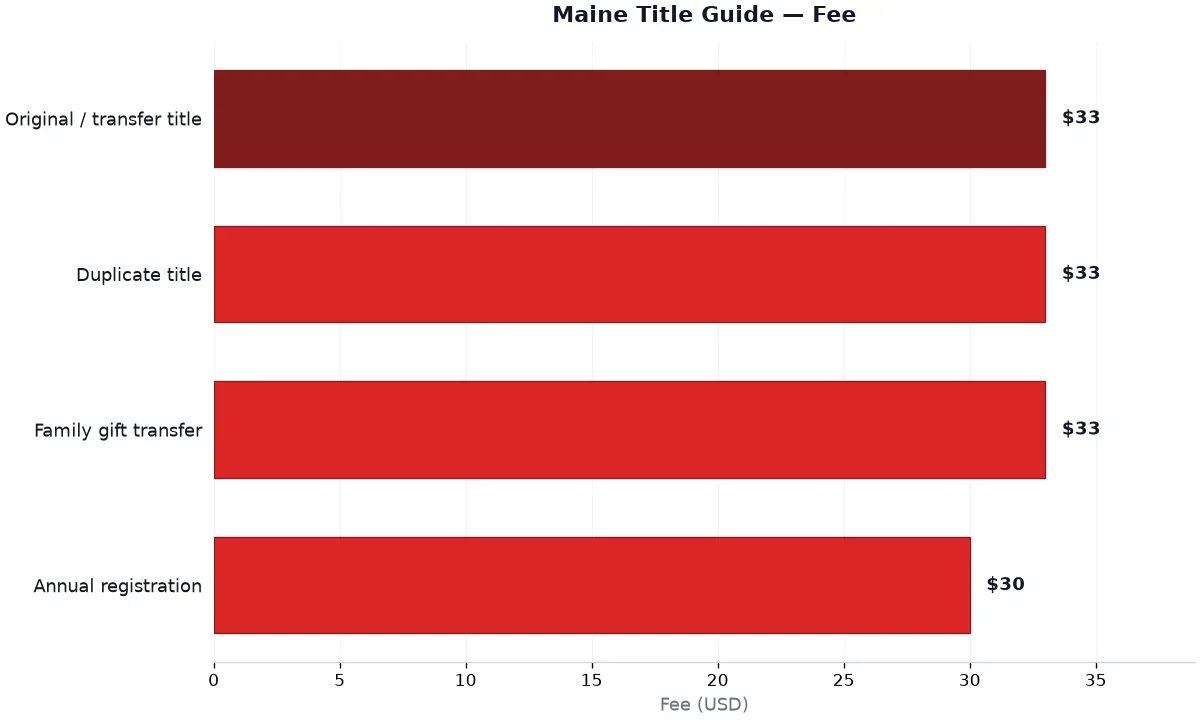
| Transaction | Fee | Tax | Where |
|---|---|---|---|
| Original / transfer title (MY1995+) | $33 | 5.5% sales tax | BMV |
| Duplicate title (MVT-8) | $33 | None | BMV branch or mail |
| Family gift transfer | $33 | Exempt with affidavit | BMV |
| Annual registration | $30+ by vehicle | Excise tax first at town | Town office |
Gifts between spouses, parents, children, and siblings claim the sales-tax exemption with the state's affidavit. The exemption is worth $1,100 on a $20,000 vehicle at Maine's 5.5% rate. The same exemption family appears in our family transfer guide and the parent-to-child walkthrough.
Moving to Maine
New residents register promptly — plan on a 30-day window from establishing residency. The sequence runs backwards from most states.
Excise tax at the town office comes first. Then title and registration, with the out-of-state title, proof of insurance, and sales tax if recently purchased.
Maine requires a VIN verification for out-of-state vehicles entering the title system. It's a quick physical check any law-enforcement officer or licensed inspector can complete on the state's form.
If the out-of-state title is missing, clear it with the previous state first. The sequence in our cross-state lost-title guide applies. The state title hub holds your old state's fee table.
Liens and Electronic Records
Maine's BMV participates in the national electronic lien system for most lenders. Payoff releases post to the record digitally, and the next certificate prints clean.
Paper releases for older loans go to the BMV's title unit for manual update. Buying a used car with a lien line showing? Require the release before paying — the clerk processes from the record, not promises.
Excise Tax Deep-Dive: What the Town Office Calculates
Maine's excise tax confuses newcomers because it's separate from everything the state does. Towns calculate it from the manufacturer's list price, not your purchase price.
The rate steps down over the vehicle's first six years. It starts at 2.5% of MSRP in year one, then declines through tiers until it settles at a floor. A truck that listed at $50,000 owes $1,250 its first year regardless of what you actually paid for it used.
The tax funds local road work, which is why it stays municipal. Two identical vehicles in different towns can owe different amounts.
Some municipalities apply the statutory minimums; a few add local option adjustments. The town office prints an excise receipt that the BMV or the same counter requires before registration proceeds.
New residents sometimes pay excise twice by accident. Their old state collected its version at departure, and Maine's town office charges from arrival.
There's no credit for the old state's tax. But Maine prorates the first-year excise by month for new registrations. Registering early in your arrival month saves real money compared to drifting into the next.
Seasonal Plates, Storage, and the Coastal Calendar
Maine's seasonal economy produced seasonal registration options — a reduced-fee plate for vehicles operated only part of the year. The trade-offs are strict: the vehicle can't legally operate outside the stated months, and insurance continues year-round. Snowbirds and summer-only convertibles use them heavily; the town office handles the election at registration time.
Storage interacts with titling in one specific way worth flagging. A vehicle stored off-road with lapsed registration still owns a live title record. Transactions that surface years later, like a sale or estate settlement, find the record frozen at the storage date.
Liens, addresses, and owner names stay as they were. Owners heading into multi-year storage do well to resolve any pending lien or title work first. The BMV's record won't fix itself while the vehicle hibernates.
For the authoritative fee schedule and the MVT-8 download, the BMV's pages at maine.gov/sos/bmv carry everything. Most town office sites link the same forms with local excise calculators.
Antiques, Trailers, and Coastal Cases
Antique vehicles qualify for specialized plates at 25 years or older. Titling still follows the standard MY1995 rule: a 1996 antique applicant titles; a 1994 one doesn't. Trailers under a weight threshold register without titles; larger ones follow the vehicle process.
And in coastal towns, boat trailers and watercraft cross into separate territory. Our lost boat title guide covers the watercraft side, including federal documentation for larger vessels.
Motorcycles title identically to cars under the MY1995 rule.
The motorcycle replacement guide handles the two-wheel specifics. The title anatomy explainer applies to every certificate Augusta prints.
The Recovery Companions
Two related situations round out the Maine picture. If the title and the registration vanished together, the recovery order in our dual-recovery guide prevents the town-office loop. If the title simply never arrived from Augusta after a transfer, the never-received process voids the outstanding certificate and reissues.
That's usually free with an affidavit. And for owners comparing New England fee stacks, our Illinois guide shows the opposite end of the national range.
The Pre-1995 Lane: Registering Without a Title
Maine's title-free lane for older vehicles deserves its own walkthrough, because it's genuinely different. A 1994 pickup changes hands with a bill of sale alone. The buyer takes that, the excise payment, and proof of insurance to the town office.
They register from paper that no state title office ever issues. No duplicate applications, no lien-line puzzles, no BMV visit at all.
The lane has edges. Buyers who plan to move the vehicle out of state discover that destination states title vehicles Maine never did. Some want Maine's documentation of that fact.
The BMV provides records searches and no-title attestations for exactly this. Sellers of old vehicles moving to title-everything states should mention the gap before the sale. Don't wait until the buyer hits their home state's counter.
Lien-free history also lives differently in this lane. Old vehicles financed decades ago cleared liens in paper systems that predate electronic records. The town office has no lien visibility — it registers on the paperwork presented.
That makes the bill of sale and any old release documents the entire ownership story. It's why Maine's old-vehicle sellers keep decades of paper in the barn desk.
BMV Branches, Mail, and the Augusta Rhythm
Maine's BMV runs branches in Augusta, Bangor, Portland, and a handful of other cities. Title work flows through them or through mail to the title unit.
Branch visits resolve same-day for straightforward duplicates; mail runs one to two weeks in normal seasons. Rural owners often mail — the forms are designed for it, with clear checklists on the BMV's site.
Timing has a seasonal shape worth knowing. Spring de-storage season and the weeks before hunting season fill branch lines with registration traffic, while mid-winter mornings are quiet.
Title-only work is lighter than registration everywhere, and phone lines answer fastest on the same quiet days. The classic Maine tip: winter mail is the fastest mail.
Errors on returned certificates go back to the title unit with a correction cover letter rather than a fresh application. Keep the envelope and the cover sheet the BMV sends. They carry the file numbers that make corrections free and fast.
Maine closes the loop with its own kind of common sense. The system asks less for older vehicles and splits duties cleanly between town and state. It processes most paperwork by mail without drama.
Owners who respect the town-first sequence (excise, then title, then registration) find the whole state apparatus runs on time. That holds even in the short window between mud season and the first nor'easter.