

Kentucky prices its title work at $6 — the cheapest filing fee of any state I've tracked. The savings hide a paperwork quirk, though.
Almost everything runs through your county clerk's office. Signatures on a title assignment need a notary stamp. Show up without one, and the clerk sends you home.
This guide covers the whole system for 2026. It walks through replacing a lost title with Form TC 96-167 and completing a private sale.
You'll also find the 6% usage tax, the 30-day rule for new residents, and the yearly vehicle property tax. That property tax stacks on top of registration. It surprises a lot of movers.
Table of Contents
- How Kentucky Titling Works
- Replacing a Lost or Damaged Title
- Private Sales and the Notarization Rule
- Moving to Kentucky
- Liens and Electronic Titles in Kentucky
- Why Kentucky Transfers Get Rejected
- Buying Across the Border Into Kentucky
- Corrections, Name Changes, and Joint Owners
- Special Cases: Motorcycles, Trailers, Antiques
- Comparing Neighbors Before You Buy Across a Line
- Fee Verification and the Annual Fee Shuffle
How Kentucky Titling Works
Each of Kentucky's 120 counties runs titling through its county clerk. The Kentucky Transportation Cabinet sets the rules from Frankfort and prints the certificates. Its Motor Vehicle Licensing division handles the fine print.
But your clerk's office is where every form, fee, and fix actually happens. Jefferson County (Louisville) and Fayette County (Lexington) run busy counters with appointment systems. Rural clerks often finish walk-ins in minutes.
Two fees stack in most transactions. One is the $6 title filing fee. The other is the 6% usage tax on the vehicle's purchase price or trade-in value.
Kentucky also bills a yearly property tax with your registration. The amount comes from the car's value and your county's rate. That's why the same car costs different amounts across county lines.
Replacing a Lost or Damaged Title
Kentucky's replacement process runs on one main form. It's the Affidavit for Replacement or Non-Exchange of Kentucky Certificate of Title — Form TC 96-167. Add another $6 filing fee.
The affidavit states what happened to the original title. It covers lost, stolen, destroyed, or never received from a past transfer.
- Download TC 96-167 from the Transportation Cabinet's form library, or grab one at the clerk's office.
- Complete the owner and vehicle sections with the VIN, year, make, and your legal name. Match the state records exactly.
- State the reason — lost, stolen, mutilated, or non-receipt — and sign. The affidavit is a sworn statement, and a notary or the clerk can witness it.
- Pay the $6 fee at the county clerk. Most offices issue the duplicate the same day or within a week.
- Check the lien line. If the state's record shows an active lien, the duplicate lists it. File the lender's release first for a clean copy.
Did you pay off the loan years ago while the lien still shows? Clear it before ordering the duplicate.
The process in our lien release guide applies in Kentucky the same as everywhere. The clerk can't ignore what the state's record shows.
Private Sales and the Notarization Rule
Kentucky private sales need the seller's signature on the title assignment notarized. This trips up buyers and sellers from nearby states where a plain signature works fine.
The fix is cheap and fast — most banks, clerk offices, and shipping stores have notaries. Skipping it means the clerk rejects the transfer. Then you're chasing the seller for a second signing.
The buyer then files Form TC 96-182 — the Application for Kentucky Certificate of Title or Registration. They pay the $6 title fee and the 6% usage tax. Then the vehicle gets registered.
The usage tax bases on the price written on the assignment, with trade-in credits where they apply. Kentucky doesn't let wild under-declaring slide. The clerk compares your price against book values.
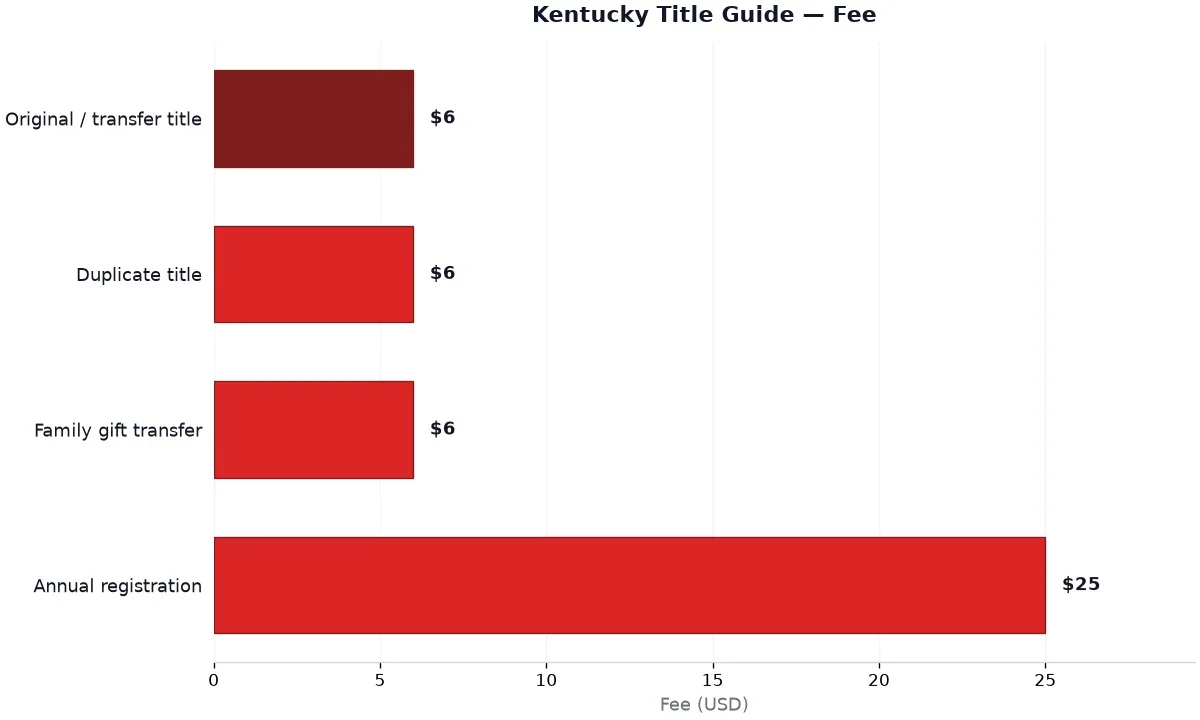
| Transaction | Fee | Tax | Where |
|---|---|---|---|
| Original / transfer title | $6 | 6% usage tax | County clerk |
| Duplicate title (TC 96-167) | $6 | None | County clerk |
| Family gift transfer | $6 | Exempt with affidavit | County clerk |
| Annual registration | $25+ by vehicle | Property tax added | County clerk |
Gifts between spouses, parents, children, and siblings skip the usage tax. File the state's gift affidavit with the transfer to claim it. A $25,000 SUV moving from parent to child saves $1,500 in tax with that one form.
Our parent-to-child transfer guide explains the same logic in detail. Gift paperwork works the same way.
Moving to Kentucky
New residents get 30 days to title and register. Bring the out-of-state title, proof of insurance, and a photo ID. Also bring payment for the title fee, usage tax, and registration.
Some counties require a VIN check for out-of-state vehicles. It's usually a sheriff's verification or a quick clerk inspection. Call ahead and bundle it into one trip.
Missing the out-of-state title? Sort it out with the previous state first. Kentucky wants that old record closed before it prints its own certificate.
Our cross-state lost-title guide sequences the whole recovery, and the state title hub holds each state's fees and forms.
Liens and Electronic Titles in Kentucky
Kentucky runs an electronic lien program for most lenders. Payoff releases go to Frankfort online, and your next title action comes out clean.
Older paper liens need the lender's signed release presented at the clerk. Buying a used car with a paper title that shows a lien? Require the release document before money changes hands.
The clerk won't process around it.
Why Kentucky Transfers Get Rejected
- No notary stamp on the seller's assignment — the top Kentucky rejection
- Usage tax missed or set too low against the book value
- Open lien on the state record with no release paperwork presented
- Application name mismatched with the ID presented at the counter
- White-out, crossed-out lines, or blank fields on the assignment
Rejections come back marked with the exact defect. Fix the packet, and Kentucky clerks reprocess it without a second fee in most cases.
The cost of a mistake is usually a return trip rather than money.
Buying Across the Border Into Kentucky
Kentucky counters see a steady flow of cars bought next door — Tennessee, Indiana, Ohio. The notarization rule makes the border direction matter.
A Kentucky seller signs over a title to an out-of-state buyer — notarize it at home first. Bringing home an Indiana assignment with no notary stamp takes the seller's help by mail. A notarized duplicate assignment or an act-of-sale affidavit closes that gap.
The usage tax bases on the price you declare at Kentucky registration. The clerk compares it against regional book values. A cheap deal next door doesn't skip the check — the tax floor follows the car, not the deal.
Budget the 6% on the realistic value when you're negotiating an out-of-state purchase. The tax bill lands at registration, not at the border.
Dealers simplify this: Kentucky dealers handle the title work, collect the tax, and hand you a temp plate. Private purchases across state lines carry all the paperwork yourself.
That's why the county clerk's checklist page is worth printing before the drive home.
Corrections, Name Changes, and Joint Owners
Kentucky fixes title errors at the clerk with proof documents. Marriage certificates and court decrees fix name changes, and error affidavits fix factual mistakes. The corrected certificate prints for the standard fee.
Corrections matter most before transactions. A sale with a misspelled buyer name bounces at the buyer's clerk two counties away.
Joint owners follow one simple rule. An "and" on the title needs both signatures; an "or" lets either one act. Estate cases — inherited cars, joint accounts after a death — route through the clerk's death-certificate process.
Our inherited vehicle guide covers them in depth. The clerk's office is genuinely the single window for all of it. That's why building a relationship with your local office pays off for anyone who owns multiple vehicles.
For form downloads and the current fee schedule, check the Transportation Cabinet's site (transportation.ky.gov). It publishes everything: TC 96-167, TC 96-182, and the clerk directory with phone numbers that answer.
Special Cases: Motorcycles, Trailers, Antiques
Motorcycles title just like cars — $6 filing, 6% usage tax, notarized assignments. Trailers vary by weight. Light utility trailers may skip the title, while bigger ones follow the standard process.
Vehicles 25 years or older can carry a historic plate. Titling still runs through the clerk with the same affidavit forms.
If your motorcycle's title vanished, the motorcycle replacement guide covers the two-wheel basics. The car title explainer breaks down the document itself.
It shows what a title legally is and why notarizations and liens live on it.
Kentucky's online portal handles registration renewals. It also takes some duplicate requests for cars without liens. That saves the counter trip for the simplest cases.
Title transfers with taxes, notary stamps, or lien questions stay counter-first. The clerk's eyeball on the notary stamp is the process working as designed.
Plan one good counter visit with a complete packet instead of three partial ones. Kentucky clerks famously help those who arrive organized.
Comparing Neighbors Before You Buy Across a Line
Kentucky's $6 fee undercuts its neighbors by a mile. Our Illinois guide shows a $155 transfer-tax regime.
The Indiana guide sits in the middle at $15. The lost-title-plus-registration recovery order matters in all three states.
Where you title can be worth hundreds of dollars. Just make sure the vehicle actually operates in the state you choose.
Fee Verification and the Annual Fee Shuffle
Kentucky's General Assembly adjusts fees every so often. Clerks enforce the current schedule — no matter what any guide, this one included, printed earlier in the year.
The $6 filing fee has been stable for years. But usage-tax details, processing surcharges, and county clerk service fees move more often.
Two places carry the current numbers: the clerk association's website and the Transportation Cabinet pages.
Plan the fee stack before you reach the counter. It includes title filing, the usage tax or gift affidavit, registration, and any notary cost. Mid-cycle movers add property-tax proration too.
Buyers who price the full stack negotiate better. Sellers who quote "out-the-door" numbers without the tax get surprised calls after closing.
One more Kentucky check: cars moving between counties keep their title record. But they change the property-tax county. The clerk updates the taxing county during any title action.
Movers within the state should mention the county change explicitly. It prevents the next renewal bill from landing in the wrong county's system with the wrong rate.
Every Kentucky rule in this guide has one pattern: the clerk as gatekeeper. Notarization, the 6% tax, the gift affidavit, the TC forms — each exists for one reason. The clerk must certify the record, not judge your intentions.
Owners who arrive with the packet complete and the names matching the ID ride through fastest. Add the printed tax affidavit and you'll clear the fastest title office fee schedule in the region.