
Louisiana plays by civil-law rules, and that shows up everywhere in its title system. Every assignment gets notarized. The state keeps most titles electronically instead of handing you paper.
Every transaction carries a handling fee, too. The total for an original title runs about $80: the $68.50 fee, $8 handling charge, and a technology fee. That's among the priciest in the country.
This 2026 guide covers the Louisiana system end to end. You'll find the Office of Motor Vehicles and public tag agents here, plus the notarization rule that rejects out-of-state paperwork.
Duplicate titles run through Form DPSMV 1799, and the electronic title retention program gets its own section. The boat-title rules matter in a state with more water than most.
Table of Contents
- How Louisiana Titling Works
- The Notarization Rule
- Electronic Title Retention: Louisiana's Default
- Replacing a Lost or Missing Title
- Private Sales and the Act of Sale
- Moving to Louisiana
- Public Tag Agents vs OMV Offices
- Corrections, Name Changes, and the Notary Habit
- Boats and Motors: The Louisiana Specialty
- Louisiana vs Neighbors
- The Louisiana Flood Factor
How Louisiana Titling Works
The Office of Motor Vehicles (OMV), under the Department of Public Safety, sets every rule and prints every certificate. You transact through two channels: OMV field offices, or licensed public tag agents.
The agents are private offices that charge a small service fee for same-day processing. In metro New Orleans and Baton Rouge, tag agents often beat OMV lines by hours.
Louisiana's fee structure layers three charges on most title work. The base fee is $68.50 for original and duplicate titles. Add the $8 handling fee and a small technology fee.
Sales tax adds 4.45% state plus parish and local rates, collected when the title transfers. Budget roughly $100 all-in for a typical used-vehicle transfer in most parishes.
The Notarization Rule
Louisiana requires notarized signatures on title assignments and bills of sale — a legacy of its French civil-law heritage. A seller's plain signature, valid in Texas or Mississippi, stops at the Louisiana counter. The buyer and seller sign before a notary, who stamps the document.
Out-of-state purchases into Louisiana inherit this rule. If you bought a car in Atlanta with an unnotarized assignment, the Georgia title is fine. But the Louisiana application wants either the notarized assignment or a notarized act of sale describing the transaction.
Notaries at tag agents, banks, and shipping stores resolve this for $10 to $25. That's cheaper than a rejected application round-trip.

Electronic Title Retention: Louisiana's Default
Since its title retention program rolled out, Louisiana holds most titles electronically at the OMV instead of mailing paper. Your ownership lives in the state's database.
A paper certificate prints only when you request one or when a transaction requires it. Lienholders participate electronically, so payoff releases update the record without paper shuffling.
Practical effects: when you sell, the buyer's application pulls the electronic record. Your "title" is the notarized act of sale plus the state's database entry.
When you need proof of ownership for an insurance or loan question, the OMV prints a certified copy. And if you simply prefer paper, request a printed title for the standard duplicate fee.
Replacing a Lost or Missing Title
Duplicate titles run through Form DPSMV 1799 (Vehicle Application) with the duplicate-title fee — $68.50 plus handling. File at an OMV office or tag agent, or by mail to headquarters. Because the record is electronic for most vehicles, the duplicate prints from the database with current owner and lien status.
- Complete DPSMV 1799 with the VIN, vehicle description, and your legal name exactly as the OMV records show.
- Mark the duplicate-title section and state the reason — lost, stolen, damaged, or never received.
- Sign before a notary — yes, even the duplicate application follows the state's notarization habit in most offices.
- Pay the fees ($68.50 plus handling). The printed certificate comes same-day at tag agents, or by mail from OMV in two to four weeks.
- Check the lien line on arrival — an unreleased electronic lien prints on the new certificate, so clear payoffs first.
If the original was mailed and never arrived, use the non-receipt path on the same form. It often waives the duplicate fee with an affidavit. That's the same logic our never-arrived title guide describes nationally.
Private Sales and the Act of Sale
Louisiana private sales traditionally use a notarized "act of sale" alongside the title assignment. That's the state's term for a bill of sale. The document names both parties, describes the vehicle by VIN, and states the price.
Both signatures sit under the notary's stamp. Public tag agents keep blank forms, and the OMV publishes a template.
The buyer files the act of sale, the assigned title, and proof of insurance. Payment covers title fees plus the 4.45% state sales tax. Parish add-ons stack on top of the state rate.
Parish rates vary widely. New Orleans combines state, parish, and city layers that push totals past 9%. Rural parishes stay closer to the state floor.
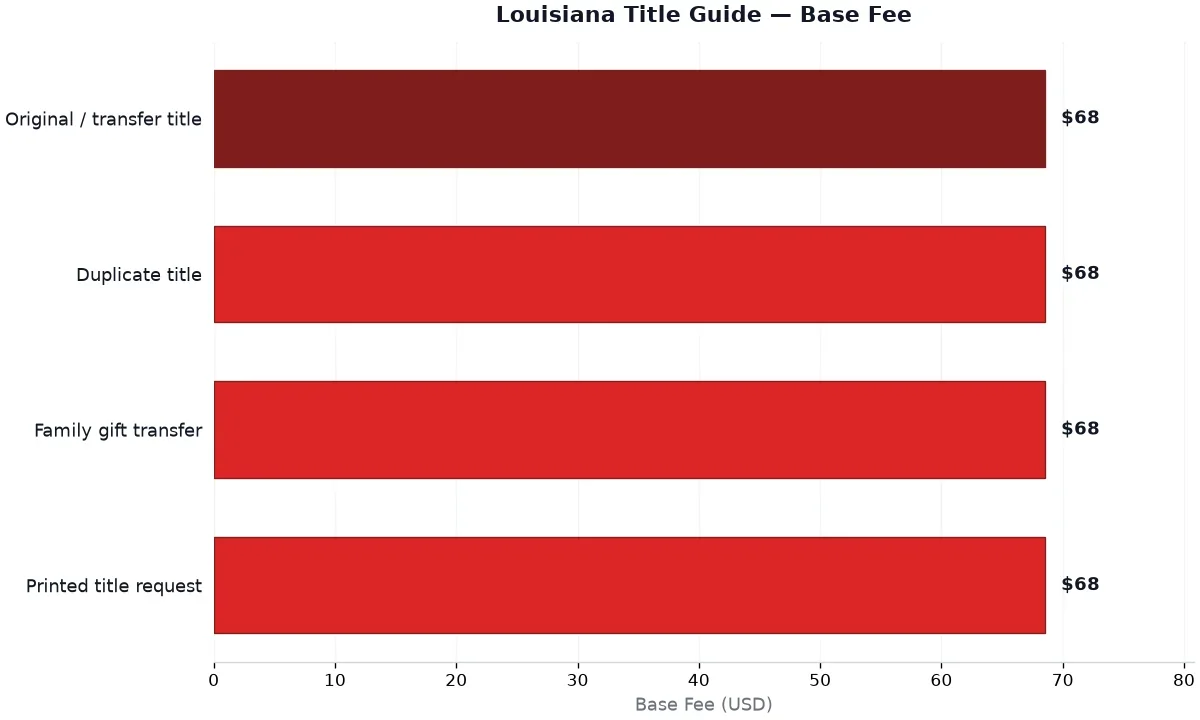
| Transaction | Base Fee | Extra | Where |
|---|---|---|---|
| Original / transfer title | $68.50 | $8 handling + tech fee + sales tax | OMV or tag agent |
| Duplicate title (DPSMV 1799) | $68.50 | $8 handling | OMV or tag agent |
| Family gift transfer | $68.50 | Tax-exempt with affidavit | OMV or tag agent |
| Printed title request | $68.50 | Only if not on file | OMV or tag agent |
Family transfers between spouses, parents, children, and siblings skip the sales tax with the state's affidavit. That's meaningful when the exemption applies to a $30,000 truck against a 9% combined rate. The same exemption logic drives our family transfer guide nationally.
Moving to Louisiana
New residents have 90 days to title and register — generous by national standards. Bring the out-of-state title, proof of insurance, ID, and payment for fees and use tax. Louisiana verifies VINs on out-of-state vehicles through its inspection process, and the OMV or tag agent schedules it when required.
If the out-of-state title is missing, resolve it with the previous state first. Louisiana wants the old record closed before issuing its own certificate.
Our cross-state lost-title guide sequences that recovery. The state title hub holds every state's fees and forms for the move.
Public Tag Agents vs OMV Offices: Picking Your Counter
Louisiana is one of the few states that licenses private tag agents alongside state offices. The difference is practical, not cosmetic.
Tag agents charge a service fee, typically $8 to $25 on top of state fees. In exchange they offer same-day processing, shorter lines, and staff who do title work all day. OMV field offices charge nothing extra but trade in queues that stretch past an hour in metro parishes.
The service-level split matters most for time-sensitive work. A duplicate needed for a sale closing tomorrow is a tag-agent job. A routine correction next month is an OMV errand.
Every parish has at least one agent, and the OMV's site lists them with hours. Some agents run appointment systems; most operate retail-style, walk in and wait.
One caution: agents can't approve anything outside the standard rulebook. Complicated cases — bonded titles, court-ordered transfers, heirship stacks — go to OMV field offices or the headquarters title unit.
Staff with actual authority work the file there. Bringing an edge case to an agent buys you a referral, not a solution.
Corrections, Name Changes, and the Notary Habit
Louisiana corrects title records through the same DPSMV 1799 with a correction section, supporting documents attached. Name changes need the certified court or marriage document; factual errors need an affidavit explaining the discrepancy. The correction fee matches the duplicate schedule in most cases, and the electronic record updates once the application processes.
The notary habit follows corrections too. Affidavits notarize, and clerks who see thousands of notarized documents weekly notice missing stamps instantly.
Louisiana notaries are notably powerful by national standards (civil-law notaries can draft documents). For title work, the plain notary stamp at any bank or agent office does the job.
Joint-owner rules follow the "and/or" convention nationally, but Louisiana adds a community-property wrinkle. Vehicles acquired during marriage may belong to the community even when titled to one spouse. That's why divorce and death transactions in Louisiana often carry extra spousal affidavits.
The clerk's office will flag it. Bring the marriage or divorce documentation whenever the title history spans a marriage.
Boats and Motors: The Louisiana Specialty
In a state built on water, boat titling matters. Louisiana titles most motorized boats and outboard motors 25 horsepower and above, with fees mirroring the vehicle schedule. Watercraft purchases need the same notarized act of sale, and the OMV processes boat titles alongside vehicle transactions.
If a boat title vanished, our lost boat title guide covers the state-by-state recovery including Louisiana's HIN-based lookups. Motorcycles follow the car process with lower fees.
The motorcycle replacement guide covers the specifics. The title anatomy explainer still applies to every certificate the OMV prints.
Louisiana vs Neighbors
The contrast with bordering states is stark. Our Arkansas guide shows $10-class fees and no notarization requirement. Texas sits in between with mid-range fees and its own forms.
Louisiana's costs buy something real. Same-day tag-agent service helps. So does an electronic record that survives floods, moves, and lost paperwork better than any glovebox.
For lien payoff mechanics after a Louisiana purchase, the lien release guide applies. For titling vehicles into an estate plan, the living-trust transfer guide walks the trustee formats that work at OMV counters.
The Louisiana Flood Factor
Weather is a title consideration that Louisiana takes more seriously than anywhere else. Floods damage vehicles — and paperwork.
Owners who lost titles to storm damage or evacuation displacement follow the standard duplicate path. The OMV processes storm-affected replacements with the same DPSMV 1799 form. The state's disaster declarations have historically paused or waived some fees, so ask when the calendar includes a named storm.
Flood-damaged vehicles that get repaired and returned to road carry salvage or rebuilt title brands that follow the vehicle forever. Buyers in the used market check those brands the way coastal residents check elevation. The brand appears on the title, and the OMV's records make the history traceable.
Sellers of rebuilt vehicles disclose the brand or face the state's misrepresentation rules.
Disaster documentation matters for the paperwork side too. Insurance settlements, FEMA registrations, and disaster-claim letters help establish ownership when documents vanished in the flood. The FEMA claim records and your insurer's file reconstruct the chain that a missing title would have proven.
Louisiana rewards the same discipline every other state does. That means complete packets, notarized signatures, and a record check before the visit. It charges more when you improvise.
The owners who treat the OMV system with its own formality move through it quickly. That covers everything from the act of sale to the duplicate affidavit. The ones who import other states' assumptions pay in return trips.
One habit covers the whole guide: check the OMV record before any transaction. Do it the way you would check the weather before a barge trip.
The record shows the lien status, the owner names, and whether a paper title exists at all. Those five minutes online decide which half of this guide applies to you.