
Giving a car to your son or daughter takes one DMV visit and almost no tax — when the paperwork is right. Texas cuts the charge to a flat $10 gift tax on Form 14-317. California exempts qualifying family transfers through a Statement of Facts. Skip the affidavit and the state taxes the swap at full book value, gift or not.
The parent-to-child transfer has its own wrinkles beyond the forms: minor-age recipients who cannot register alone, insurance that must move before the keys do, and college kids who take the car across state lines. This guide covers all three, plus the exact sequence that keeps the deal free and clean in 2026.
Gift or Sale? Pick the Right Frame First
A genuine gift — no payment expected, now or later — uses the family exemption lane. A sale at any real price uses the normal transfer lane with its sales or use tax. Mixing the two is where families create problems.
The "$1 sale" fails everywhere. State DMVs compare declared prices against book value, and token sales get taxed at fair market value anyway, sometimes with a penalty. The gift affidavit route is legal, cheaper, and designed for exactly this situation. Write "gift" in the price box, attach the exemption form, and the transaction is honest on its face.
The Paperwork: Title Assignment Plus Gift Affidavit
Two documents do the work in nearly every state. Fill both completely and the clerk processes the transfer in one visit.
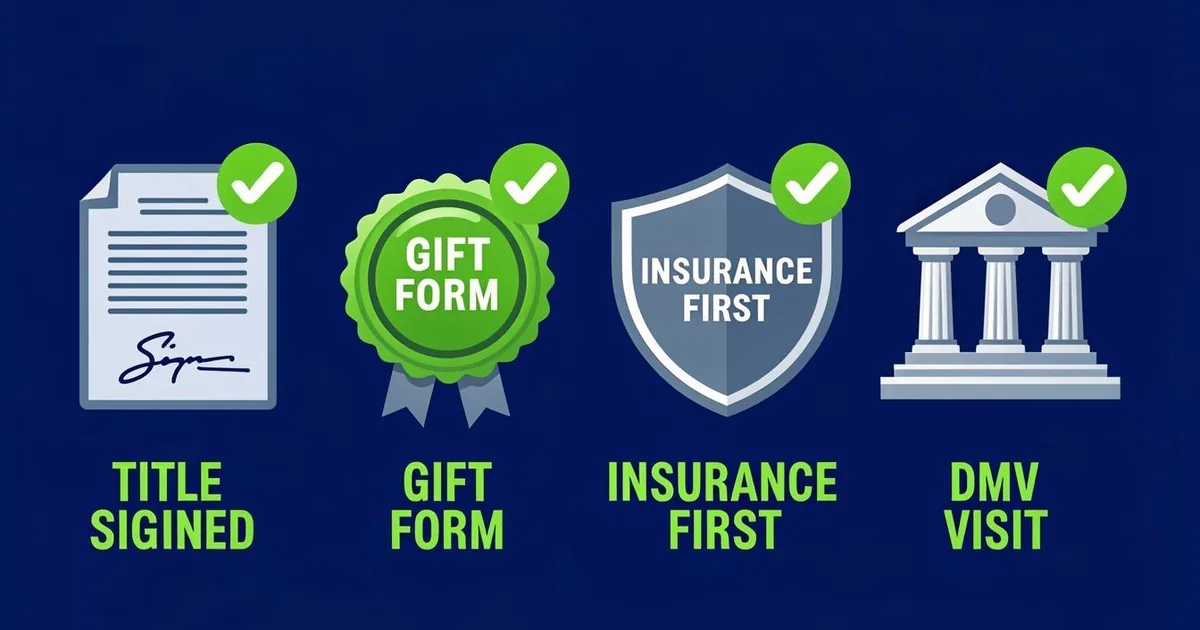
- Fill the title assignment as a gift. Parent signs the release of interest, the odometer reading goes in (mandatory for vehicles under 20 model years old under NHTSA rules), and the price line says "gift."
- Complete the state's gift or exemption affidavit. Texas wants Form 14-317 with both signatures; California wants a Statement of Facts claiming the family transfer exemption; Massachusetts uses MVU-26 for parents giving to children.
- Notarize if required. Some states notarize the affidavit, some the title itself, some neither. The form's footer says which.
- File at the DMV with the fee. The child pays the title fee, any flat gift tax like Texas's $10, and registration.
- Photograph the signed stack. One photo of the completed title and affidavit ends every future "who signed what" question.
The broader family-transfer context — including which relationships each state's exemption actually covers — lives in transferring a title between family members. This guide stays on the parent-child lane.
The Title Assignment, Line by Line
Most rejected child transfers fail on one skipped line, so it pays to walk the certificate before anyone signs. Titles vary by state, but the fields below appear on all of them.
| Field | What Goes There for a Gift | Why Clerks Reject |
|---|---|---|
| Buyer/Transferee name | The child's full legal name exactly as on their license | Nicknames or missing middle initials |
| Sale price / consideration | "Gift" or $0 per the state's convention | Blank price lines read as an unfinished sale |
| Odometer | Actual mileage, no tenths, dated | Blank on vehicles under 20 model years |
| Seller signature(s) | Every owner on the front of the title | One of two co-owners missing |
| Buyer signature | The child — or the co-titling parent if the child is a minor | Minor signed where the state forbids it |
| Damage disclosure | Per the state's form for newer vehicles | Skipped on transfers in disclosure states |
Use black or blue ink, stay inside the boxes, and make no strike-throughs — a corrected line often requires a sworn statement or a fresh duplicate title. If the title has no room left or a line is already damaged, order the duplicate first using the process in how to replace a lost car title, then do the gift on clean paper.
When an Actual Sale to Your Child Makes Sense
Gifting is not always the best structure. Selling at a real price creates a clean arm's-length record that some families prefer for estate-planning or fairness reasons — especially when siblings who did not receive a car are watching the ledger.
A documented sale also enables creative financing that banks will not touch. Parents frequently structure informal notes — $200 a month for two years — and the paper title transfer can happen at signing while the note lives separately, or at payoff depending on family trust levels. The IRS still applies the gift-analysis rules to below-market loans, but ordinary family car notes rarely approach reportable interest territory.
The tax cost of a real sale is the state's use tax on the price. On a $9,000 sale in an 6 percent state, that is $540 — real money, which is why the gift affidavit dominates when the relationship and fairness concerns allow it. Families splitting estates should compare both structures with an advisor before choosing.
What the Transfer Costs in the Biggest States
Parent-child transfers get the friendliest treatment in the tax code almost everywhere. These verified 2026 anchors show the spread.
| State | Cost for a Genuine Gift | The Form That Does It |
|---|---|---|
| Texas | $10 flat gift tax + title fee | 14-317 Affidavit of Motor Vehicle Gift Transfer |
| California | Use-tax exempt for qualifying family | Statement of Facts (family transfer section) |
| Idaho | 6% use tax exempted | ST-133GT Gift Transfer certificate |
| Massachusetts | 6.25% sales tax exempted | MVU-26 (parents to children, spouses, siblings) |
| Florida | Sales tax exempted with proof | Exemption declared on the title application |
Federal gift tax almost never enters the picture: the IRS annual exclusion allows $19,000 per recipient in 2026, and any typical hand-me-down sits far below it. Even a $30,000 truck to one child only reports the overage against a $15 million lifetime exemption — nobody writes the IRS a check over the family sedan.
Can a Teenager Hold the Title at All?
States split on minors. Most allow a person under 18 to hold title, but the minor cannot sign binding contracts, register the vehicle alone, or carry a standalone insurance policy. Practically, that makes co-titling the standard move.
Co-titling parent and child together keeps everything legal while the kid is underage: the parent's signature carries the registration, and the insurance policy sits with the adult. The parent's name stays on the title until the child reaches the age of majority, then a simple removal transfer — often exempt again as a family transfer — drops the adult name.
A few states restrict minor ownership more tightly, and a handful let 16-year-olds title outright. One call to the county DMV settles your state's exact position before the visit. Bring the birth certificate if the clerk needs relationship proof for the exemption — some counters ask, some never do.
Insurance Moves Before the Keys Do
The single most common parent mistake is transferring the title and forgetting the policy until after an accident. Insurance follows the titled owner. The day the title records in the child's name, the parent's policy stops covering the car properly — and the child cannot legally drive it without their own or a family policy listing them.
Get the quote before the DMV visit. Adding a teen driver to a family policy raises premiums dramatically; the child's own policy on the gifted car can cost more or less depending on age, driving record, and the vehicle. Whichever structure you choose, the coverage start date should match or precede the title date.
Parents keeping the car insured on their own policy after the title transfer should expect the carrier to require the title correction. Carriers verify titled owner against policyholder, and mismatches surface at renewal or at the worst possible moment — a claim.
When the Kid Takes the Car to Another State
College relocations create a registration puzzle. Most states let full-time students keep home-state plates and registration while attending school — student exceptions are written into the vehicle codes of the big college states. The car stays legally home-registered even though it parks in Austin or Boston for four years.
That exception has limits: the student keeps a home-state driver's license, maintains home-state insurance, and does not take a job permanent enough to establish residency. A graduate who stays after commencement crosses into new-resident territory and registers locally, typically within 30 to 90 days of establishing residency depending on the state.
Parents should also know what the transfer means for their own liability. Once the title and policy are in the child's name, the parent's exposure ends for that vehicle. Co-titled arrangements keep parental exposure alive, which cuts both ways depending on the kid's track record.
Timing the Gift Around the First License
Sequencing beats spontaneity on teen transfers. The cleanest order is license first, insurance quote second, title transfer third — because several states require a licensed driver of minimum age before the vehicle can even be registered, and the insurance market prices an unlicensed title-holder strangely.
Handing keys on the birthday feels generous and creates a coverage gap if the policy work lags. Bind the coverage the week before, complete the title the week after, and the whole arrangement is airtight from mile one. Parents who co-title during this window should calendar the removal transfer for the child's age of majority — it takes two minutes at the counter and closes the loop.
The same sequencing logic applies at the far end of parenthood: adults settling a parent's affairs should read the estate sequence before touching the title, because probate paperwork changes which forms apply. Divorcing parents splitting vehicles follow the spousal rules at title transfer between spouses instead of the gift lane.
Mistakes Parents Make on This Transfer
Clerks watch the same parent-child failures weekly. None of them survive a prepared visit.
- Blank odometer box on a car under 20 model years old — the packet bounces.
- No gift affidavit at all, so the clerk taxes book value as a sale.
- Title assignment signed by one parent when the title lists both.
- Lien still showing because the payoff release never reached the DMV.
- Insurance canceled the same day, leaving the kid uncovered before their own policy started.
- Grandma's-name fronting that denies the first claim.
Parents handing cars to children heading into marriage or divorce situations should also read title transfer between spouses — a gifted car can become marital property, and timing matters. And when the giving goes the other direction, from an estate to adult children, the rules shift to inherited vehicle titles.