
PCS orders arrive, and the household becomes boxes. The car title — which lived in a folder unopened since the last move — vanishes into the deployment shuffle.
Discovering it missing from overseas is a different order of problem than discovering it missing across town. You cannot drive to a DMV, and mail takes weeks each way.
Every form wants a signature from someone standing on American soil. None of which makes it unsolvable. It makes it a planning exercise.
Service members solve this constantly, using three tools. The civilian world uses them too: notarized powers of attorney, family-member agents, and state DMV processes built for deployed owners.
This guide walks the whole path, with the military-specific resources that make each step faster. It covers a car you left stateside, one you shipped, or a sale to close from twelve time zones away.
Table of Contents
- Why "Lost Title" Gets Harder From Overseas
- The Power of Attorney: The Tool That Solves Everything
- Running the Duplicate Application From Abroad
- The Special Cases: Sale, Storage, and Shipped Vehicles
- The SCRA Note for Financed Cars
- What States Do Differently for Deployed Owners
- Before Wheels-Up or After: The Timing Question
- Pre-Deployment Paperwork: The Ten-Minute Version
- The Legal Office and the Family Paper Trail
Why "Lost Title" Gets Harder From Overseas
Three constraints stack. Distance removes the counter visit, which is how most duplicate-title questions get answered in one conversation.
Mail latency turns a two-week process into a six-week one. The replacement title mails to a stateside address, and forwarding from an APO or FPO adds its own cycle.
And identity is harder to prove remotely. Several states want a notarized application from owners who apply by mail. A notary stamp from a foreign jurisdiction is not always accepted on its face.
The military answers all three. Base legal assistance offices provide free notarization that every state accepts. It is a notary acting under federal authority on a US installation.
Military postal rules handle documents to and from APO/FPO addresses, though timing stays unpredictable. And the power of attorney converts the problem from "you must appear" to "your agent appears". That document is the single most valuable one in the whole situation.
The Power of Attorney: The Tool That Solves Everything
A specific, notarized power of attorney is the master key. It authorizes a named person — spouse, parent, trusted friend — to act on your behalf with the DMV.
With it, your agent can request the duplicate title and sign state applications. The agent can also receive the mailed document and, in many states, execute a sale on your behalf.
Without it, most state processes stall at the first counter question. Clerks cannot take instructions from someone not on the record.
Draft it deliberately. Name the agent by full legal name and describe the vehicle by VIN. Then enumerate the powers: "apply for duplicate title, execute title applications, and sign titling and registration documents with [state] DMV".
A general POA works in some states; the vehicle-specific version is accepted everywhere and raises no questions. Installation legal assistance drafts these daily and knows which states want which language. Ask them to match your state's preferences.
One wrinkle: a handful of states want the POA itself recorded or submitted with the application. Some also cap POA validity — one year is a common limit for vehicle transactions.
Have your agent confirm the state's requirements before the application goes in. A rejected POA discovered by mail costs a full round trip you cannot afford from abroad.
Running the Duplicate Application From Abroad
With the POA executed, the duplicate process itself is the standard one, run by proxy. The stateside mechanics live in our standard duplicate title process guide. The steps that work from abroad, in the order that avoids rework:
- Identify the state's duplicate process and whether it can run by mail. Most states offer a mail-in duplicate application. A growing number run the request through an online account. If you can log in from abroad, that option removes the agent entirely for this step.
- Execute the application and POA together. Your notarized application (legal assistance again), the POA, and a copy of your military ID go in. Add the agent's ID and the fee — commonly $10 to $30 depending on state.
- Use a stateside mailing address. The replacement title should go to your agent or a family address, never directly to an APO/FPO. The stateside hop adds weeks, and carriers handle DMV mail inconsistently abroad.
- Have the agent follow up by phone. One call to the DMV title desk does it, with the application date and the agent's authority confirmed. That call turns "six weeks and pray" into a tracked request.
- Store the result, not the original. When the title arrives, the agent scans and sends it to you. The original then stays somewhere a future deployment will not lose it. That is the lesson of this whole exercise.
The Special Cases: Sale, Storage, and Shipped Vehicles
Selling a stateside car from overseas is the highest-stakes version. The buyer needs a signed title; you need money and zero future liability.
With the POA, the agent can execute the sale. Draft the POA to explicitly include the power to sell, sign the title over, and receive payment.
Buyers of "seller is deployed" cars are (rightly) cautious. A notarized POA, a scan of your ID, and a phone number that reaches you changes their calculus entirely.
Payment runs through traceable channels. Wire to your US account — never cash to an agent you have not known for a decade.
Long-term storage raises the quiet risk. Titles left in stored vehicles or household goods shipments resurface damaged or not at all.
If the car goes into storage at a family property, the title should not go with it. It belongs in your document file or with your agent.
Storage-time insurance and registration decisions vary by state. Some allow non-operational status that suspends registration without penalties. The title sits at the center of all of them.
Vehicles shipped overseas under PCS rules travel with paperwork handled separately from household goods. Confirm before the shipment whether the title rides with the vehicle or stays in your documents.
Losing a title to a shipping container is preventable with one question before the container closes. The shipping process itself is a benefit program, but the title remains your responsibility throughout.
The SCRA Note for Financed Cars
One SCRA-adjacent note deserves its own paragraph, because it changes the money math. The act's protections extend beyond the interest cap to certain default judgments and repossession limits while deployed. Loan servicing for a stateside vehicle falls squarely in the territory the act governs.
The consumer bureau's SCRA guidance at consumerfinance.gov summarizes which protections apply automatically and which require the orders-based request. Service members with financed vehicles should read it once per deployment cycle.
The protections changed over the years. The version most people remember is not always the version in force.
A financed car adds the lien-release dance to the timeline. Our guide on titles and active loans covers the lender side in detail.
What States Do Differently for Deployed Owners
Most states accommodate deployed service members without ceremony: mail-in duplicates, POA acceptance, extended windows for expiring registrations. A handful go further. The extras: dedicated military sections on DMV sites, email submission of notarized applications, or suspension of deadlines while deployed.
A few are simply rigid. Knowing which one you are dealing with shapes whether the agent applies early or waits for a window.
The efficient move is one call by the agent, with the POA number in hand. Two questions: can this duplicate application run by mail with the attached POA? Does the state offer anything specific for deployed owners?
The answer takes five minutes and routinely shortens the process by a month. Our state guides hub keeps the fees, forms, and contacts current for every state. Our application guide covers the paperwork structure the agent will be filing.
Military families relocating between states face a cousin of this problem. Our guide to a lost title while moving out of state covers the cross-state version.
Before Wheels-Up or After: The Timing Question
The deployment-timing question comes up in every family conversation about this process, and the honest answer has two halves. The paperwork half is clean: a POA executed and a duplicate requested before wheels-up resolves in weeks. It runs entirely stateside, with no deployment interference.
The complications half is heavier. Everything that starts after departure inherits the mail latency, the proxy dynamics, and the stateside-agent dependency. Still solvable — but at three to five times the calendar cost.
The gap between those halves is the single strongest argument for the pre-deployment legal-assistance visit. It is the reason every installation checklist puts vehicle paperwork next to the will and the financial power of attorney.
The vehicle is usually the second-largest asset a service member owns. The paperwork protecting it costs an hour.
Pre-Deployment Paperwork: The Ten-Minute Version
Every lesson above compresses into a pre-deployment checklist that takes one legal-assistance visit. Execute a vehicle-specific POA naming your agent.
Cover duplicate titles, registrations, lien matters — and the power to sell, if a sale is possible. Photograph the title and store the scan somewhere you can reach from abroad.
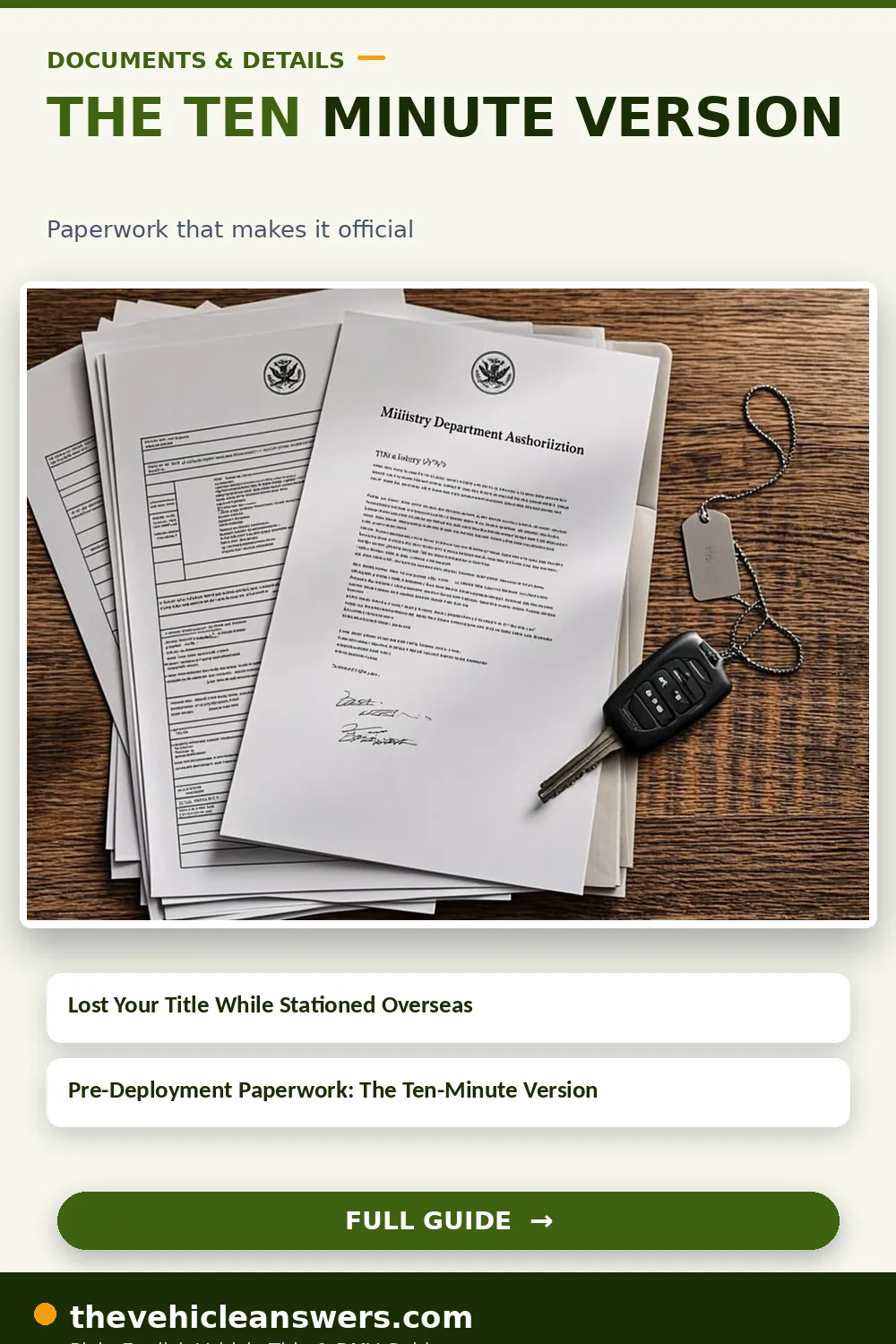
Confirm the state's mail-in processes for duplicates and renewals. Put the payoff and lender contact details in the file if the car is financed.
And decide where the original physically lives: with the agent, in a fire safe, or in your stateside document folder. Never in the glovebox, and never in a shipping container.
Service members who run that checklist never need this guide's harder sections.
The ones who skip it discover the alternative: a $15 duplicate and a free notarization executed before wheels-up. That is the cheapest insurance the military paperwork system offers.
Need the civilian-side context: what the title document actually does, and why agents need such specific powers? Our title explainer covers the mechanics.
Military families moving between states can compare old and new state requirements on the guides hub.
The Legal Office and the Family Paper Trail
Additional family support resources, including document checklists for deployments, are available at militaryonesource.mil. State DMV contacts are reachable through each state's official site. California-based families, for example, use dmv.ca.gov.
One more resource belongs in every deployed owner's file. It is the installation legal assistance office's own deployment checklist, which most bases publish and update.
It bundles the vehicle POA with the other documents a deployment touches: financial powers of attorney, the will, dependent-care authorizations. One appointment covers the stack. The attorneys there see enough vehicle cases to know your state's current quirks.
The office exists precisely so service members do not have to improvise legal paperwork from twelve time zones away. Using it before departure is the difference between a five-minute fix and a five-month correspondence.
A note for family members acting as agents: keep every DMV receipt and confirmation number. File them in the same folder as the POA itself. The paper trail you build stateside is the paper trail that answers questions overseas.