

A grandmother decides her grandson should have the Corolla she has driven for twenty years. The keys change hands in an afternoon, everyone cries a little, and the paperwork question surfaces.
Where is the title? Nobody knows. It was last seen in a folder sometime around the previous decade.
The gift was real; the proof of it is not. Without paper, the grandson owns a car he cannot register, insure, or legally drive.
Gifted-vehicle title problems are their own category, because gifts lack the one document every sale produces: a purchase transaction. What replaces it is a gifting affidavit, an ownership chain, and occasionally a declaration worth ten dollars of notary ink.
This guide covers the easy version (title exists, just misplaced) and the harder one (title genuinely gone). It also covers the version nobody expects — the giver has died, moved, or disappeared since the keys did.
Table of Contents
- The Easy Version: The Title Exists Somewhere
- The Gift Paperwork Itself: What Makes It Official
- The Hard Version: No Title, a Complicated Giver
- The Bonded Title Endgame for Gifted Cars
- The Five-Minute Version of Prevention
- The Tax Math Behind the Gift Affidavit
- When to Do the Transfer
- The Giver's Side of Prevention
- Mid-Process Tonight: One Link at a Time
The Easy Version: The Title Exists Somewhere
Start by assuming the title is findable, because it usually is. Givers misplace titles in the same places everything else goes.
Think the folder with the tax papers, the safe deposit box, or the old kitchen drawer nobody opens. Before any paperwork gymnastics, run the search properly. Ask the giver directly where they kept important papers.
Check with any co-owner too. And look wherever the vehicle's last registration renewal came from.
If the search fails, the fix is the giver's duplicate-title application. It's a routine request in every state — typically $10 to $30, processing in days to weeks. Our standard replacement walkthrough covers it.
The gift then completes normally. The giver signs the fresh title over to the recipient with "gift" noted.
The gift-exemption affidavit rides along, and the recipient files everything at the DMV. Total extra delay: one mail cycle.
The Gift Paperwork Itself: What Makes It Official
Gifts fail at the DMV when they arrive looking like handshakes. The packet that passes has four components.
First, the title signed over to the recipient — price field marked gift, zero, or the state's preferred notation. Second, the state's gift or family-transfer affidavit: the specific form that asserts the relationship.
Critically, that affidavit claims the sales-tax exemption most states extend between qualifying relatives. Third and fourth: both parties' identification, plus the recipient's insurance proof and standard title fees.
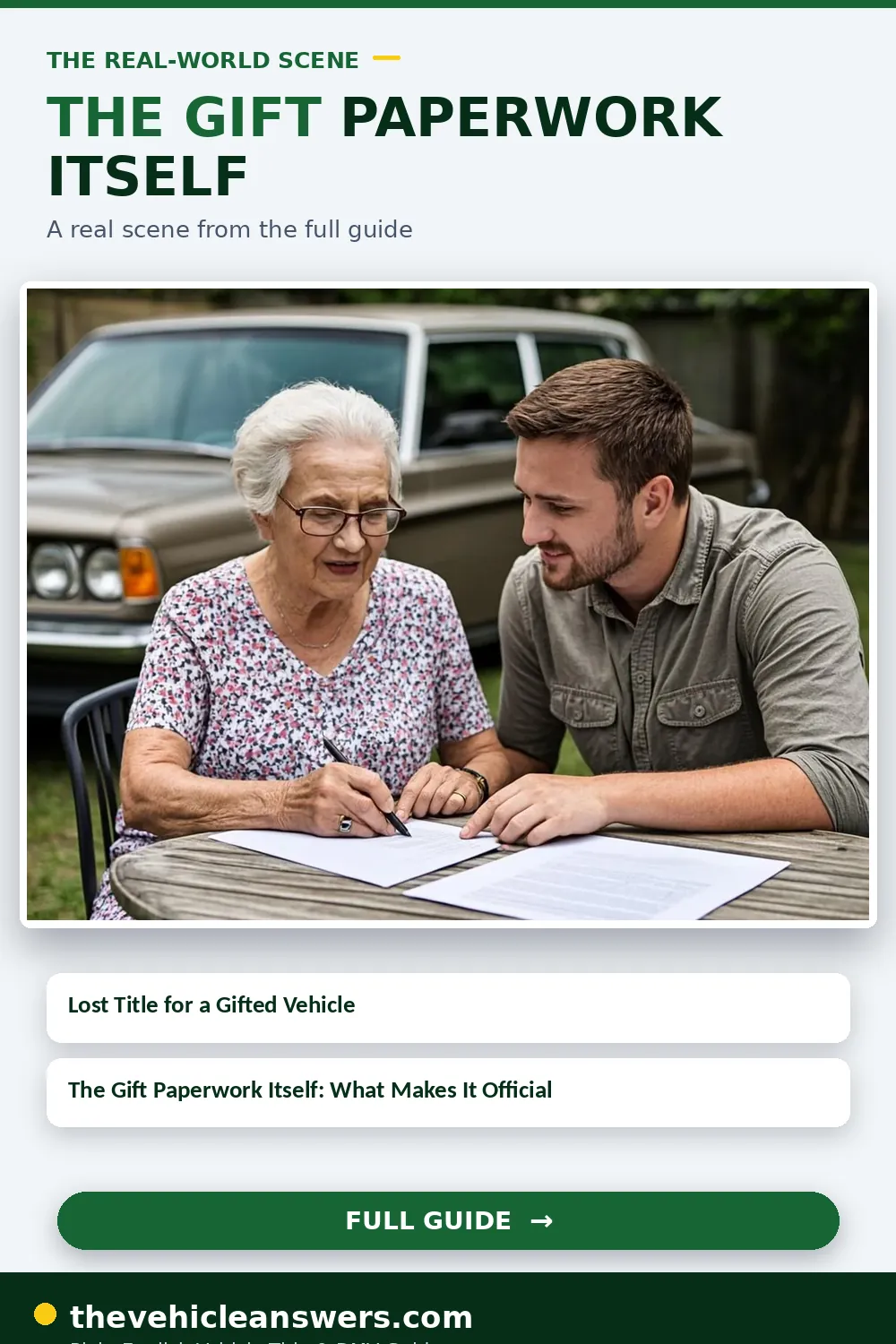
The affidavit is the piece people skip, and skipping it costs real money. Without it, many states assess sales tax on the vehicle's book value anyway.
That's a four-figure surprise on a car that was free. The relationship rules vary — most states exempt parents-to-children, spouses, and often siblings or grandparents-to-grandchildren.
A few states are stricter. The form is short. The notary requirement, where one exists, is a ten-minute errand at a bank or shipping store.
Document the gift itself, beyond the state form. A simple signed statement works.
The wording is plain: "I, [giver], transfer ownership of [year/make/model/VIN] to [recipient] as a gift on [date]". Both parties sign it.
It costs nothing. It's the evidence that answers questions years later, when the giver has passed and the recipient sells the car.
The Hard Version: No Title and a Complicated Giver
The genuinely difficult gifted-title cases share a pattern. The giver cannot simply reapply for a duplicate.
The categories, in ascending difficulty:
- The giver moved out of state. The duplicate runs in the state where the vehicle is titled. That may be neither where the giver nor the car now lives. The giver applies to the old state by mail. Or they execute a power of attorney naming someone to run the application. Interstate gift transfers otherwise follow the receiving state's normal process.
- The giver died after the keys changed hands. An un-titled gift becomes an estate question, and the answer depends on timing, estate size, and state small-estate thresholds. Our guide on inherited vehicle titles covers the executor paths. Survivors may complete the gift through affidavit procedures or simplified probate. The written gift statement from the section above becomes the essential evidence.
- The giver is estranged or unreachable. The vehicle was given, but no paperwork exists and the giver will not or cannot sign. This is ownership reconstruction. The recipient builds the case with the written gift statement and any dated evidence of the handover. Photos and insurance records showing the car at their address both count. Then comes the state's ownership affidavit process — or the bonded title route. A surety bond backs the title for the state's bond period when nobody can produce a signature.
Each of these runs on documentation density. The recipients who win are the ones who can show a dated trail.
Insurance that covered the vehicle years before the paperwork, registration renewals, and maintenance records all work. They corroborate the story the paperwork cannot yet tell.
The Bonded Title Endgame for Gifted Cars
When the giver genuinely cannot sign, the bonded title is the state's designed exit. That covers the deceased without a traceable estate, the vanished, and the simply unreachable. The recipient posts a surety bond, commonly valued at one to one-and-a-half times the vehicle's worth.
The bond is held for three to five years while any legitimate claimant can surface. The state then issues a clean title, and after the bond period the ownership is fully mature.

Bonded titles carry a stigma in some corners that they haven't earned for gift cases. The bond exists to protect the true owner. In a genuine gift, there is no competing claimant to protect against.
The premium is modest. The application is the state's standard bonded-title packet with your evidence attached. The process is the same one used for abandoned cars and missing-signature sales.
Keep the original gift evidence even after the bonded title issues. It's the story behind the bond if anyone ever asks.
The Five-Minute Version of Prevention
For families planning a gift rather than untangling one, the paperwork takes an afternoon when done at handoff.
The giver signs the title to the recipient with gift notation. Both parties sign the state's gift affidavit and a simple gift statement. The recipient files within the state's window, and everybody keeps copies.
Compare that with the bonded-title endgame and the afternoon pays for itself a hundred times over.
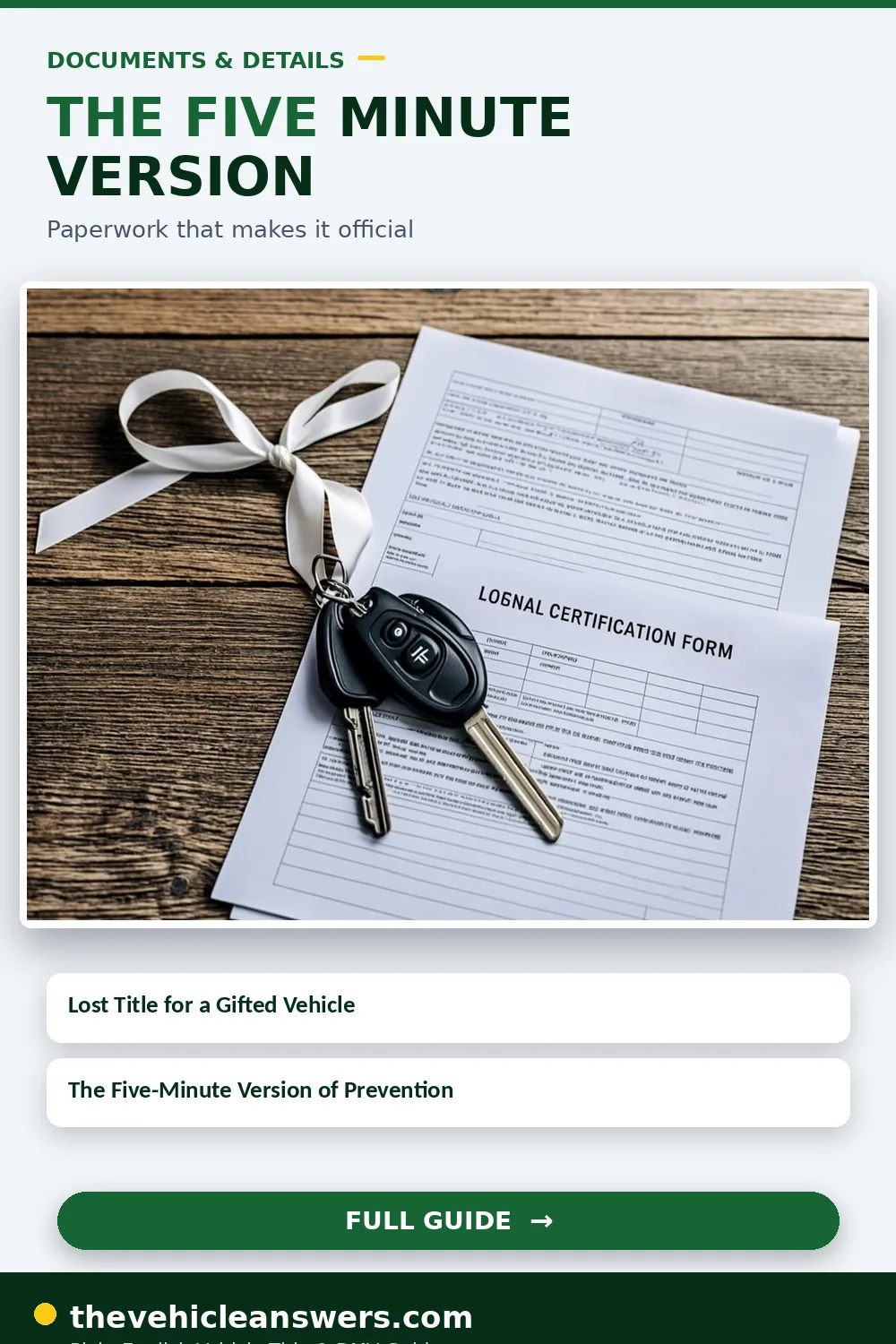
Three habits close the remaining gap. Photograph the signed title and affidavit before filing, so the evidence survives any office mishap. File the gift within the state's transfer window.
The same deadlines as sales apply. Late fees attach to gifts too.
Keep the giver's contact details in the vehicle file, too. The day the recipient sells, a notarized statement from the original giver resolves ownership questions in minutes.
The state-by-state gift forms and fees are on the guides hub. The family-exemption mechanics are in our family transfer guide. And the title explainer covers why this single document decides every question in this article.
The Tax Math Behind the Gift Affidavit
The tax-exemption mechanics deserve their own worked example, because the savings justify the paperwork. Consider the grandmother's Corolla, worth perhaps $6,000 on the book-value sheets a state might use.
In a state that taxes private transfers at five percent, an unclaimed gift costs the family $300. It's assessed against the recipient at filing and due before registration. The affidavit that prevents it takes ten minutes and a notary.
The same arithmetic scales with value. The family truck at $18,000 carries a $900 surprise, and the classic mustang at $30,000 carries $1,500.
The affidavit forms differ state to state. California's family-transfer process at dmv.ca.gov and Texas's gift affidavit at txdmv.gov are the two most-copied examples.
But the mechanism is identical everywhere. The form asserts the relationship, the relationship qualifies for the exemption, and the exemption is what the filing claims. Skip the form and the tax isn't a mistake — it's the default.
When to Do the Transfer
The timing question families actually ask is when to do the transfer. The answer surprises people: the paperwork is cheapest the week the keys change hands. Every delay adds a documentation step.
A gift filed immediately needs the title, the affidavit, and the filing fee. That's the whole list.
The same gift filed two years later needs everything above, plus more. The reason for the delay needs explaining, the giver's cooperation needs re-obtaining, and sometimes a death certificate replaces their signature.
Nothing about the transfer improves with age. The vehicle doesn't care, the state doesn't benefit, and the family's memories don't substitute for the form.
The sentimental reasons for waiting are real; the paperwork reasons for not waiting are heavier.
The Giver's Side of Prevention
The final perspective belongs to the givers rather than the recipients. Prevention lives on that side of the transaction.
A giver who wants the car to matter after they're gone can make the paperwork part of the gift itself. Sign the title at handoff, not someday. File the affidavit with the recipient in the same afternoon.
Write the one-page gift statement in their own words, dated and signed. Do it while the signature is exactly what it says it is.
The gifts that transfer cleanly are the ones where the giver treated the paperwork as part of the present. The recipients who inherit that paperwork inherit the car and its story together.
Families report that's how the giver intended it all along.
Mid-Process Tonight: One Link at a Time
A final word for the recipients mid-process tonight. The paperwork above looks long, but each item is short, and the sequence runs in a straight line.
The search takes an evening. The duplicate takes a form and a fee. The affidavit takes a notary and a signature.
The filing takes a counter visit. That's the whole chain.
Nothing in the chain is hard; everything in the chain is necessary. The chain only looks intimidating when all of it is stacked in front of you at once.
Work it one link at a time — search, replace, claim, file — and the gifted car becomes legally yours. The family member who gave it to you gave the easy part.
The paperwork is the part you give back.