

There is a specific flavor of relief in opening the glovebox and finding no title. Then your hand lands on the registration, and the picture changes. The registration proves the state already believes you own the car.
That single document changes the replacement conversation. It moves from proving the vehicle is yours to confirming what the records already show. Owners in this position get the fastest, cheapest, and least interrogated version of the duplicate process.
This guide explains why the registration helps so much and how to use it when applying. It also covers the corroboration states sometimes want and the situations where a registration alone is not enough.
Those cases usually involve a live lien, an interstate move, or a name mismatch. Each one has its own fix, covered below.
The one-sentence version: with a current registration in your name, replacing a lost title is a routine duplicate request. The standard replacement walkthrough covers the basics of that request.
What follows is the playbook for leaning on that registration, plus the snags that occasionally complicate an easy case.
Table of Contents
- Why a Registration Changes Everything
- The Fastest Route: Online Duplicates
- Using the Registration to Get the Duplicate
- When the State Asks for a Little More
- The One Snag That Matters: A Lien on the Record
- When You Need This for a Sale
- Keeping the Next Title From Getting Lost
- Where a Registration Stops Helping
Why a Registration Changes Everything
A title and a registration are two views of the same state record. The title is the ownership document. The registration is the permission-to-drive document, renewed annually and always current in the state's database.
When your registration matches the VIN and your name, the state has already settled the ownership question internally. Your duplicate application just re-issues the paper. Nothing has to be proven from scratch.
That is why owners holding a registration skip the hardest parts of unusual title cases. There is no bill-of-sale archaeology, no ownership affidavit stack, no bonded-title conversation. The clerk matches your registration against the record, takes the fee, and files the request.
Processing in most states runs days to weeks, with fees that cluster between roughly $10 and $30. The state guides hub lists each state's exact number and form.
The Fastest Route: Online Duplicates
The fastest version of this process deserves its own section, because it changes behavior. A growing number of states now issue the duplicate title entirely online.
Identity is verified through the DMV account and payment is taken in the same session. The paper then arrives by mail in the state's standard window. Owners who qualify should use it.
The online channel removes the counter conversation entirely. That removes the small documentation questions that turn quick errands into second visits.
The states that run full online duplicates note it on their DMV portals. The National Motor Vehicle Title Information System's consumer site at vehiclehistory.gov is the separate federal tool. It shows what the title system already says about a vehicle.
Checking it before you file confirms the record matches your registration. That is a useful two-minute step for anyone who wants certainty first.
Using the Registration to Get the Duplicate
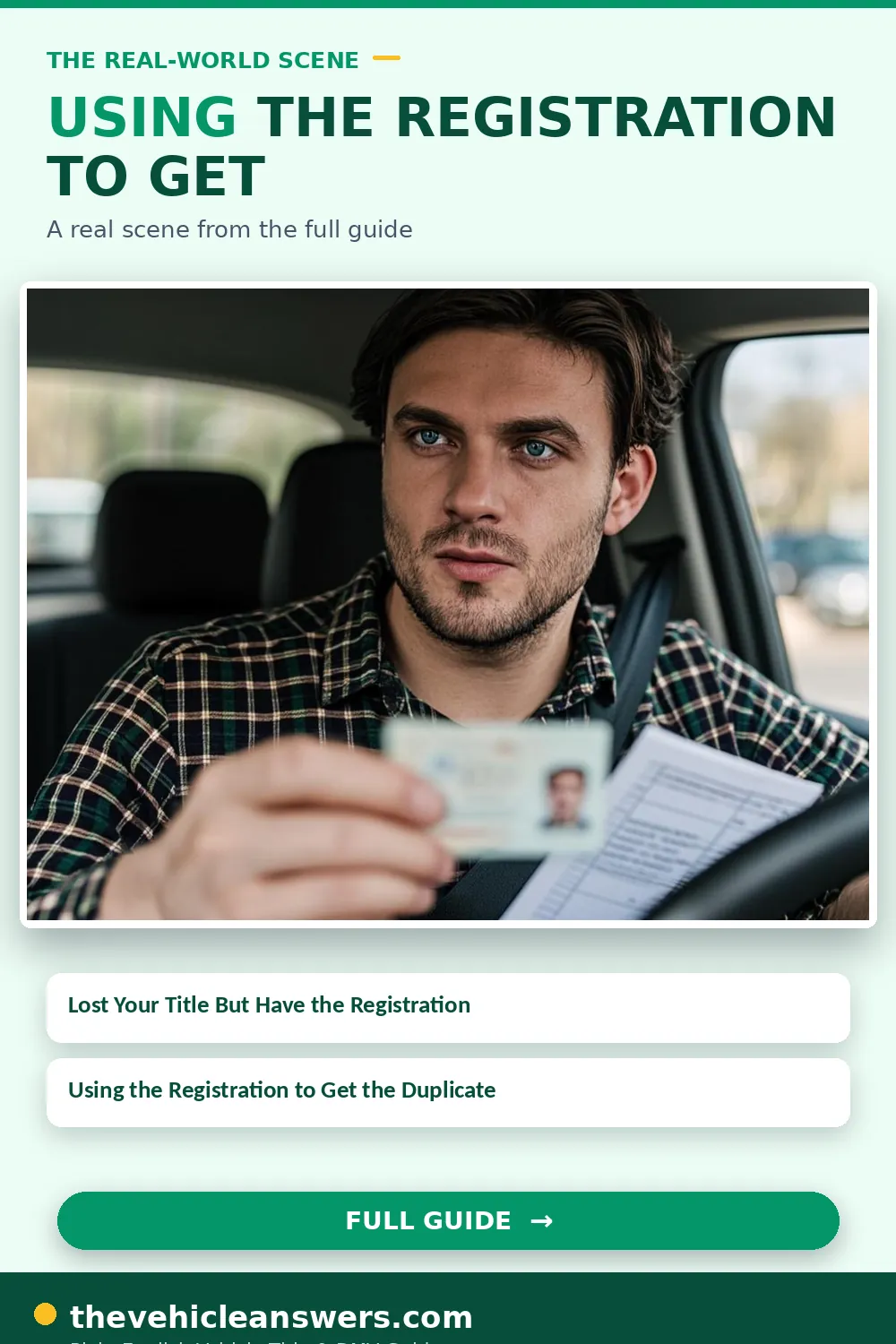
The application itself is the standard duplicate process, with your registration doing the identity work. This is the sequence that gets owners in and out in one visit or one online session.
- Confirm the record is clean. Check that the registration's VIN, name, and address all match reality. Fix any mismatch at the same time to avoid a second trip. A typo from a previous owner era or an old address counts.
- Choose online or counter. Most states offer the duplicate title application online, by mail, or in person. Online is fastest when available; the counter is best when the record needs a live fix.
- Bring the registration and ID. The registration proves the record; your ID proves you are the person on it. Some states also ask for the plate number and a fee payment, nothing more.
- Note the lien question. If the record shows a lienholder, the duplicate may route to the lender or require their involvement. This is the most common snag, and it gets its own section below.
- Wait out the mail window. Most states mail duplicates in one to three weeks. Same-day titles exist in a handful of states for an extra fee. The counter clerk can tell you if yours does.
When the State Asks for a Little More
Occasionally a clerk wants one more document beyond the registration. This is normal, and the standard corroboration items are simple.
Expect a government photo ID matching the name, the plate number, or in some states a short ownership affidavit. None of this is the heavy proof burden that untitled situations face. It is confirmation, not investigation.
The cases that genuinely need more share a pattern. The registration is old, the name changed, or the vehicle came from another state.
A name change is fixed with the document that produced it. That means the marriage certificate, divorce decree, or court order, filed alongside the duplicate request.
An out-of-state vehicle usually means the new state wants its own title anyway. The registration from the old state supports that application as ownership evidence. In most cases, though, the old state's duplicate title comes first, and the destination state's requirements drive the sequence.
The pages on the state guides hub lay out both sides of any interstate move. Read both before you start driving paperwork between states.
Glovebox cleaned out, move in between, papers gone—the fix is still ordinary. Registrations re-print instantly in most states, free or for a few dollars, through the online portal or any kiosk. Reprint the registration, then run the duplicate title application with it.
The two together take an afternoon. Our guide on losing both the title and registration walks that combined case end to end.
The One Snag That Matters: A Lien on the Record
Everything above assumes a clean record. If the state's file still shows a lienholder, the duplicate title conversation changes. That lienholder might be a bank from a loan paid off years ago, or an active auto loan.
In financed vehicles, many states mail the replacement title to the lienholder of record. Others require the lender's release before issuing anything to you.

Check the lien status before applying; most state portals show it free. If a lien appears and the loan is genuinely retired, the release step comes first.
Our guide to titles entangled with a loan explains how to clear the record. Only then does the duplicate flow normally.
If the lien shows but you never owed money on this car, stop. Investigate before filing anything. A lien you cannot explain is a records-error or fraud signal.
Both possibilities deserve a conversation with the DMV's title desk. An online form is the wrong tool for that conversation.
When You Need This for a Sale — and When a Registration Is Not Enough
Sellers discover the lost title the week a buyer appears. The obvious question: can the sale proceed on registration alone? In most states, no—the buyer's DMV wants the title itself, signed.
The registration is your evidence while the duplicate processes, and it lets you show the vehicle is yours. The sale itself finishes with a title in hand.
Order the duplicate before listing the car. Buyers who hear "it's in the mail" discount accordingly.
Our guide on sorting the title before a transfer explains the pre-sale cleanup. It is worth ten minutes before the ad goes live.
Two contexts where the registration genuinely carries more weight. First, insurance: carriers routinely accept a registration as proof of ownership for adding or updating a vehicle. Second, some lenders will begin title-loan work from a registration while the duplicate processes.
Closing still wants the actual title, in both cases. Treat the registration as a bridge, not a destination.
And the context where it carries none: vehicles that were never titled in your state. That includes registrations issued to a previous owner, or states that never required titles for the vehicle's age.
Neither version substitutes for ownership evidence in a new-state application. Those situations run through ownership-reconstruction: affidavits, bill-of-sale chains, and sometimes a bonded title. That is a different process with a different burden of proof.
Keeping the Next Title From Getting Lost
Once the duplicate arrives, break the cycle instead of repeating it. Store the title somewhere a glovebox cleanup will never touch.
A home fire safe works, and so does a scan plus a physical folder. Anything beats the car.
The registration lives in the vehicle; the title never needs to. Owners who follow that one rule almost never file a second duplicate.
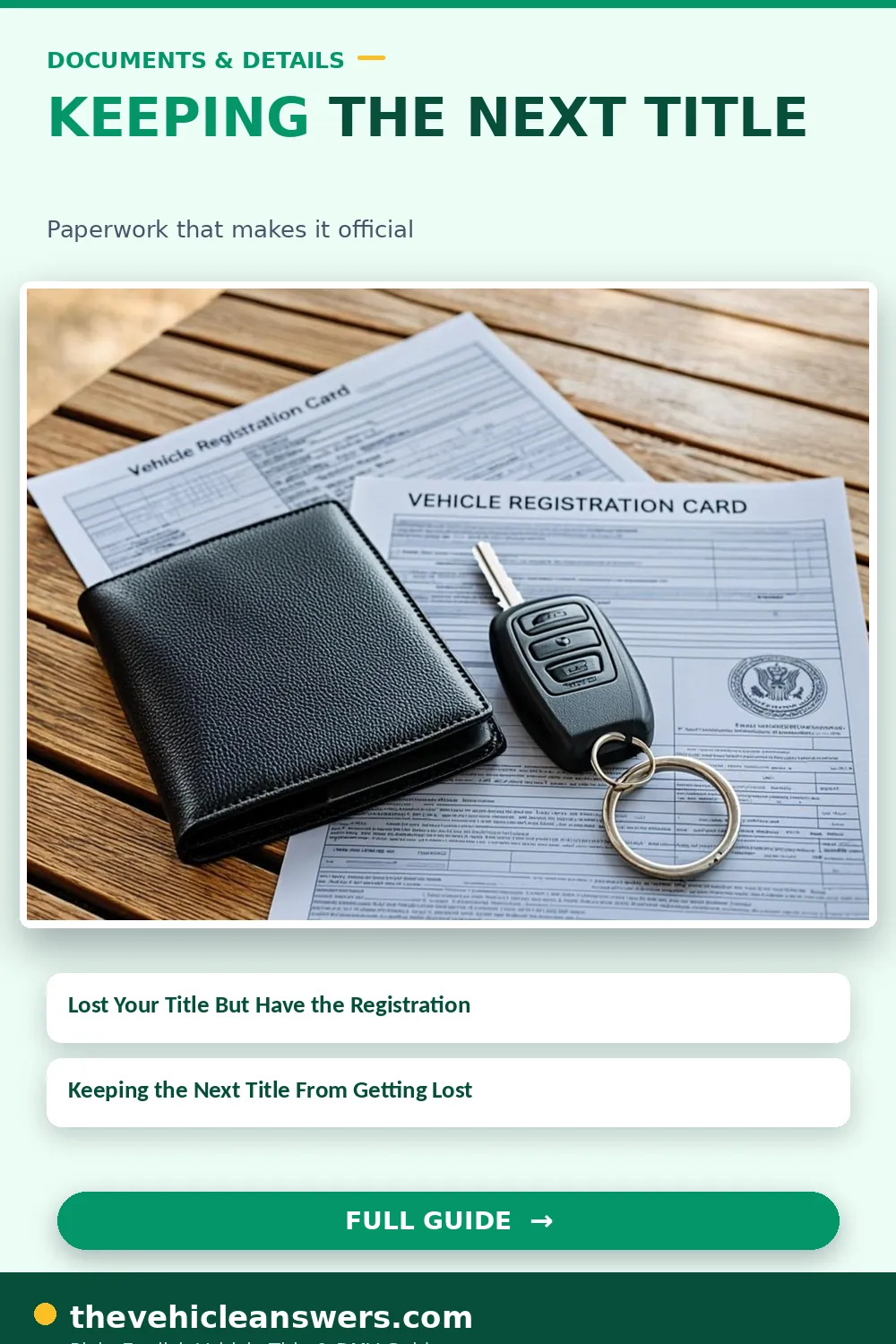
Photograph or scan the new title the week it arrives. Keep the scan with your insurance records.
If it is ever lost again, the duplicate application takes five minutes with the scan in hand. Every field the form asks for is already readable.
One habit costs nothing today and saves a duplicate fee someday. When the replacement arrives, write the vehicle's plate number and the date on the folder where the title lives.
The households that lose titles are rarely disorganized ones. They are households where the document's home moved and nobody updated the map.
A labeled folder survives moves, remodels, and the decade between duplicates. You do not want to repeat that sequence from memory, and the label means you never have to.
Where a Registration Stops Helping
The safe-storage habit pays off again when the vehicle is eventually sold or gifted. Produce the title the same day a buyer appears, and you close on your own schedule, at full price. Our explainer on what a car title is covers why this document anchors every future transaction.
The state pages on the guides hub keep the fees and forms current as rules change. Bookmark yours for the next renewal cycle.
Some owners prefer to see the record before trusting it. The federal site at vehiclehistory.gov shows what states have reported about the vehicle, including its lien history.
It is a paid report, which makes it optional for a simple duplicate case. For anyone who suspects a messier record, it answers the question before the DMV visit does.
One boundary worth restating in plain language: a registration proves the state's belief about ownership. It does not transfer ownership.
Every shortcut in this guide works because the state's record already agrees with your story. The moment those two diverge, the registration's magic stops and the heavier processes take over.
A different name, an unexplained lien, or a vehicle never titled here is exactly that divergence. Owners in the easy case should enjoy it. Owners who discover they were never in the easy case now know where to start.
Buying or selling instead of replacing? The mileage disclosure rules apply at every transfer, even when the title arrives by a replacement route.