
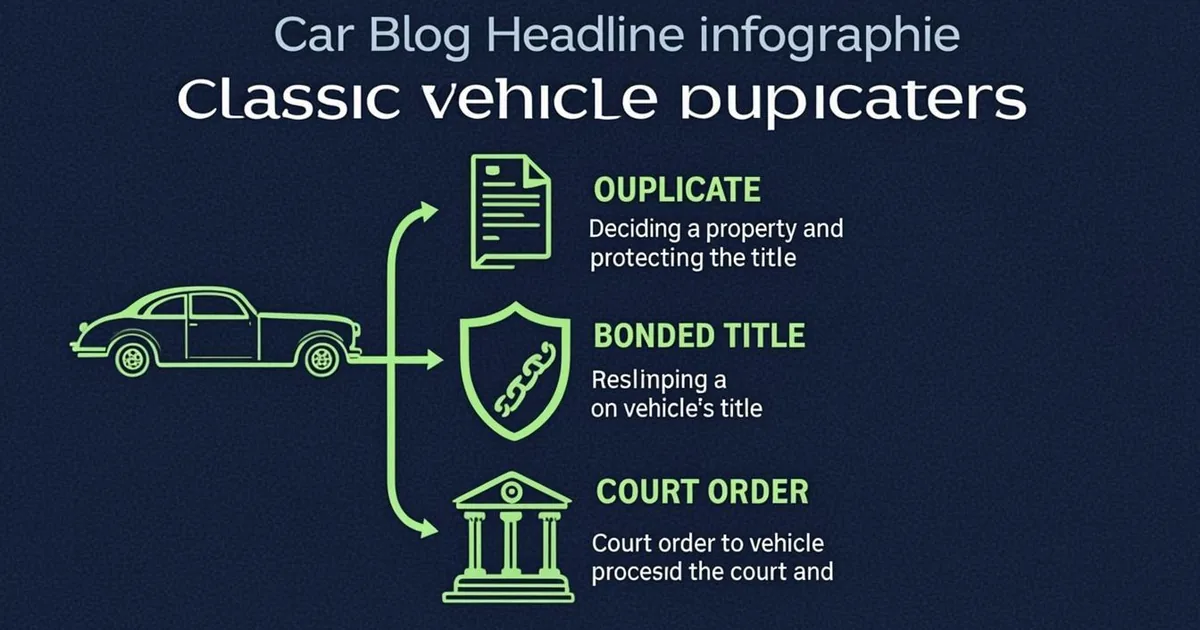
A lost classic car title is a different sport from losing paperwork on a 2015 Camry. Pre-1981 vehicles carry short or missing VINs, titles issued to owners who died decades ago, and registration gaps spanning four states and fifty years. The DMV clerk cannot fix any of that with a standard duplicate form — but three proven paths can.
This guide walks the duplicate route when a record exists, the bonded-title route when it does not, and the court-ordered route when nothing else works. It also covers the evidence file that decides every one of these cases, and the 1981 VIN line that explains why your '65 Mustang's paperwork looks nothing like a modern car's.
Why Pre-1981 Titles Are Harder to Replace
1981 is the magic year. That model year standardized the 17-character Vehicle Identification Number across the industry, which let states and insurers build real databases around individual cars. Before 1981, VINs were shorter, manufacturer-specific, and often stamped inconsistently — so pre-1981 records live in whatever the state happened to keep, if they survive at all.
Ownership history compounds the problem. A 1970 Chevelle may have passed through five owners across three states, sat unregistered in a barn for twenty years, and outlived the owner whose name the last title carried. Some states also exempted very old vehicles from titling entirely in earlier eras, meaning no title record exists anywhere for certain classics — the car was last "documented" by a registration card from 1978.
The good news: states have processed thousands of these cases, and the paths are well worn. The bad news: every path runs on evidence, and evidence is what most classic owners lack. Build the file first; the sections below show how.
Path 1: The Duplicate Title (When a Record Exists)
If the car was titled in your name and the paper vanished, this is the boring route. Every state's duplicate process — the same one in how to replace a lost car title — applies to a 1969 Corvette exactly as it applies to a new truck. The record exists; the state prints a copy.
Complications appear at the edges. A title listing a deceased owner routes through the estate process instead — see lost title for an inherited vehicle for the survivor paperwork. A title listing a name that no longer matches your license (marriage, emigration spelling changes) needs a corrected-title step or a notarized same-person affidavit first. And a title recorded in another state means applying there, in that state's process, before your state will touch the car.
Where the last title was never in your name — you bought the car years ago and the seller's name still leads — the duplicate belongs to that prior owner. Many states let you apply with a signed statement from them; long-lost sellers push you to the bonded path below.
Path 2: The Bonded Title (No Record, No Paper)
The bonded title is the workhorse for no-paper classics. You prove ownership with alternative evidence, post a surety bond protecting the state against competing claims, and receive a title — usually branded "bonded" for a three-to-five-year window before converting to clean.
Texas illustrates the mechanics. The Bonded Title Application (Form VTR-130-SOF) goes in with supporting evidence of ownership — bills of sale, invoices, canceled checks — and an original lien release if any lender ever appeared. The state weighs the evidence, may require a VIN inspection or auto theft law enforcement check, then sets the bond amount, typically 1.5 to 2.5 times the vehicle's value. Surety companies charge premiums that for common classics run $100 to $300 for the bond period.
- Collect the evidence file (the section below lists what counts).
- Get the VIN verified. A physical inspection matches the car to your paperwork; some states route this through state police or inspection lanes.
- Apply for the bonded title with the state's specific form and the evidence attached.
- Buy the surety bond once the state confirms the amount — this is a quick insurance transaction.
- Receive the bonded title and drive legally; the brand clears after the state's window if no competing claim lands.
Path 3: The Court-Ordered Title
Some classics defeat both simpler paths — genuinely missing records, contested ownership, or a state examiner unconvinced by the evidence file. The court-order route asks a judge to declare ownership, and the resulting order compels the DMV to title the car.
This is a lawyer-assisted process in practice, filed in the county where the vehicle sits. The evidence file does double duty as courtroom proof, and a quiet title petition — the common vehicle for this — resolves competing claims on the record at the same time. It costs real money and takes months, which is why it stays the last resort for high-value classics where the price is justified.
Building the Evidence File That Wins These Cases
Every path above runs on the same fuel: documented ownership history. Examiners and judges weigh age and credibility, so older, contemporaneous paper beats recent declarations. Assemble everything before touching any form.
- Any prior title, even one listing a previous owner — it anchors the chain.
- Old registrations from any year the car was on the road.
- Bills of sale, notarized where possible, from every transfer you know about.
- Canceled checks or money order receipts tied to the purchase.
- Insurance cards, declarations pages, or claim files naming the car.
- Repair invoices and parts receipts from shops that worked on the specific vehicle.
- Build sheets, date codes, and judging documentation matching the VIN plate.
- Notarized statements from prior owners or their heirs, with dates and details.
Photograph the VIN plate and any secondary frame stamps as part of the file. Pre-1981 plates can be riveted, stamped, or inline — examiners know the era's conventions, and clean photos that match those conventions speed the verification. Mismatched or re-stamped plates push the case toward the theft-check lane, so document before you apply.
VIN Verification on Old Iron
Bonded and out-of-state paths lean on a physical VIN verification, and old cars fail these for reasons modern cars never see. Routine wear can flatten a stamp. Restorations sometimes replace cowl panels, moving the plate to a new surface. And a minority of barn finds carry plates from parts cars assembled decades ago by previous owners who kept no notes.
The verification officer compares the physical number against your evidence file and state or national databases. Bring the file, bring the car clean enough to read the stamps, and bring any restoration receipts explaining panel work. Where the plate itself is damaged, states handle re-stamping through their inspection units — never re-stamp privately, which converts a paperwork problem into a felony.
Motorcycles follow the same logic with shorter VIN conventions pre-1981, and the dedicated walkthrough at lost motorcycle title replacement covers the two-wheeled variants of this process.
Antique Plates, Insurance, and the Title Connection
Many owners pursue a fresh title specifically to reach antique or classic plate status, which brings restricted-use perks: reduced fees, exempt or relaxed emissions, and in some states Historic-style plates with permanent or long-cycle validity. Plate programs classify by age — typically 25 years or older, with definitions varying by state — and require a valid title as the entry ticket.
Insurance for classics runs through agreed-value policies from specialist carriers, and those binders require the title too. The carrier insures the car you document, matching VIN and model specifics, which makes a clean title the foundation of the coverage rather than a formality.
Restricted-use rules matter after the paperwork lands: most antique plates limit road use to exhibitions, maintenance runs, and club events. Owners planning regular driving should compare the antique program against standard registration before choosing, because the cheap plate with tight limits is wrong for daily drivers.
How Three States Handle the Same Barn Find
The same evidence file produces different outcomes across state lines, which is why multi-state classic buyers plan the titling state early.
| State | No-Title Classic Path | What Sets It Apart |
|---|---|---|
| Texas | Bonded title via VTR-130-SOF | Explicit evidence list; law-enforcement VIN check common |
| Montana | Bonded title through the Motor Vehicle Division | Bond premiums typically $100 to $300 with roughly 3-to-4-week processing |
| California | Bonded title or record-of-ownership inquiry | Strictest review; licensed title services handle many cases for a fee |
The variance is the point: identical paperwork that sails through one state stalls in another. Sellers marketing no-title classics "as-is" transfer the burden knowingly, and buyers price that burden — the difference between a clean duplicate and a bonded path routinely runs into four figures.
What the Paths Cost in Real Money
Classic title recovery has a price ladder, and knowing it before you buy a project protects the budget. These are realistic 2026 figures across the common paths.
| Path | Typical Cost | Timeline |
|---|---|---|
| Simple duplicate (record exists) | $2 to $50 state fee | 1 to 4 weeks |
| Bonded title | $100 to $300 bond premium + state fees + inspection | 3 to 8 weeks |
| VIN verification / inspection | $10 to $50 | Days, once scheduled |
| Court-ordered (quiet title) | $500 to several thousand with counsel | 2 to 12 months |
Buyers should subtract the expected path cost from any no-title purchase price, then subtract more for the wait. A $6,000 no-title project with a bonded path ahead is really a $5,500 project on a two-month clock — sellers who pre-solve the title capture that margin themselves, which is why the smartest move before listing a classic is starting at lost title before transfer.
The bonded premium also scales with declared value, so honest valuations matter. Undervaluing the car to shrink the bond is both a false statement on a state form and a coverage problem if a claim ever lands mid-bond-period. Appraisals from classic-car professionals satisfy both the state and the surety.
Classic Title Mistakes That Cost Years
Collector forums record the same disasters repeatedly. Avoid this list and the worst case is weeks, not years.
- Buying a no-title project "because the frame is worth it" without pricing the bonded path first.
- Paying cash with no receipt — the single most damaging move in this niche.
- Re-stamping or replacing VIN plates without state involvement.
- Letting a seller "keep the title" while selling the car, leaving a severed chain.
- Starting in the wrong path — filing duplicates against records that do not exist.
- Ignoring a deceased owner on the record instead of running the estate lane first.
The repair order is always: evidence file, then verification, then the right path in the right state. Jumping straight to a form is how classic-title sagas begin. And for modern-vehicle owners reading ahead, the standard-playbook version of all this starts at what is a car title — the classics just make every step harder.