

Most used-car sales go wrong in the fifteen minutes around the handshake, not in the weeks after. A title signed in the wrong pen color creates a rejection letter. A blank odometer field invites the same trouble.
A buyer who never files leaves parking tickets and toll violations routed to the seller. Tax bills follow from guessed values. The transfer process is not complicated; it is just unforgiving of gaps.
This guide splits the sale into the two roles that share it. Sellers get the prep sequence, the signing rules, and the liability exit. Buyers get the verification checklist, the filing deadlines, and the payment-safety rules that keep strangers from becoming adversaries.
State fees and deadlines vary, but the core sequence below holds everywhere. The state-by-state guides hub covers each state's exact numbers.
Table of Contents
- Seller Prep Before the Buyer Shows Up
- Signing the Title Correctly
- The Buyer's Checklist After the Handshake
- The Seller's Liability Exit
- Payment Safety for Both Sides
- What Each Side Owes, and When
- Five Errors That Create DMV Disasters
- When the Sale Isn't a Simple Private Sale
Seller Prep Before the Buyer Ever Shows Up
The seller's half of the deal is decided before an ad goes live. Start with the title itself: confirm it exists, is in your name, and has no liens recorded.
New to the document? Our guide on what a car title is explains each field in plain language.
A title still showing a lender's name blocks everything. Release the lien and clear the record first; our guide on titles with an active loan covers that path.
If the title is lost, order the duplicate now, not when a buyer is standing in your driveway. The standard replacement process takes days to weeks depending on the state.
Next, assemble the sale file. Gather a bill of sale, the current registration, service records, and any warranty paperwork. Your DMV's template works; a two-paragraph written version works too.
Pull the lien status from your state's online portal if it offers one, and screenshot it. Some states issue paper titles where the lien was satisfied but never re-issued, and buyers' banks will flag it.
Ten minutes of prep prevents the most common sale-collapse scenario. That is a deal dying at the buyer's DMV appointment two weeks later.
Signing the Title Correctly: Where Deals Get Made or Broken
The title assignment is a legal instrument, and states reject sloppy ones with impressive consistency. Use the owner's legal name exactly as printed. Fill every required field before signing, in black or blue ink.
No white-out, and no strays. A wrong-name scratch-out usually means a trip for a duplicate title, sometimes with a notarized statement explaining the error.

- Buyer's full legal name as on their ID; "and spouse" shorthand only where the state allows it
- Sale price, written numerically—this feeds the buyer's sales tax and your own liability record
- Odometer reading, no tenths, plus the federal disclosure on vehicles within the disclosure window
- Date of sale on both the title and the bill of sale, matching each other
- Both signatures in the designated boxes only—a signature on the wrong line can void the assignment
Notarization is the state wildcard. Some states require a notarized seller signature for the transfer to be valid; others never ask. Check your state's rule before meeting the buyer.
A missing notarization discovered later means tracking the seller down again. Sellers become unfindable with remarkable speed once money changes hands. Verify the requirement first and save yourself the chase.
Federal odometer law deserves its own paragraph. Vehicles from model year 2011 onward are exempt from written disclosure for their first 20 years. Older vehicles, and all 2010-and-before models, need the disclosure, and every state's title has the box for it.
Fill it when required, even if the exemption seems confusing. An odometer gap is a rejection reason on its own, and fixing one means another DMV trip.
The Buyer's Checklist After the Handshake
Buyers own the process from the moment they drive away. The title in your hand is not ownership yet. It is the input to your ownership, and the clock is running.
Every state sets a filing deadline, most commonly between 10 and 30 days from the sale date. Late filings carry penalties that climb monthly in some states.
- Verify before you pay. Match the VIN on the title to the dash plate and door jamb. Compare the seller's ID to the name on the title. If a lender's name appears, settle the lien release plan before money moves.
- Bind insurance immediately. Most states require coverage before registration. Driving an uninsured car home is the risk that never pays off.
- File the title application inside the deadline. Bring the signed title, bill of sale, ID, proof of insurance, and the fee plus sales tax. Filing fast stops the seller's unpaid tickets from becoming your problem.
- Register and plate. Often the same visit. Keep the receipt—it is your legal driving evidence until plates arrive.
- Watch for the new title by mail. Follow up if it has not arrived within the state's normal window. A misfiled application caught early is a five-minute fix.
Here is the tax note buyers always ask about. Sales tax is charged by your state on the purchase price. Several states tax book value when the declared price looks low.
Family-gift exemptions exist but almost never apply to arm's-length sales. Budget for the tax rather than discovering it at the counter; the family transfer rules explain the narrow exceptions.
The Seller's Exit: Liability Does Not Transfer Until Paperwork Does
Here is the seller's uncomfortable truth: until the buyer files the title, the state still thinks the car is yours. Toll violations, parking citations, and even crimes committed with the vehicle route to the last registered owner. The protection is the paper trail you create at handoff plus the notification you file after.
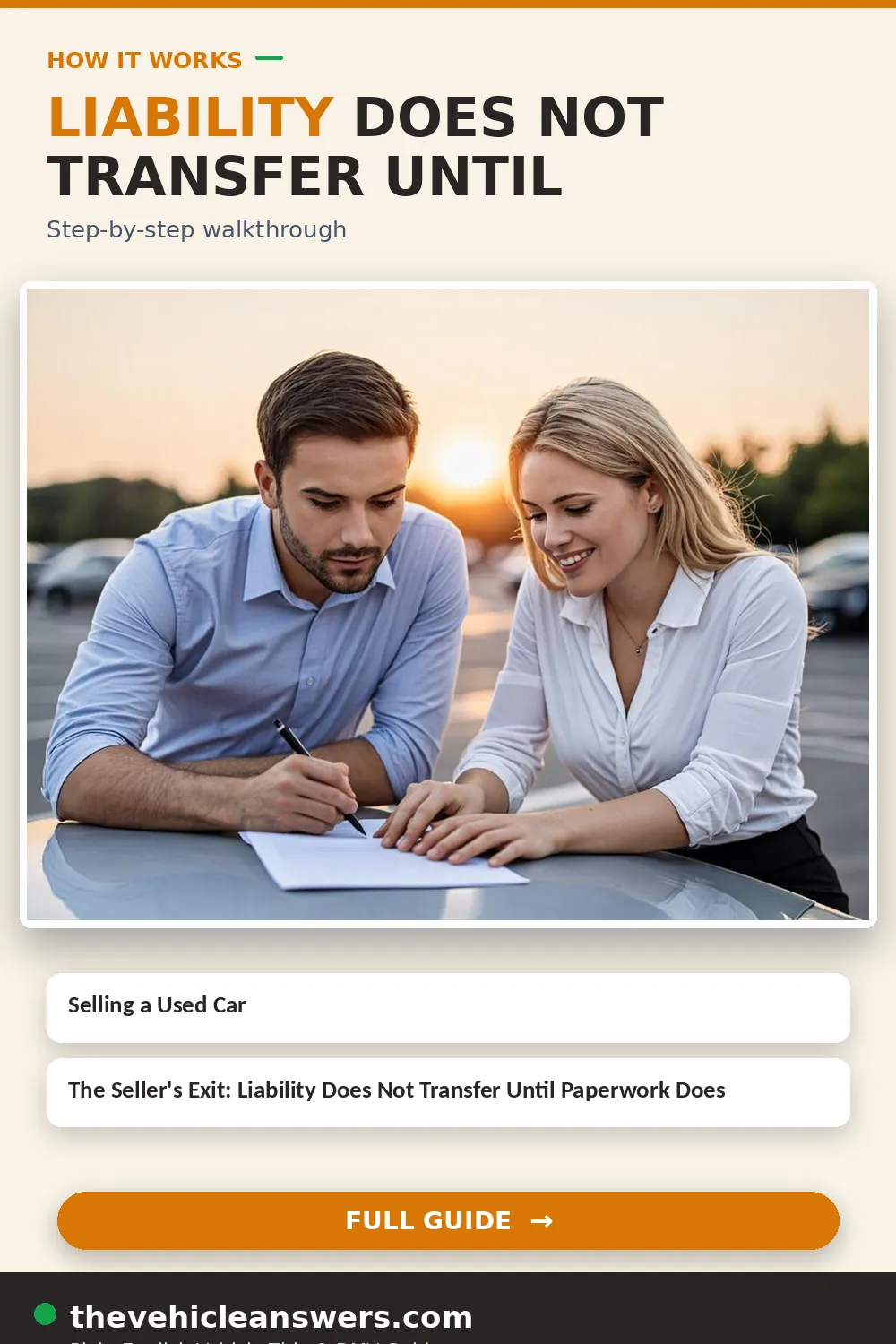
Two documents do the work. First, the bill of sale: signed by both parties, dated, with the VIN and price. It is your evidence of when liability ended.
Second comes the notice of sale or release of liability, which most states offer. California's version is famous, but the concept exists broadly. Filing it tells the state the vehicle changed hands.
Submit it the day of the sale or the day after; it takes minutes online in most states. Then handle the plates. States split on whether they stay with the seller or transfer with the car.
Plates stay with the seller in most states. Transferring them to your next vehicle, or returning them, can matter for refunds and liability. Photograph the odometer and the signed title before the buyer drives off.
I have watched a single dashboard photo end a five-month toll-violation dispute. The seller was a neighbor who moved her Civic along in 2024.
Payment Safety for Both Sides
Stranger-to-stranger sales carry a payment risk that cuts both ways. Cash is still king for amounts under a few thousand dollars.
Count cash twice, ideally at a bank counter. Some sellers write the buyer's name and the amount on the bill of sale as a receipt.
For larger amounts, a cashier's check drawn at a local branch works. The professional move is completing the whole transaction at the buyer's bank.
The buyer gets the check in person, and the seller watches it print. Both walk out with zero counterfeiting risk.
Personal checks and payment apps are where sales go sideways. A personal check can bounce after the title is signed; payment apps can be reversed through disputes weeks later.
Wire transfers are legitimate, but verify the account in person. The pattern to refuse is any payment method where the money might un-happen after the title has transferred.
Buyers face the mirror risk: paying before verifying. Never hand over funds before matching the VIN and checking the seller's ID against the title. Confirm the lien status too if any lender appears.
A title search through the state's portal or a vehicle history report is cheap insurance. It protects you from buying a car with a branded or encumbered past.
The odometer disclosure deserves one more pass, because it is the field both sides most often fumble. The federal window excludes model year 2011 and newer vehicles for their first twenty years. The exclusion covers the written disclosure only.
Misstating mileage knowingly is fraud in every case. The disclosure box on the title exists for every vehicle that needs it.
When in doubt, fill it in.
A completed disclosure has never caused a problem; a skipped one has caused thousands.
The federal rules behind the box are maintained at nhtsa.gov. State variations ride on top of them.
What Each Side Owes, and When
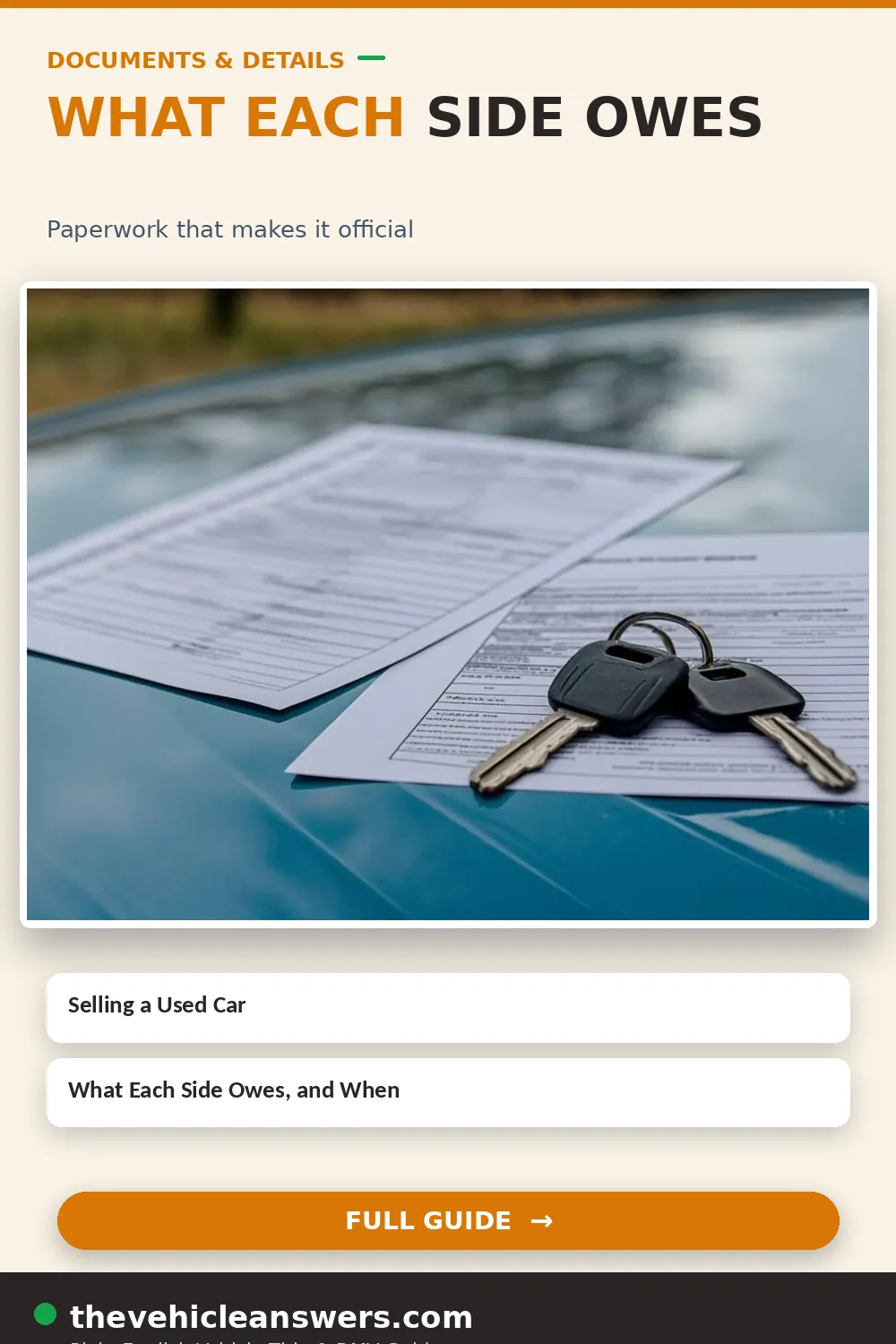
| When | Seller owes | Buyer owes |
|---|---|---|
| Before meeting | Clear title in hand, lien released, sale file assembled | Insurance quote ready, payment arranged, VIN research done |
| At handoff | Sign title fully, bill of sale, keep copies, collect safe payment | Verify VIN and ID, sign bill of sale, take delivery of title |
| Within days | File notice of sale / release of liability; handle plates | Bind insurance, file title + registration before deadline |
| Within weeks | Confirm record no longer shows the vehicle; keep file 3+ years | New title arrives by mail; store it somewhere findable |
That last seller row matters more than people think. Check the state portal a month after the sale to confirm the record moved.
Some states let the seller force the record if the buyer never filed. You submit the buyer's information with proof of sale. Doing that before the next ticket arrives is the difference between a footnote and a nightmare.
The Five Errors That Turn Clean Sales Into DMV Disasters
First, blank fields on the title. Every empty line is a future dispute, and missing odometer entries trigger rejections.
Second, the "we'll file it later" buyer. Their penalty clocks and the seller's liability both keep running.
Third, the informal handshake between relatives that skips the bill of sale. Family or not, the tax office and the toll authority do not know that.
Fourth, selling with an unresolved lien. The buyer's money is spent, the title cannot transfer, and the law's answer is "you should have checked."
Fifth, the seller who cancels insurance early. That converts a paperwork delay into personal liability exposure.
Every one of those has a boring, cheap prevention, and all of them are listed above. None costs more than a phone call or a photocopy.
When the Sale Isn't a Simple Private Sale
The steps above assume a clean title in a private owner's hands. A vehicle inside a divorce settlement, a probate estate, or a lender's lien is different. The transfer inherits an extra layer of authority paperwork.
That layer is a decree, executor's letters, or a lien release. It must precede the signing.
The sequencing rule stays constant across all three: establish the authority to sign before signing. A signature without authority produces exactly the rejection-and-repair spiral this guide exists to prevent.
The state-specific fees and deadlines for the filing that follows are on the state guides hub. California's notice-of-transfer process at dmv.ca.gov is the best-known example of the seller's liability exit in action.
If your sale is crossing state lines, read the destination state's page before signing anything. The buyer registers in their state under its deadlines and tax rules. Both sides should know those numbers before the handshake.
The paperwork of a used-car sale is about ninety minutes of total effort spread across two people. That is trivially small against the cost of undoing a bad transfer, which is measured in months.
One federal paper trips more used-car deals than any fee: the odometer disclosure statement. Our guide walks the three certifications and the 20-year exemption rule line by line.