
The cheapest version of your next truck lives three states away. The listing says "will ship or meet halfway". Out-of-state private purchases work — the price gaps are real, the selection is wider, and the logistics are solved problems.
What the listing doesn't tell you is that the paperwork crosses two DMV bureaucracies. The friction concentrates in one place. The receiving state wants its own title, built on documents the selling state's DMV produced under its own rules.
This guide covers the full sequence. It starts with verifying the deal remotely and the paperwork that crosses state lines with the car. Then comes the legal drive home, plus titling and registration in your state.
Two steps surprise buyers more than the rest. The sales tax credit rule saves used-vehicle buyers real money. And the VIN verification step ambushes anything with a salvage or out-of-state past.
Table of Contents
- Before Money Moves: Verification Across the Miles
- The Paperwork That Crosses State Lines
- Driving It Home: The Legal Window
- The VIN Verification Surprise
- The Sales Tax Credit for Out-of-State Buys
- Titling and Registering in Your State
- Buying From an Out-of-State Dealer
- Temp Plates and Insurance for the Drive Home
- The Whole Playbook in Five Verbs
Before Money Moves: Verification Across the Miles
Distance removes your ability to eyeball documents, so the remote checks carry more weight. Get photographs of the actual title — front and back, readable — plus the seller's ID matching the name. Also ask for the dash VIN plate and the odometer.
Ask for a live video walk of the car with the VIN plate in frame. A three-minute video call catches more than twenty emails.
Run the VIN through the federal recall database at nhtsa.gov. Pull a history report too, exactly as you would on any purchase. Distance changes nothing about brands, liens, or rollback flags.
The lien question deserves a direct answer in writing. A car with an active loan can absolutely be bought across state lines. The payoff mechanics just need a plan before money moves.
The safe version settles the lender's balance and the seller's remainder at the same banking session. Our guide on buying with a lien in play covers the structures.
If the seller cannot produce a readable title image, treat the deal as untitled and price in the extra weeks. The bill-of-sale-only purchase is a different, slower transaction.
The Paperwork That Crosses State Lines
Four documents make the interstate transfer work. First is the signed title from the selling state, completed per that state's rules.
Check its notarization requirement before signing day. A missing notary seal from a notary state poisons the packet for weeks.
Second, a dated bill of sale with the VIN, price, and both parties. Your state's tax office and the seller's records both lean on it.
Third, the odometer disclosure where the federal window applies — the title usually carries it. Fourth, the seller's registration copy, which corroborates the ownership chain when your DMV cross-checks.
The selling state's release-of-liability or notice-of-sale, where one exists, belongs to the seller. Confirm they filed it, though. Until they do, tolls and tickets from your drive home route to them.
That's the kind of dispute that sours even clean deals. Ask for the confirmation screenshot at handoff — it takes them two minutes and saves both of you a month.
Driving It Home: The Legal Window
The drive from the seller's driveway to your state is the leg buyers sweat. The rules are more forgiving than folklore suggests.
Most states recognize the signed title plus a bill of sale as sufficient proof of ownership for transport. A personal-auto policy from your own insurer typically covers the drive. Confirm coverage before pickup, not after.
Some sellers' insurance extends briefly. Yours is the one that definitely does.
Temporary permits exist for exactly this trip in several states. The selling state may issue a transit permit. Or your own state may offer a trip permit for vehicles being brought in.
Neither permit is universally required. What matters everywhere is the paperwork in your glovebox.
Signed title, bill of sale, insurance card — those answer the "whose car is this" question at a traffic stop. A lead-foot buyer with paper in order gets a conversation. A paper-less buyer gets a tow.
| Leg | Documents that must be present | Nice to have |
|---|---|---|
| Pickup and the drive home | Signed title, bill of sale, your insurance card, seller's registration copy | Transit/trip permit where offered |
| Arrival in your state | Everything above, plus your VIN verification if the state requires one | Printed appointment confirmation for the DMV |
| Titling and registration | Full packet: title, bill of sale, ID, insurance proof, fees and tax | Vehicle history report for any brand questions |
The VIN Verification Surprise
Here is the step that ambushes out-of-state buyers. Many states require an official VIN verification on vehicles entering from elsewhere.
The trigger is usually any salvage or rebuilt history, missing plates, or paperwork irregularities. The verification itself is a physical inspection. An officer, DMV inspector, or certified agent confirms the VIN matches the documents and signs a state form.
Costs range from free to roughly $50. It depends on who performs the inspection.

Check whether your state requires it before the purchase, not at the counter. The requirement shapes the timeline. A verification appointment in a busy state can add a week.
Western states run this process routinely for incoming vehicles. Several use certified third-party verifiers who come to the vehicle.
Bring every document to the inspection, clean the dash plate enough to read, and the visit takes fifteen minutes. The states that require verification are flagged on our state guides hub, so you can confirm in one page-load.
The Sales Tax Credit for Out-of-State Buys
The tax question arrives with a pleasant surprise in most states. When you title a vehicle bought out of state, you owe your state's sales or use tax on the purchase. But any sales tax you legally paid in the selling state is credited against it.
Buy a truck in a low-tax state and register in a high-tax one, and you pay the difference. Buy where you paid more than your home state charges, and many states credit up to their own rate. That effectively zeroes the bill.
Two footnotes matter. The credit applies to tax legally paid — a receipt or the tax line on the seller-state's paperwork proves it.
That's one more reason the bill of sale and any tax documentation travel in the packet. The credit doesn't exist everywhere — a handful of states charge their full rate regardless.
Your state comptroller or DMV page states the rule plainly. The fifteen minutes of checking before purchase has saved buyers four-figure amounts.
Titling and Registering in Your State
With the car home and verified, the filing is your state's standard new-to-you vehicle process with interstate add-ons.
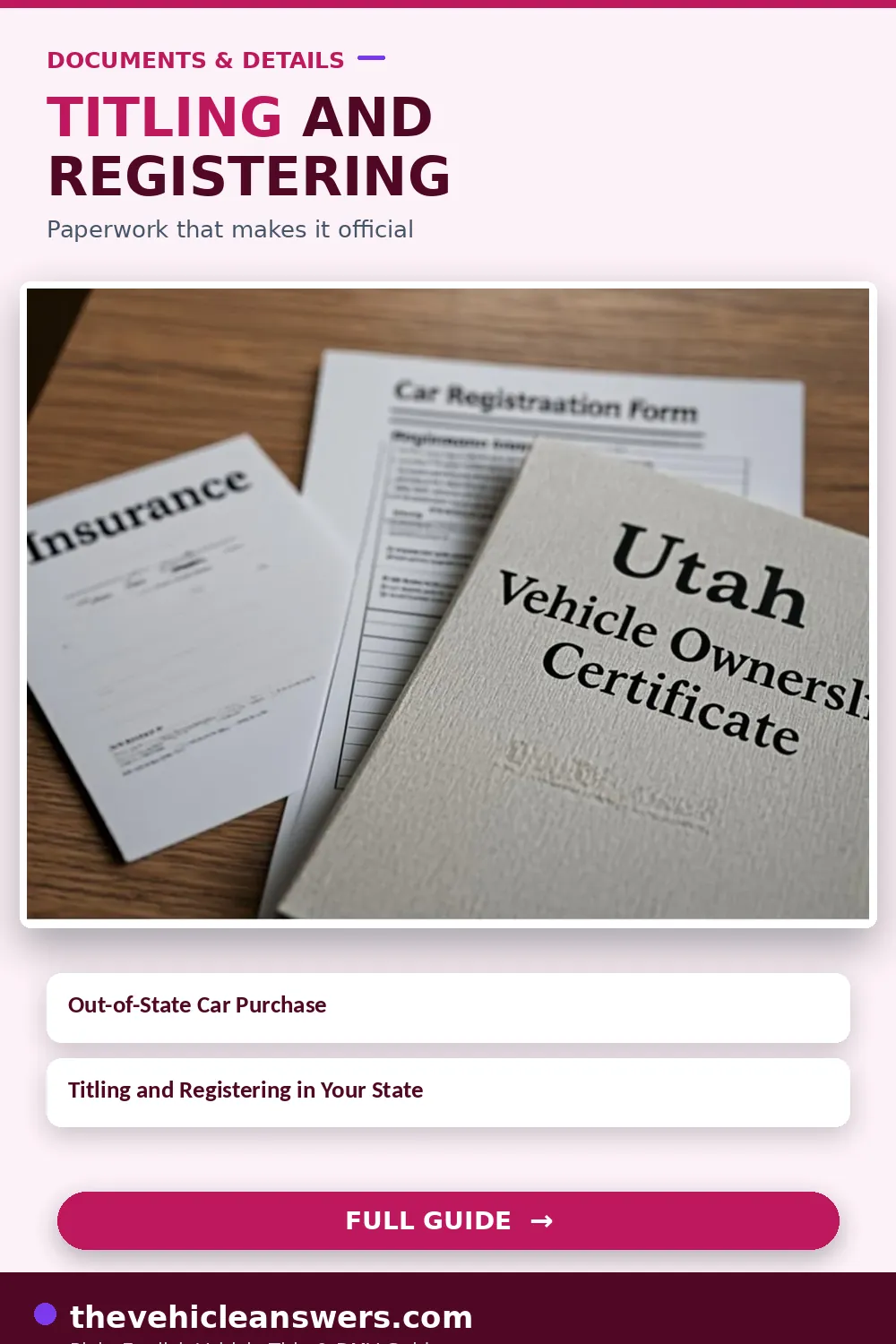
The packet holds the out-of-state title (surrendered — your state issues its own), the bill of sale, and odometer records. Add the VIN verification where required, your ID, and insurance proof. Then payment for the title fee plus the net tax after any credit.
Filing windows run 10 to 30 days from bringing the vehicle in, in most states. The deadline usually counts from the purchase or arrival date.
Check yours, because interstate filings drift past windows more often than local ones. A missed window means late fees or a fresh application.
Processing runs a few weeks, and your state's new title arrives by mail as the vehicle's new anchor document.
If your state's record shows a surprise from the selling state, resolve it at the counter. A brand that didn't appear in the listing or an old lien still on record qualifies. Handle it while the seller is still reachable by phone — not months later when they're a memory.
Our title application guide covers the filing structure. If the selling state's title is lost or defective mid-deal, the duplicate process runs on the seller's side first.
The full state-by-state fees and windows live on the guides hub — check both states before you commit. Our title explainer covers why the document matters enough to plan around.
Buying From an Out-of-State Dealer
Interstate dealer sales add a layer private sales lack. The dealer handles its own state's paperwork.
But the delivery to your state still hands you the title process. The dealer's documents also occasionally assume their state's rules.
Out-of-state dealer purchases arrive with the title assignment already executed. Verify it anyway: VIN against the dash plate, name against your ID, lien status against the record.
Dealers make clerical errors at the same rate DMVs do. The difference is the fix: a dealer's error found at your counter becomes a phone call to their title department. That call is usually efficient, occasionally glacial.
The remote-verification discipline applies to dealers exactly as it applies to strangers on classified sites. The discount is that dealers have a compliance department to complain to.
Temp Plates and Insurance for the Drive Home
Every interstate buyer eventually faces the temp-plate question. Several states issue temporary registration on the spot at titling — a paper plate valid for the filing window. Others expect the buyer to transport on the seller's paperwork and register on arrival.
The answer shapes the drive-home logistics. It lives on your state's DMV page or one counter call.
What never changes is the insurance. The drive home is insured by your policy or not at all. The binder conversation happens before the pickup, in every state, for every buyer.
Buyers who arrange both — the temp plate answer and the insurance binder — drive home legally anywhere. The ones who skip the calls improvise at the pickup.
The Whole Playbook in Five Verbs
This guide fits in one sentence: verify remotely, document completely, drive legally, file promptly, tax honestly. Each verb has a section above. Each section exists because a buyer somewhere skipped it and paid for the skip.
The interstate purchase trades paperwork complexity for price and selection. The trade is genuinely favorable. The buyer who treats the paperwork as part of the purchase finishes with a clean title and a legal registration.
The state pages on the guides hub keep the numbers current. The habits above keep the process boring — and boring, in vehicle paperwork, is the win condition.
Some states notarize assignments and some do not. Check the state notarization rules before the seller signs anything.