

Buying from a private seller gets the price dealers cannot offer. It also gets none of the paperwork help dealers provide. There is no finance office checking the title.
No backlog room fixes a signature. Everything that makes the car legally yours is your job now: verification, payment safety, the filing. The checklist below is how buyers avoid becoming the cautionary story in their friend group.
The structure is chronological. Before you see the car: the remote checks that kill bad deals cheaply. At the meeting: the verification sequence and the signing rules.
After money changes hands: the filing deadlines and the follow-ups that make the purchase official. Print the checklist or keep it on your phone. Every item exists because somebody skipped it once and paid for that skip.
Table of Contents
- Before You Drive Out: The Remote Verification
- At the Meeting: The Verification Sequence
- The Signing: Fields That Cannot Be Blank
- What History Reports Catch — and Miss
- Beyond the Paper: Service History and Recalls
- Payment Safety: How Buyers and Sellers Stop Ripping Each Other Off
- After the Handshake: Filing Before the Deadline
- The Seller's Side and the Inspection
- The Folder Habit: File Everything in Week One
Before You Drive Out: The Remote Verification
Half of all bad private purchases can be detected from your couch. That is before you spend an afternoon or a tank of fuel.
Ask the seller for the VIN up front. Run the federal recall check on the manufacturer's or NHTSA's site. Open safety recalls are free to fix at dealers, and knowing them changes your negotiating position.
Pull the vehicle history report too. The point is not the accident history alone. It is the title brand — salvage, flood, rebuilt, odometer rollback flags — and the ownership chain length.
Ask the seller three questions directly, and listen carefully to the answers.
Is the title in your name, physically in hand? Any lien or loan on the vehicle? Why is it being sold?
Evasive answers to the first two are deal-killers in disguise. A seller without the title in hand may be legitimate — banks hold titles in some states. But that seller needs the release verified before money moves.
An unexplained lien becomes your problem the day after purchase — not the seller's.
At the Meeting: The Verification Sequence
The in-person check runs in a fixed order, and the order matters. Each step is cheap to walk away from and expensive to undo. Run it before any money appears:

- Match the VIN three ways. Dashboard plate, door jamb sticker, and the title document — digit by digit, out loud. A mismatch here is the walk-away signal; explanations come cheap to sellers and expensive to buyers.
- Compare the seller to the title. The name on the title should match the seller's government ID. "It's my uncle's car" or "I'm selling it for a friend" changes the picture. The real owner must be present or must have executed a notarized authorization. Otherwise you are buying from someone who does not legally own it. Our family title transfers guide covers that paperwork.
- Check the lien status. Look at the title face for a lender's name or lien section. Many state DMV portals offer a free title lookup by plate or VIN. Run it on your phone at the curb. A recorded lien needs a release plan before payment, full stop.
- Read the title's condition. No erasures, no white-out, no scratched-out names, no missing corners. A damaged or altered title may be reissuable, but the reissue belongs to the seller's timeline, not yours.
- Check for the brand. Salvage, rebuilt, flood, or odometer brands printed on the title belong to the car forever and reprice it instantly. A car that looks too clean for its brand is telling you something. So is a price too cheap for its lack of one. The brand is the answer.
- Test drive on insurance that covers you. Confirm your existing policy extends, or bind coverage, before the keys move. A crash on the seller's policy during a test drive is a coverage dispute nobody wins quickly.
The Signing: Fields That Cannot Be Blank
The title assignment is where private sales legally happen. Incomplete assignments are the single biggest reason buyers' filings bounce. Before handing over payment, watch every one of these fields get filled, in ink, with no blanks:
- Buyer name exactly as on your ID — this becomes the name on your title
- Sale price, numeric — your sales tax bills from this line
- Odometer reading, no tenths, with the federal disclosure where required. Model year 2011 and newer are exempt for their first 20 years
- Date of sale, matching the bill of sale
- Seller signature(s) in the designated box. All owners listed on the title must sign — not just whoever drove you around the block
- Notarization, if your state requires it. Check before the meeting: a missing notary seal can void the transfer entirely in notary states
Take a dated bill of sale even where the state does not require one. One page: the VIN, price, both names, both signatures, and the sale date. It is your receipt, your tax evidence, and the document that anchors any later dispute.
Our guide on bills of sale as ownership evidence covers what makes one robust.
What History Reports Catch — and Miss
The history-report question deserves a nuanced paragraph, because buyers routinely over- or under-use them. The commercial reports excel at the paper side. That means brands, odometer flags, title history across states, and the ownership chain length.
What they miss is the unreported damage. Think of the private repair, the insurance claim settled below the total-loss threshold, or maintenance a previous owner deferred.
The reports and the mechanic's inspection cover complementary halves. The professional move is running both on any purchase above trivial money.
The federal consumer entry point for the title-system records is vehiclehistory.gov. The commercial reports add their own databases on top. Neither replaces putting the car on a lift.
Beyond the Paper: Service History and Recalls
One more verification costs nothing and catches more than it should: the service-history conversation. Ask the seller what was repaired, when, and where — then call the shop. Sellers with real maintenance records volunteer them; sellers inventing a history dodge the specifics.
This is not detective work. It is the same documentation-density logic that runs through this guide. The difference: it is applied to the seller's mouth instead of the seller's paper.
Ten minutes of phone calls shift the verification picture from documents to dates. The two together are what a confident purchase actually rests on.
The safety recall check belongs in the same pre-payment tier. The federal database at nhtsa.gov lists open recalls by VIN at no cost.
A recall fixed free at a dealer before closing becomes your repair bill after. That difference is a negotiation you can only have before the money moves.
Buyers who run the VIN check before the meeting arrive knowing the car's open items. Buyers who discover them after closing inherit someone else's errand.
Payment Safety: How Buyers and Sellers Stop Ripping Each Other Off
The payment question has a boring, nearly perfect answer: complete the transaction at a bank. The buyer gets a cashier's check or counts cash at the counter. The seller watches the check print or the money count.
Both parties walk out with zero counterfeiting risk and a witness. For anything over a couple thousand dollars, this single decision removes the entire category of payment disputes.
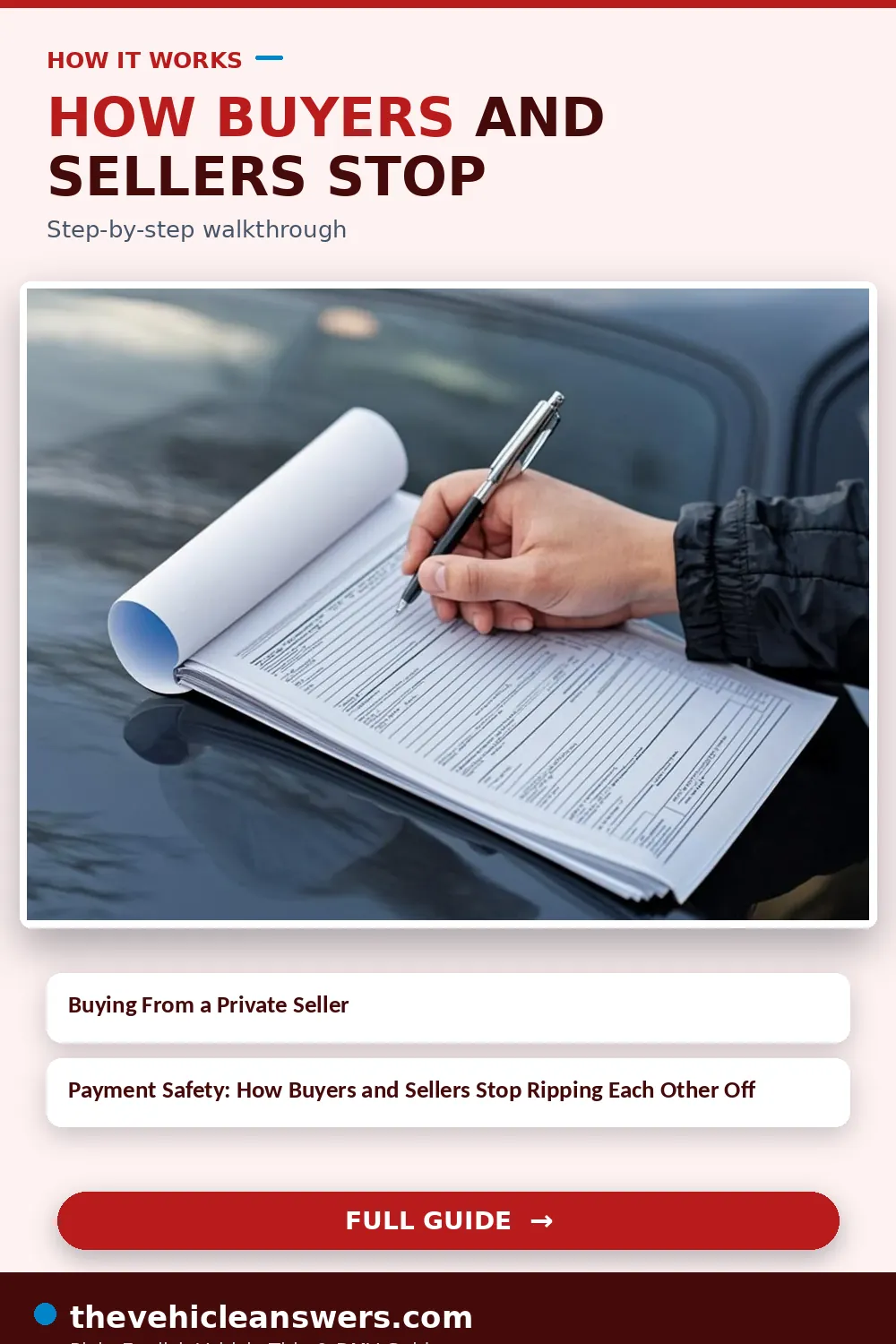
What buyers should refuse from the other side is rarer but real. Watch for a seller demanding payment apps for a car sale. App payments are reversible through disputes, sometimes weeks later.
Personal checks from strangers carry bounce risk. And pressure to pay before the verification sequence completes is itself the red flag.
The one-way rule protects you as the buyer. No money moves until four things are true. The VIN matches, the ID matches, the lien question has an answer, and the title is signed.
Sellers with clean paper never object to that order. The objection itself is information.
After the Handshake: Filing Before the Deadline
The car is yours in fact but not yet in law. Every state sets a filing window for the new title and registration.
Most windows run 10 to 30 days from the sale date. Late filings carry penalties that climb in several states. The filing sequence, in the order states actually want it:
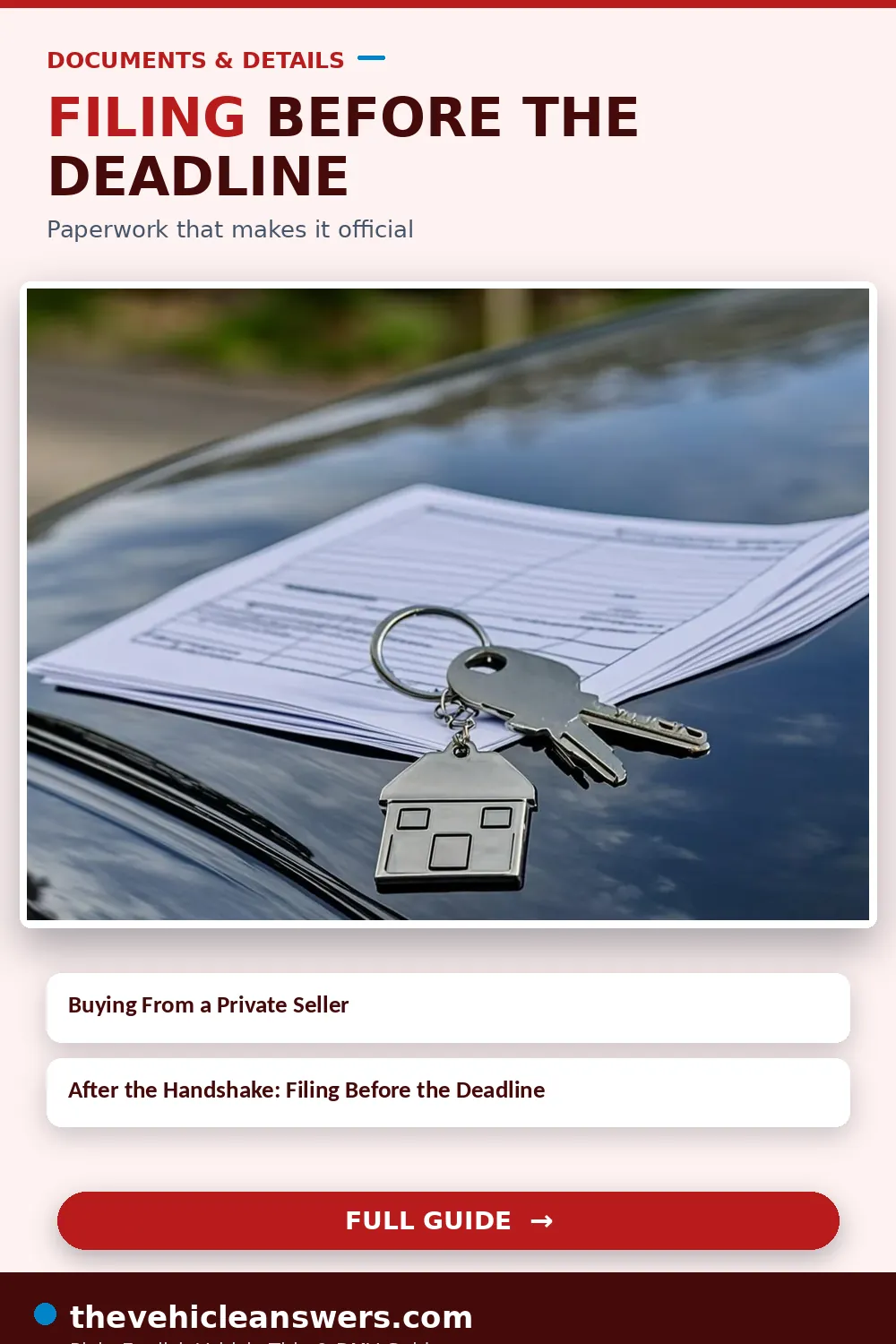
- Bind insurance first. Most states require proof of coverage before registration, and the drive-home should already be insured.
- File the title application. Signed title, bill of sale, ID, insurance proof, fees, and sales tax. Many states file online now; the rest want a counter visit.
- Register and plate. Often the same transaction. Keep the receipt — it is your temporary proof of legal operation.
- Watch for the title by mail within the state's normal window, and follow up if it is late. A misfiled application found in week three is a five-minute fix; found in year three, it is a problem.
Deadline windows vary state to state, and so do the fees. The state guides hub lists each state's window, costs, and forms. Our application guide covers the filing itself.
Discover the title is missing before the filing? Our guide to a lost title before transfer walks the replacement path.
The first week of ownership is also the moment to photograph and archive your copy of everything. The paperwork you store on day one is the paperwork that answers questions in year five.
The Seller's Side and the Inspection
The seller carries mirror-image obligations: release of liability, plates, insurance timing. Our step-by-step transfer guide covers their side of the same handshake. The title explainer explains why every one of these fields earns its place on the document.
A closing word on the biggest fear in private purchases: the car turns out to be something other than advertised. The checklist above prevents most versions of it.
The brand check catches washed salvage histories. The VIN check catches identity games. The lien check catches borrowed-money surprises.
What no checklist catches is mechanical reality behind a clean paper trail. That is why the pre-purchase inspection by your own mechanic remains the single best dollar-per-protection purchase in the used-car world.
Paper and metal are different risk systems. The checklist above governs the paper; the hundred-and-fifty-dollar inspection governs the metal. Buyers who run both buy with their eyes open — and buyers with open eyes almost never become cautionary tales.
The Folder Habit: File Everything in Week One
The last habit worth adopting happens the week after the purchase, not the day of: file everything. One folder, physical or scanned, labeled with the vehicle.
Into the folder goes the signed title copy and the bill of sale. Add the insurance binder, the inspection report, and the recall check printout.
Owners who file at purchase answer every future question from the folder. Owners who file someday answer future questions from memory, and memory loses to paperwork in every dispute ever recorded.
The folder costs nothing today and becomes the vehicle's biography. That trail makes the next sale, the insurance claim, or the interstate move a formality instead of a project.
Before you sign the assignment, read the federal odometer disclosure rules so the mileage block passes the clerk on the first try.