
Repossession scrambles the normal title order. The lender takes the vehicle, and the paper title you never held stays with the lien record. Eventually the car sells at auction, often with none of the original documents in sight.
Whichever side of that auction you're on, the title problem has a defined legal fix. You might be the owner who redeemed the vehicle, or the auction buyer waiting on paperwork. You might even be the original owner whose name still haunts the record.
The rules come from state repo statutes and the DMV's repossessed-title processes. Every fix below follows one of those two sources.
Table of Contents
- Three Sides, Three Different Title Paths
- You Bought a Repo at Auction: Getting Your Title
- You Bought Back Your Car: Reclaiming the Paper
- The Original Owner After the Sale
- Deficiency Balances and the Title Boundary
- Buying From Online Repo Platforms
- Realistic Timelines and Who Owns Each Step
- The Document Checklist That Rescues Any Repo Title
- After the Certificate Arrives
- Sale Reversals, Buyback Rights, and Paperwork Errors
- The File You Build in Week One
Three Sides, Three Different Title Paths
When a lender repossesses, its lien interest lets it take and sell the vehicle. Ownership on paper still shows the borrower until a transfer happens. The sale creates a chain: lender sells, buyer needs title, borrower's name must exit.
Each state's DMV runs a repossessed-title lane for exactly this. It usually requires the lender's affidavit of repossession, the sale documents, and the fee.
For the original owner, the title question usually ends at the sale — but not always. If you redeem the vehicle before the sale, you pay the full balance plus repo fees. The loan ends, and the lien releases back to you like any payoff.
If the auction price fell short of the loan, the deficiency debt continues — but the title interest is gone.

You Bought a Repo at Auction: Getting Your Title
Repo auctions hand buyers a receipt, not a title. The certificate comes later from the lender or its auction agent. That party files the repossession paperwork with the DMV, and a new title issues in the buyer's name.
The timeline is the pain point. Most lenders deliver within 30 to 45 days, but paperwork delays push it past two months regularly.
- Preserve the auction packet. The bill of sale, buyer's number, payment receipt, and any lienholder affidavit all matter. This set is your claim on the title until the certificate prints.
- Confirm who files. Ask the auction house whether the lender files the repo title or you do with their documents. Some states put the application on the buyer with the lender's affidavit attached.
- Calendar the 30-day mark. If no title arrives by then, contact the lender's title department in writing. Repo title departments handle volume; written requests with VIN and sale date move fastest.
- Escalate at 60 days. Send a written demand citing the sale documents. For regulated lenders, add a complaint to the state attorney general or the Consumer Financial Protection Bureau. That combination lights the fire most delays need.
- Use the DMV's backstop if needed. If the lender truly stalls, most states issue a title from the auction documents plus a bond. The bonded-title process exists precisely for paperwork that never comes.
You Bought Back Your Car: Reclaiming the Paper
Redemption means paying the full loan balance plus repossession and storage fees before the auction. It entitles you to the vehicle back, and the title follows the payoff path. The lender must release the lien once the redemption payment clears, exactly like a normal payoff.
In electronic lien states, the DMV then mails a clean title automatically. In paper states, take the release to the DMV and retitle.
The trap is timing documentation. Ask for the redemption amount in writing, pay by traceable method, and demand the lien release letter the same week. A redemption is legally a payoff.
Our lien release guide covers the follow-through. If the paper title itself went missing during the repo shuffle, the paid-off-vehicle duplicate process applies.
The Original Owner After the Sale
Once the auction closes, the original owner's title interest is over — but the record sometimes doesn't reflect it. A stale registration renewal notice, a toll bill, or a parking citation can arrive months later. It gets tied to a vehicle you no longer possess.
Fix these with the paper trail: the repo notice, the sale date, and the lender's confirmation that title transferred. That packet closes the loop with every agency still mailing you.
Sometimes the lender never completes the title transfer, and liabilities keep landing on you. That's a written-demand situation with real teeth. State repo statutes obligate lenders to complete sale paperwork.
Regulators respond to documented complaints. Keep every notice dated; the paper trail is the whole case.
Deficiency Balances and the Title Boundary
Repo math ends one of two ways. When the auction price covers the loan plus fees, the case closes with no residue. When it doesn't, the remaining "deficiency balance" becomes a collection matter.
The boundary matters because debt collection and title rights live in separate worlds. The buyer's title process proceeds regardless of any deficiency the original owner owes.
Nothing in the title chain waits on the debt.
For the original owner, that separation cuts both ways. The deficiency is negotiable and disputable under state law. State statutes require reasonable sale practices, and below-market auction prices generate winning deficiency disputes.
But the title is gone either way. No deficiency dispute returns the vehicle after a completed sale. Owners weighing redemption against the auction window are making exactly this trade.
Some states cap or eliminate deficiencies under specific consumer protections. Military servicemembers carry federal relief under the SCRA that can void a repo entirely.
Anyone facing a repo with one of those profiles should talk to an attorney before the sale date. The title outcome follows the legal outcome.
Buying From Online Repo Platforms
A growing share of repo inventory sells through online platforms open to the public. The title dynamics change slightly on these sites. Most platforms handle the repo-title filing as part of their service.
The fee appears on the invoice. Volume relationships with lender title departments move faster than a single buyer's letters.
The verification habit changes instead of disappearing. Online buyers should confirm which entity appears on the affidavit and who actually files. Ask what the invoice's "title fee" actually covers too.
Platform receipts plus the lender's affidavit still anchor the DMV application. Download and archive everything at purchase — account screenshots fade, PDFs don't.
Buying online can mean a purchase titled in a different state. Those buyers add the out-of-state transfer layer from our cross-state guide. The repo title prints where the sale was filed.
Your home state then titles from it like any out-of-state document. Expect the VIN verification most states require.
Realistic Timelines and Who Owns Each Step
| Step | Who Acts | Typical Time |
|---|---|---|
| Repo notice before sale | Lender (state-mandated window) | 10–30 days |
| Auction and sale paperwork | Lender / auction agent | 1–2 weeks |
| Repo title filed with DMV | Lender or buyer with affidavit | 2–6 weeks |
| Clean certificate in buyer's hands | DMV printing + mail | 30–60 days from sale |
| Lien release after redemption | Lender, then DMV | 2–6 weeks |
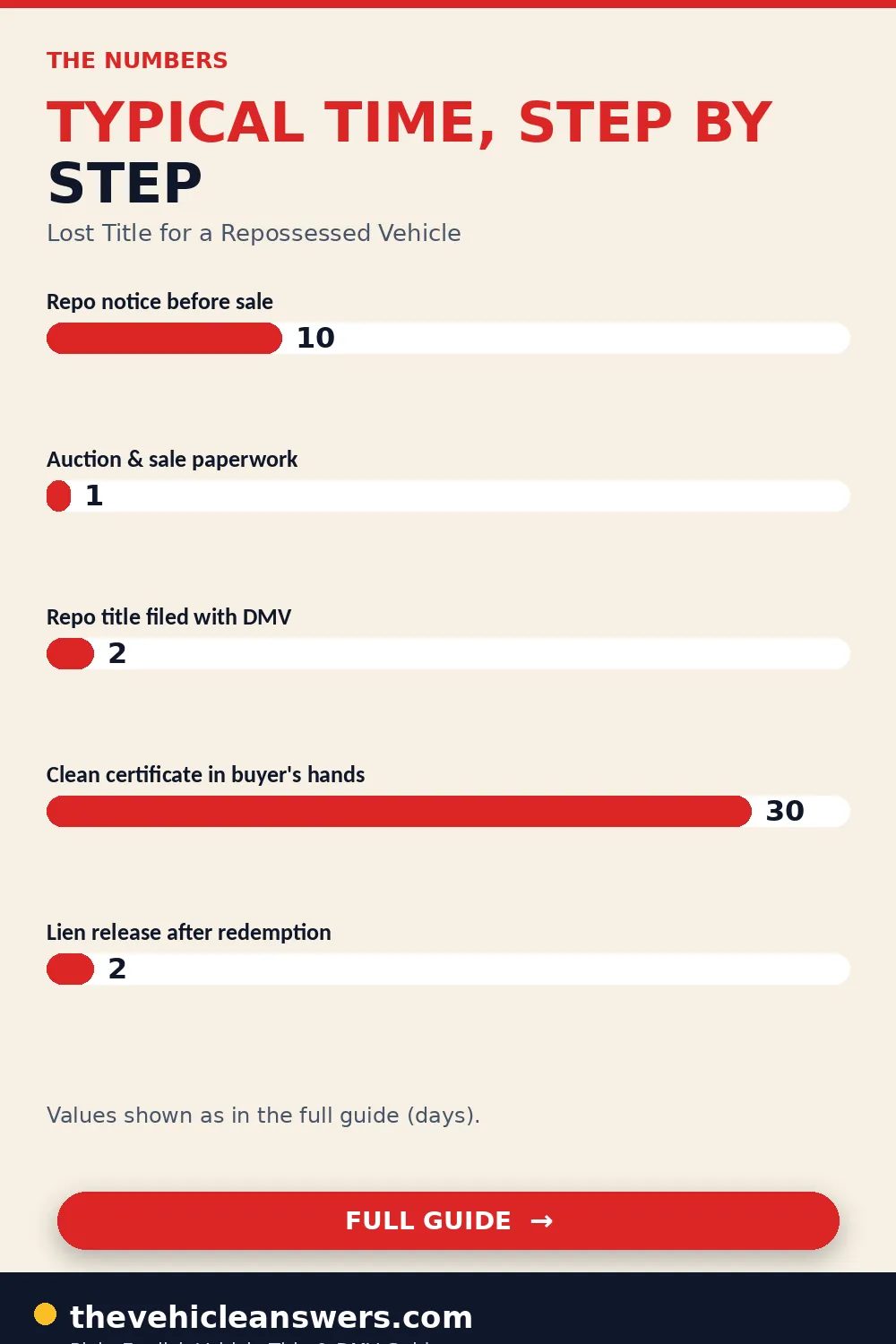
The pattern: everything moves until the lender's paperwork desk, where repo titles compete with daily origination work. Calendar-driven escalation keeps your file from sitting in that pile indefinitely. That means written contact at 30 days and a regulator complaint at 60.
The Document Checklist That Rescues Any Repo Title
- Repossession notice and the lender's pre-sale letters, dated
- Auction bill of sale with buyer number and payment proof
- Lender's affidavit of repossession, or the request to produce it
- Redemption payment receipt, if you bought the vehicle back
- Lien release or paid-in-full letter for redemption paths
- VIN photographs matching the auction paperwork
This folder answers every clerk question the DMV will ask. It also substitutes for the documents that got lost in the repo shuffle. Buyers working from a bare auction receipt can rebuild most of it.
Our bill-of-sale transfer guide explains which parts stand alone. It also flags which ones need the lender's backup.
After the Certificate Arrives
Verify the new title shows only the correct owner, an empty lien box, and the right VIN transcription. Repo paperwork passes through many hands. Transcription errors cluster there.
Then update insurance, registration address, and any toll or parking accounts tied to the vehicle. Do it the week the certificate lands.
If the certificate arrives with errors, the DMV's correction process fixes them free in most states. The fix works when the source documents support it.
And if a future loan ever puts a lien back on this vehicle, day-one rules apply. The coordination playbook lives in our active-loan title guide.
The document you're protecting has a full anatomy: owner boxes, lien lines, assignment sections. That breakdown lives in the what-is-a-car-title explainer. The general replacement walkthrough covers every ordinary lost-title case outside the repo lane.
Sale Reversals, Buyback Rights, and Paperwork Errors
Repossession law gives original owners some late-inning rights that touch the title process. A repo without proper notice, or a sale without the state-mandated window, can unwind entirely. The lender returns the vehicle, the loan reinstates, and the title question resets to the original lien setup.
Owners who suspect procedural defects should raise them before the sale date. Courts can pause the process cheaply at that stage.
Post-sale, the window narrows to documentation disputes. Typical examples: a wrong VIN on the affidavit, sale-date errors, or a buyer's name misspelled at filing. These flow back to the lender's title department for correction.
The DMV's correction process fixes certificates to match source documents. Nobody loses a car over a typo. But buyers can lose months if nobody sends the correction request.
For regulated lenders, the CFPB remains the escalation address. Its site, consumerfinance.gov, routes repo paperwork complaints to the lender's compliance desk. State banking regulators carry parallel authority over local institutions.
The winning pattern is unchanged from every other section. It comes down to dated documents, written demands, and calendar-driven escalation.
The File You Build in Week One
Whatever your position, the repo-title system runs on the same currency as every other title fix. That currency is documentation with dates attached. Participants who kept every notice, receipt, and letter move through the DMV in one visit.
Everyone who relied on phone promises supplies the paperwork archaeology later. In repo cases more than any other, week-one paperwork becomes month-two title.
If only one document gets preserved from any repo episode, make it the dated inventory from the repossession day.
It anchors the VIN, the condition, and the timeline that every later form asks about. That single paper has saved more repo-title cases than any affidavit filed after the fact. Build it early, and the DMV visit stays boring.