You made the final payment and the lender confirmed the payoff. Then the moment came to find the title, and it's nowhere.
The glovebox is empty and the moving boxes were recycled. The bank that held the loan has already archived your account.
This exact situation has a known recovery path, and it's shorter than most people fear.
The good news: a paid-off loan actually makes the replacement easier, because there's no lender permission to chase. The paper trail you need is the lien release, which both the lender and the state's electronic record can produce. Here's the full sequence for 2026.
Table of Contents
- First: Which System Held Your Title
- The Recovery Sequence, Step by Step
- The Waiting-Game Problem: Mail Lost After Release
- When the Lender Says They Lost It Too
- When the Payoff Was Years Ago
- Lease Buyouts: The Payoff's Cousin
- If You Need to Sell Before the Paper Arrives
- Preventing the Next Lost Title
- Working the DMV Counter: The Paid-Off Edition
First: Figure Out Which System Held Your Title
Start by working out how the loan was set up — it decides who holds what. In electronic lien and title (ELT) states, no paper title existed during the loan. The DMV held the record online, with the lender listed in its system.
At payoff, the lender's release transmitted to the DMV, which mails a clean paper title to you automatically. If you live in one of these states, the title may simply be in transit.
In paper-title states, the physical certificate lived with the lender. In some older arrangements, it lived with you while the lien showed on it. If the lender held it, they mail it after release — signed or with a release letter.
Maybe you held it all along. Then this is an ordinary duplicate with one extra document: proof the lien cleared.
The Recovery Sequence, Step by Step
- Collect the payoff evidence from the lender. Ask for a paid-in-full letter and the lien release — or a copy of the release they filed online. Lenders keep these records for years; one call or a secure message usually does it.
- Check the state record with your VIN. If the lien shows released and a title was mailed, wait the stated window first. A lien still showing means the release step isn't finished — resolve that with our lien release walkthrough.
- Order the duplicate title. File your state's replacement application with the release attached. The fee runs $10 to $35, and the new certificate prints with only your name — no lienholder box filled.
- Watch the mail window. Standard duplicates arrive in two to six weeks. If nothing comes, our guide on a title that never arrived in the mail covers the trace-and-reissue process.
- Verify the paper on arrival. Check that the owner line is correct and the lienholder box is empty. Errors caught in week one fix free; errors caught at sale time cost weeks.

The Waiting-Game Problem: Mail Lost After Release
The most common version of this story is simple. The DMV mailed the clean title months ago and it vanished. Wrong address from a move, mail theft, or an envelope lost in a transition.
The state's record shows "title issued" but your hands hold nothing. That mismatch has its own paperwork.
The fix is the non-receipt process: most states void the outstanding certificate and reissue with a simple affidavit. The key is filing before someone else could intercept the document. A lost title in the wild is a fraud risk.
That's why states take non-receipt reports seriously and move fast on them. Our never-received guide lists the affidavit forms by state.
When the Lender Says They Lost It Too
Older loans, merged lenders, and closed credit unions sometimes have no release paper to hand over. Don't panic. The state's online record fills in for missing paper more often than people expect.
If the DMV's system shows the lien released, that record itself satisfies most duplicate applications. The clerk notes the release date from the database.
If the record still shows an active lien and the lender can't produce a release, you're in the escalation path. That means a written demand first. Then the Consumer Financial Protection Bureau, if the lender is federally regulated.
Then come successor-liability claims if the lender merged. The merged company's legal team issues successor releases as routine work — the duty survived the merger.
The full lien release guide maps the whole escalation ladder. And the bonded-title backstop exists in every state for the truly orphaned cases.
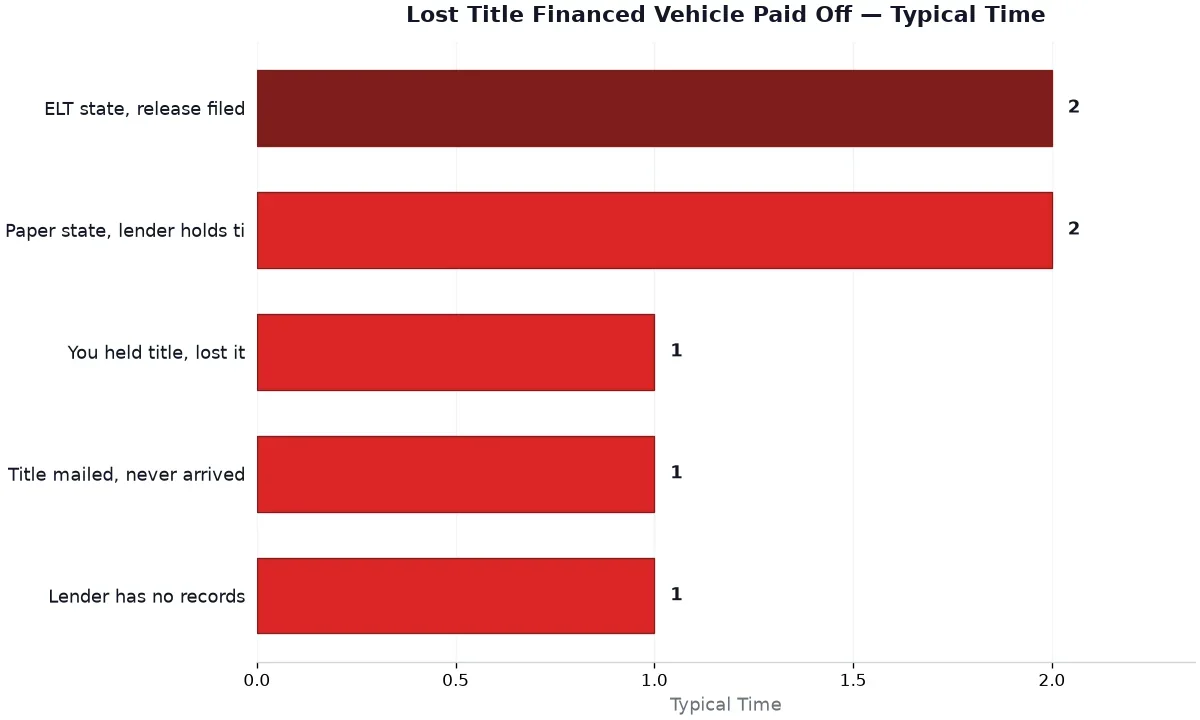
| Your Situation | Who Acts | You Get | Typical Time |
|---|---|---|---|
| ELT state, release filed | DMV mails automatically | Clean title in mail | 2–6 weeks |
| Paper state, lender holds title | Lender mails released title | Signed title → optional reissue | 2–4 weeks |
| You held title, lost it | You file duplicate | Clean duplicate with release | 1–3 weeks |
| Title mailed, never arrived | You file non-receipt affidavit | Void + reissue | 1–2 weeks |
| Lender has no records | Escalation or state record | Record-based or bonded title | 1–6 months |
When the Payoff Was Years Ago
Old payoffs add a treasure hunt to the process. Lenders merge, and loans get sold to servicers. The release that "definitely happened" leaves no trace in the current company's service records.
Start at the state record. If the DMV's system shows the lien released years ago, you may need nothing but a duplicate application. The state's own database is the proof, and clerks can annotate the release date from it.
If the record still shows the lien, work the chain of title on the loan itself. Request the loan's servicing history from the current holder.
Each transfer names the one before it, building a breadcrumb trail back to the firm that took the payoff. Successors inherit release duties, and a servicing-history request letter usually pulls the archived release within their response window.
Truly orphaned liens (lender dissolved, no successor, no archived records) end at the bonded-title counter. There the state issues a certificate backed by a surety bond. It costs more and takes longer, but it's a guarantee, not a favor.
After the bond period ends, the title stands clean for good. Every state's DMV publishes its bonded-title requirements. The process exists exactly for records like this one.
Lease Buyouts: The Payoff's Cousin
Lease buyouts create the same "where's my title" puzzle through a different door. At buyout, the leasing company assigns ownership and files the papers. There was never a lien to release, so no release paper will ever come.
The title prints fresh in your name, usually within the standard four-to-eight-week window. Set a calendar reminder at week six.
If months pass with nothing in the mailbox, call the lessor's title team — not a loan servicer. Lease buyout titles lag most when a third-party dealer ran the buyout instead of the lessor directly. Your buyout contract shows who handled what.
That adds one more office to the paper trail. Your buyout agreement, purchase option statement, and payment proof are the evidence set that unlocks the trace.
Here's the rule worth keeping: whatever the deal type, the state's title record is the ground truth. Everything else — lender letters, dealer promises, old emails — is evidence to fix the record when it lags. Checking the record first costs nothing and tells you which fight you're in.
If You Need to Sell Before the Paper Arrives
Selling a paid-off car with no title in hand stalls at the buyer's DMV — no certificate, no transfer. The honest options: wait for the duplicate (weeks, not months in most states). Or structure the sale around the lender's branch if any paper step can complete there.
What doesn't work is selling on a bill of sale alone. Buyers learn quickly that a bill of sale without a title leaves them stranded at the counter. Refund demands follow.
Two detail-level tips close out the paid-off recovery. The first one involves the odometer disclosure.
If your state's duplicate application wants one for vehicles in the disclosure window, pull your records. The last inspection or service record rebuilds the reading. Guesses on federal paperwork create problems; records don't.
Second, the address on file. Duplicates mail to the address in the state's record. An old address from the loan era sends your clean title to a stranger's mailbox.
Update the address with the DMV before ordering, not after.
Preventing the Next Lost Title
When the clean certificate arrives, photograph both sides and store the original away from the car. A fireproof file at home beats a glovebox that belongs to any parking-lot thief. Note the title number in your records; it speeds any future reissue.
If another loan ever enters the picture, the coordination rules change. Our lost title with an active loan guide covers the lender-permission steps that paid-off owners no longer face.
And for a refresher on what each part of the document actually controls, the car title explainer is the reference. The replacement walkthrough stays the roadmap for every non-loan duplicate in any state.
Working the DMV Counter: The Paid-Off Edition
Counter visits go better when the packet answers the clerk's three standard questions before they're asked. Those are: who owns it, what happened to the lien, and why no title is in hand.
Your paperwork answers all three. The paid-in-full letter names you and the account. The release paper shows the lien cleared, and the lost-title box on the application explains the missing paper.
Bring the loan's full ID details: account number, VIN, and the exact legal name on the loan. Payoff records index by account, and the clerk checks the VIN against the state record. A nickname on one paper and a legal name on another is the classic avoidable return trip.
Two proofs of address help if you moved during the loan era. Expect the visit to take twenty minutes with a complete packet.
Ask for the confirmation receipt with the application number. That number is your trace tool if the mail window passes silently.
Clerks resolve number-based requests faster than name searches. The Federal Trade Commission posts useful background on the disclosure rules some forms mention.
A last word on patience: the paid-off recovery is the best-conditioned lost-title case there is. No lender permission is needed, the release trail exists somewhere reachable, and the state record confirms the endpoint. Every step has a form, a fee, and a timeline.
The end result is a certificate that shows what the payoff already made true: the car is entirely, provably yours. That's the whole fight, won on paper.