A Delaware vehicle title is the state's official proof of ownership, and every fix for a lost, damaged, or lien-stuck certificate runs through the Delaware Division of Motor Vehicles. The First State charges some of the highest replacement fees in the country, $50 for a duplicate title, while taxing vehicle purchases at a flat 5.25 percent with no sales tax on top. Those two numbers shape almost every Delaware title decision.
Delaware also does something many states gave up on years ago: it still wants original paper for everything. Photocopies are rejected outright, and the DMV actively encourages buyers and sellers to complete transfers together at one of its four facilities. For a small state, the rules have personality.
This guide covers every common Delaware title problem in 2026: replacing a lost title with Form MV213, transferring ownership after a private sale, the 30-day deadline and its $35 late fee, handling liens in a paper-first state, and bringing an out-of-state vehicle across the line.
Delaware Title Work Still Runs on Paper
The Delaware DMV says it directly: documents such as title applications, powers of attorney, and estate executor papers must be originals. Photocopies are not accepted. That single policy shapes every transaction, because you cannot scan your way out of a problem here.
Electronic lien and title, which more than 40 states now use for at least some lenders, has not taken over Delaware's system the way it has in Florida or Georgia. Paper certificates remain the normal product, and lien releases arrive as signed documents rather than database updates. If you are used to e-titles, Delaware's paper habit takes adjustment.
The state leans on its counter staff as a feature, not a formality. The DMV recommends that sellers transfer the title at a division facility so an associate can review the paperwork on the spot and fix errors before they become rejections. That review catches the crossed-out dates, missing odometer entries, and unsigned lien lines that mail-in applications discover weeks later.
Online help exists at myDMV.delaware.gov for eligible services, and the DMV's phone lines and DELLA chatbot handle basic questions. But the title itself, and most title problems, still end at a counter in Dover, Wilmington, Georgetown, or Harrington.
Plan around the state's calendar quirks too. Delaware DMV locations close on state holidays, lines at the New Castle facility run longest at month's end, and title processing pauses whenever a system upgrade rolls through. None of that shows up in the fee schedule, yet all of it affects when a buyer can legally drive home, so check hours before promising a same-day transfer.
What Delaware Title and Registration Cost in 2026
Delaware's fee schedule is unusual because the big number is not the title fee. It is the motor vehicle document fee, a tax on the vehicle's value that replaced what other states call sales tax. The full schedule lives on the DMV's official fees page, and here is what it charged in 2026:
| Item | 2026 Delaware Cost |
|---|---|
| New title without a lien | $35 |
| Duplicate title (Form MV213) | $50 |
| Document fee (in place of sales tax) | 5.25% of vehicle value |
| Transfer after the 30-day deadline | $35 late fee |
| Vehicle sales tax | None |
| Annual vehicle property tax | None |
The document fee deserves its own history lesson. It sat at 4.25 percent for years, and the state announced the increase to 5.25 percent effective October 1, 2025. On a $30,000 vehicle, that is $1,575, which dwarfs every other fee on the list.
Registration fees stack on top, and they scale with the vehicle's weight rather than a flat rate. The DMV's fee page lists the current schedule, and dealer calculators on the state's portal estimate the combined damage before you commit to a purchase.
One more fee hides in the timeline. The $35 late fee only looks small next to the document fee, but it stacks with everything else a slow buyer owes, and Delaware assigns it to the title issuance itself. A buyer who stalls past day 30 pays it every time the paperwork finally crosses a counter, which makes sellers wise to write the deadline into the bill of sale.
Replacing a Lost, Stolen, or Damaged Title: Form MV213
Delaware charges $50 for a duplicate title, one of the steepest replacement fees in the country, and the fee must accompany the Application for Duplicate Title. The state does not process the request without payment, and it does not offer a discount for damaged certificates versus lost ones.
The form is MV213, available from the Delaware DMV's duplicate title page and its dealer portal. Fill in the vehicle identification number, the current owner information exactly as it appears on the vehicle record, and the reason for the request. A damaged title application should include the mutilated original, because the state wants the old certificate surrendered.
Stolen titles follow the same MV213 route with one addition. File a police report first, keep the complaint number handy, and mention it on the application. A stolen certificate floating around with your vehicle's VIN on it is a fraud risk, and the paper trail protects you if someone tries to use it.
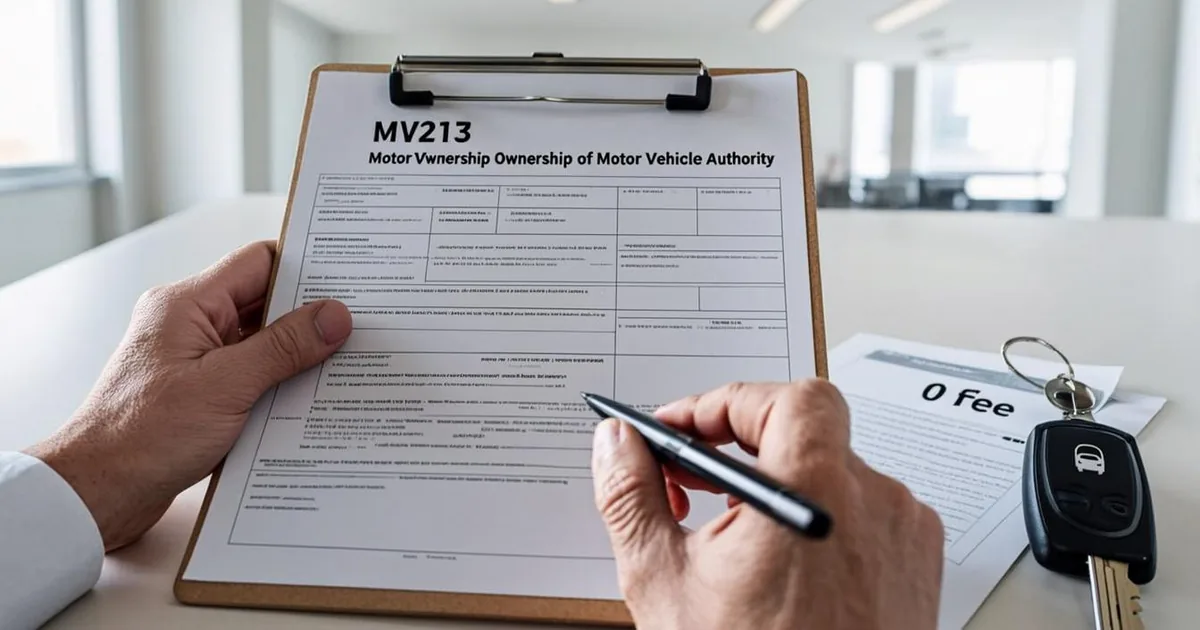
You can apply by mail to the DMV at 303 Transportation Circle in Dover, or at any of the four division facilities. Processing typically takes two to four weeks, and the replacement ships rather than printing over the counter, so build that wait into any sale deadline.
- Confirm the vehicle record. Make sure the address and name on file are current, because the duplicate mails to the record, not to your wishes.
- Complete Form MV213 in full. Missing VIN digits and name mismatches are the two most common rejection causes.
- Attach the $50 fee. Checks go to the Delaware DMV, and the state also accepts the usual card and cash options at counters.
- Surrender the damaged original if you have one. Lost titles skip this step, but the affidavit section replaces it.
- Wait for the certificate, then sign nothing until the buyer is in front of you. An open assignment invites fraud problems.
If a lien appears on the vehicle record, involve the lender first. A duplicate with an active lien mails to the lienholder, and paying $50 for a certificate that never reaches your mailbox is a preventable disappointment. The active loan title guide explains how that handoff works.
Selling a Delaware Car: Transfer at the Counter
Delaware law gives buyers no grace period to speak of: application for the new title should follow the purchase immediately, and never more than 30 days later. After that, a $35 penalty fee attaches to the title issuance. Sellers should quote that deadline to buyers, because a slow buyer can cost real money.
The DMV's preferred sale happens at a division facility with both parties present. The associate reviews the assignment, processes the buyer's new title, and removes the seller's name from the record in one visit. It is the strongest liability protection a Delaware seller can buy for the price of a parking spot.
When meeting at the DMV is impossible, the seller still owes the state a notification. Complete the Seller's Report of Sale and mail it to the DMV with the registration card stub, which takes your name off the vehicle for enforcement purposes. Skip that step and the next owner's parking tickets find your mailbox.
Sales to dealers work differently. Hand the registration card to the dealer and mail the Seller's Report of Sale to the DMV. The dealer handles the title chain from there.
Odometer entries deserve precision. Federal rules require the mileage disclosure on the assignment, and an estimate, a five-digit rollover reading, or a blank line can void the transfer at the counter. Write the exact number, note "actual mileage" where the form asks, and double-check it against the dashboard before signing. Delaware counters reject odometer discrepancies on sight, and a rejected assignment means starting the paperwork over with a buyer who is already annoyed.
Common Delaware Title Rejections
Delaware's originals-only policy means a rejected document cannot be photocopied and resubmitted. It means starting over, sometimes with a trip to Dover. The counter review catches most of these on the spot, which is exactly why the state pushes buyers and sellers to file together.
- Crossed-out or corrected entries anywhere on the assignment, even small ones.
- Name mismatches between the title, the seller's ID, and the vehicle record.
- Missing odometer reading, or a reading that fails the reasonableness check.
- Unreleased liens, or a release letter that is not on the lender's letterhead.
- Photocopied supporting documents, which the DMV rejects as a matter of policy.
- Missing signatures where notarization is required, or signatures dated out of order.
The pattern across every rejection is fixable with two habits. Review the assignment before the buyer leaves your driveway, and use the counter review option when the deal allows it. Five minutes of checking beats a second $50 duplicate fee.
Buying in Delaware: The 5.25 Percent Document Fee
Buyers pay the document fee when they title the vehicle, and the math starts with the purchase price or the vehicle's value, whichever the state accepts as the basis. At 5.25 percent, a $20,000 private sale carries $1,050 in document fee, on top of the $35 title fee without a lien.
The 30-day rule runs from the purchase date, and the $35 late fee applies once it lapses. There is no workaround or waiver for forgetting, so treat the deadline like a bill due date.
Before money changes hands, verify the paper chain. The title should show the seller's name as the registered owner, no open assignment sections, and a lien release letter if the record shows a past lender. If the seller has no title at all, the duplicate-first rule applies and the lost title before transfer guide maps the sequence.
Buyers bringing in a car from another state face the same document fee, plus a VIN verification at the DMV for vehicles titled elsewhere. Budget for both, and remember that out-of-state titles get reviewed against the national record, so any brand or odometer history follows the car across the line.
Insurance comes before the counter visit, not after. Delaware requires coverage before registration issues, and the DMV checks electronically, so bind the policy the day the deal closes. Buyers who wait for the paperwork to settle end up in the registration line twice.
Moving to Delaware With a Vehicle
New residents title and register their vehicles through the same counter process, with the out-of-state title surrendering to the Delaware system. Bring the existing title, proof of insurance, and identification, and expect the VIN verification for anything titled outside the state.
The document fee applies to vehicles brought in as well, calculated on the vehicle's value. Newcomers from states with low or no sales tax sometimes get surprised here, so run the numbers before assuming Delaware registration is cheap.
Temporary tags keep you legal while paperwork processes, and the DMV issues short-term plates for exactly this gap. Ask at the counter when you file, because driving on an expired out-of-state registration while Delaware mail catches up is not a defense traffic courts accept.
Liens and Releases in a Paper State
Delaware's paper-first system changes how liens behave. The certificate often sits with the lender, and when the loan pays off, the release arrives as a signed document rather than a database flag. Keep that release letter permanently; it is the document that unlocks re-titling later.
When a Delaware vehicle with an active lien needs a duplicate, the request flows through the lender, and the replacement mails to the lienholder. Owners planning a sale should request the release early, because waiting for a national servicer's paperwork queue is the most common source of delayed Delaware closings.
Refinancing follows the same paper logic. The new lender pays off the old one, receives the original certificate or an electronic release, and records its own lien with the state. Borrowers who lose track of the title during a refinance often panic unnecessarily; the paper is simply moving between lenders, and both institutions' lien departments can trace it. Confirm the old lien shows released and the new one shows recorded before assuming anything went wrong.
If a lienholder has merged or vanished, the state accepts successor documentation and payoff proof, though the originals-only rule means affidavits and evidence must be certified copies where applicable. Slow, but solvable.
Estate Transfers, Antiques, and Odd Vehicles
Delaware handles estate paperwork the way it handles everything: original documents required. An executor transferring a vehicle needs the certified estate papers, the death certificate, and the title or duplicate application, and the inherited vehicle guide walks through the sequence when the certificate itself is missing.
Not everything on wheels gets a Delaware title. Off-highway vehicles and ATVs are registered but not titled, snowmobiles need neither, and boats run through the Department of Natural Resources and Environmental Control. Boat trailers, oddly, do title and register at the DMV like road vehicles.
Motorcycles and mopeds are titled in Delaware, which matters because some states skip moped titles entirely. Antique vehicles follow the state's special procedures, and owners of older hobby cars should read those requirements before restoring anything with a missing paper trail.
Custom-built and kit vehicles sit at the hardest end of the Delaware spectrum. A homemade vehicle has no prior certificate to replace, so the state builds the title from scratch through inspections, ownership evidence for every major component, and sometimes bonds. Anyone assembling a car from parts should talk to the DMV before the build, not after, because retrofitting paperwork onto a finished vehicle is far harder than filing the right forms up front.
Delaware title work rewards preparation and punishes shortcuts. Bring originals, respect the 30-day window, meet the buyer at the counter when you can, and start lien paperwork before the deadline pressure starts. The fees are higher than most states, but the process itself is short and the staff review at the counter catches mistakes before they cost you months.