Massachusetts runs its vehicle paperwork through the Registry of Motor Vehicles. The RMV has quietly become one of the more digital-friendly title offices in the Northeast. Duplicate titles, address changes, and most applications move through the myRMV online portal.
That does not make the rules simple. Massachusetts carries the $75 title fee, the 6.25 percent sales tax, and the annual inspection culture. It also has the local excise tax nobody warns newcomers about.
As of October 2026, a Massachusetts duplicate title costs $25 — about 7 to 10 business days through myRMV online or in person, and 20 to 22 business days if you mail the application. Massachusetts also issues electronic titles, so you may need a printed copy before a private sale.
Mailing slows everything down in Massachusetts. The Title Division processes mailed applications in 20 to 22 business days — P.O. Box 55885, Boston, MA 02205-5889 — while myRMV online orders and in-person visits finish in 7 to 10. Since Massachusetts titles are electronic by default, ask for a printed copy if a buyer or insurer needs paper.
This guide covers the full lifecycle: when a title is required, how to replace a lost one, and every fee. It also walks the private-sale transfer for both sides. The moving-in and moving-out rules get their own section.
Bookmark it — the excise tax section alone answers the question that surprises most new arrivals. The official source for all of it is the Registry itself at mass.gov.
The RMV keeps its current forms, fee schedules, and the myRMV portal there. This guide walks the same ground with the practical sequencing the state site leaves implied. That means what to do first, what can wait, and where the common rejections come from.
Table of Contents
- When Massachusetts Requires a Title
- Replacing a Lost or Damaged Massachusetts Title
- Every Massachusetts Title Fee That Matters
- A Private Sale Transfer, Step by Step
- Moving to Massachusetts With a Vehicle
- Massachusetts Edge Cases Worth Knowing
- The Excise Abatement Most Sellers Miss
- Snowbirds, Students, and the Garage-State Question
- Massachusetts Titling, Layer by Layer
When Massachusetts Requires a Title
Massachusetts issues titles for most motor vehicles, with the model-year cutoff set well back. Vehicles model year 1980 and newer require titles. Trailers follow their own thresholds, and low-number plates carry their own prestige rules.
Older vehicles, including antiques and pre-1980 vehicles generally, can change hands on a bill of sale and old registration. That makes the pre-1980 market here easier than the paperwork suggests.
The title is the anchor document for everything else: insurance in this heavily-insured state, registration renewals, and any future sale. If yours is missing or damaged, fix it before it blocks a transaction.
Our national walkthrough of how to replace a lost car title explains the general process. The rest of this guide gives the Massachusetts numbers.
Replacing a Lost or Damaged Massachusetts Title
The replacement process runs through myRMV in most cases. You request a duplicate title online or in person at a service center, then pay the $25 duplicate fee. The new title arrives by mail in roughly 7 to 10 business days.
Massachusetts does not hand you a same-day paper title over the counter the way some states do. Plan around the mail time, especially if a sale or refinance deadline is coming.
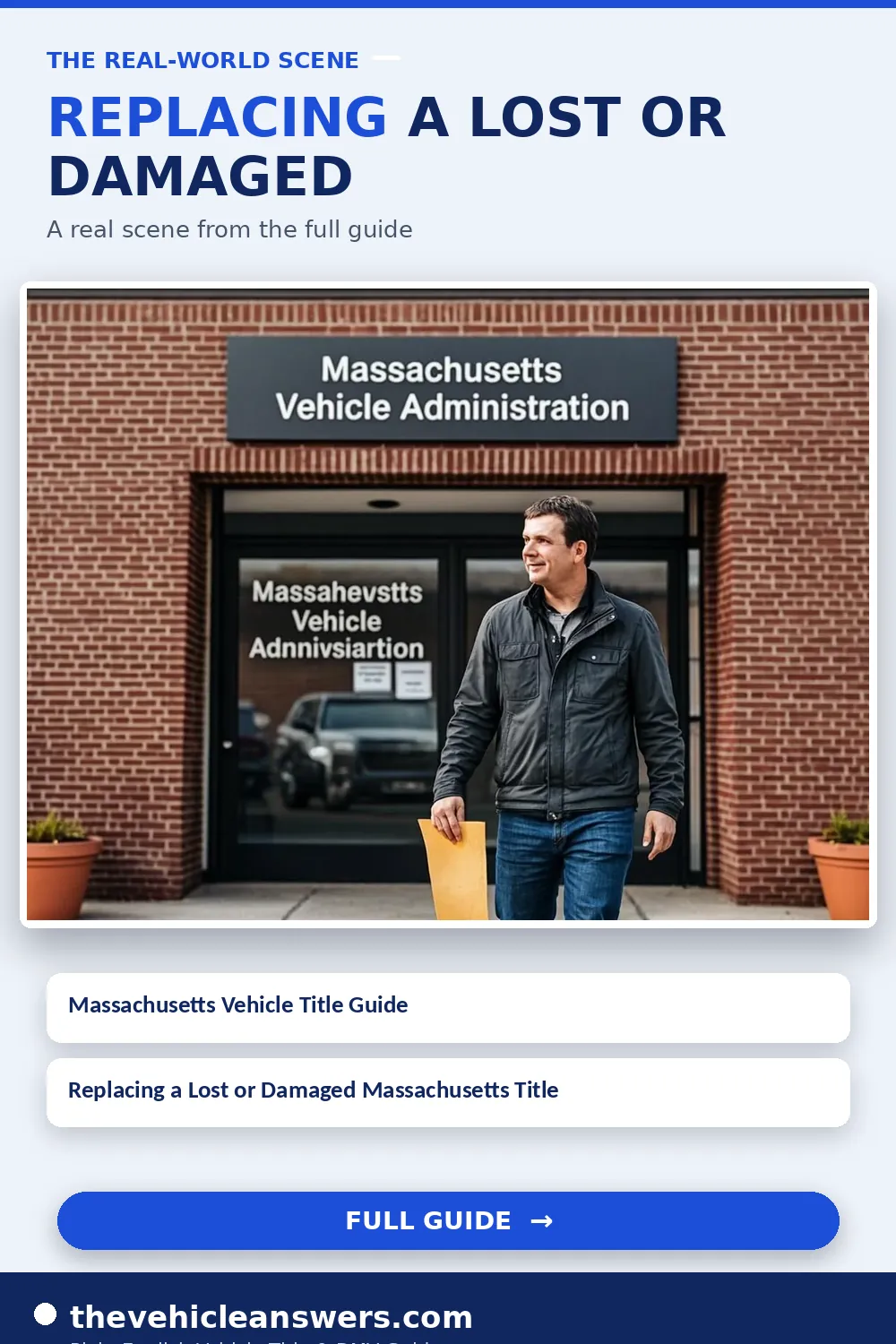
A few details matter at the counter or in the online form. The request should come from the owner of record. The address on file must be current, because a title mailed to an old address is a lost title again.
A lienholder of record changes the flow. In financed vehicles, the title often lives with the lender. Confirm where your original sits before ordering a duplicate.
Surrender a damaged-but-legible title when you apply. That prevents two valid titles circulating for the same car.
Every Massachusetts Title Fee That Matters
Massachusetts fees cluster around a few numbers. The state's 6.25 percent sales tax rides on most purchases and transfers that are not exempt.
The excise tax is the extra layer. It is an annual local tax on owning the vehicle, not a transaction fee. It bills separately through your city or town.
| Item | Cost | When you pay |
|---|---|---|
| Title fee (new or transferred title) | $75 | Any new title issuance |
| Duplicate title | $25 | Lost, stolen, or damaged title replacement |
| Registration (passenger) | $60 for 2 years | Registration renewal cycle |
| Sales/use tax | 6.25% of price | Purchase or taxable transfer (exemptions apply) |
| Motor vehicle excise | $25 per $1,000 of value | Annually, billed by your city/town |
| Inspection sticker | $35 per year | Annual safety + emissions check |
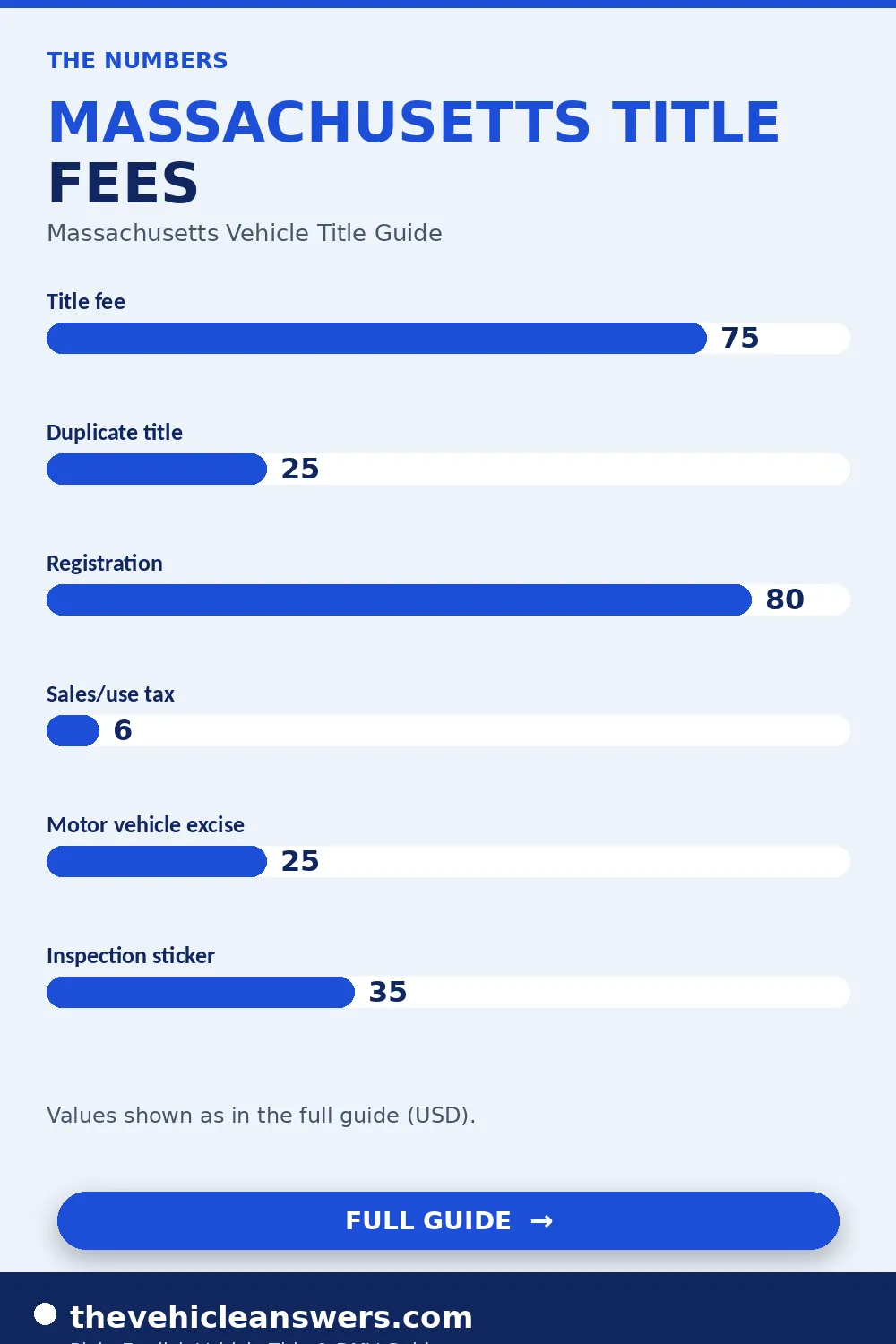
Two notes on that table. First, the excise tax bills on the manufacturer's list price depreciated by a state schedule, not on what you paid.
Owners of older cars often pay more excise than the car is worth. Abatement requests through the local assessors exist for exactly that.
Second, Massachusetts taxes private sales on book value if the declared price looks low. Keep an honest bill of sale with supporting evidence rather than inventing a number.
A Private Sale Transfer, Step by Step
Massachusetts private sales move fast when both sides do their homework. The title is the center of it.
The seller signs it over; the buyer files for a new title and registration. Insurance gets bound first, because the state requires coverage before registration. Here is the sequence that works.
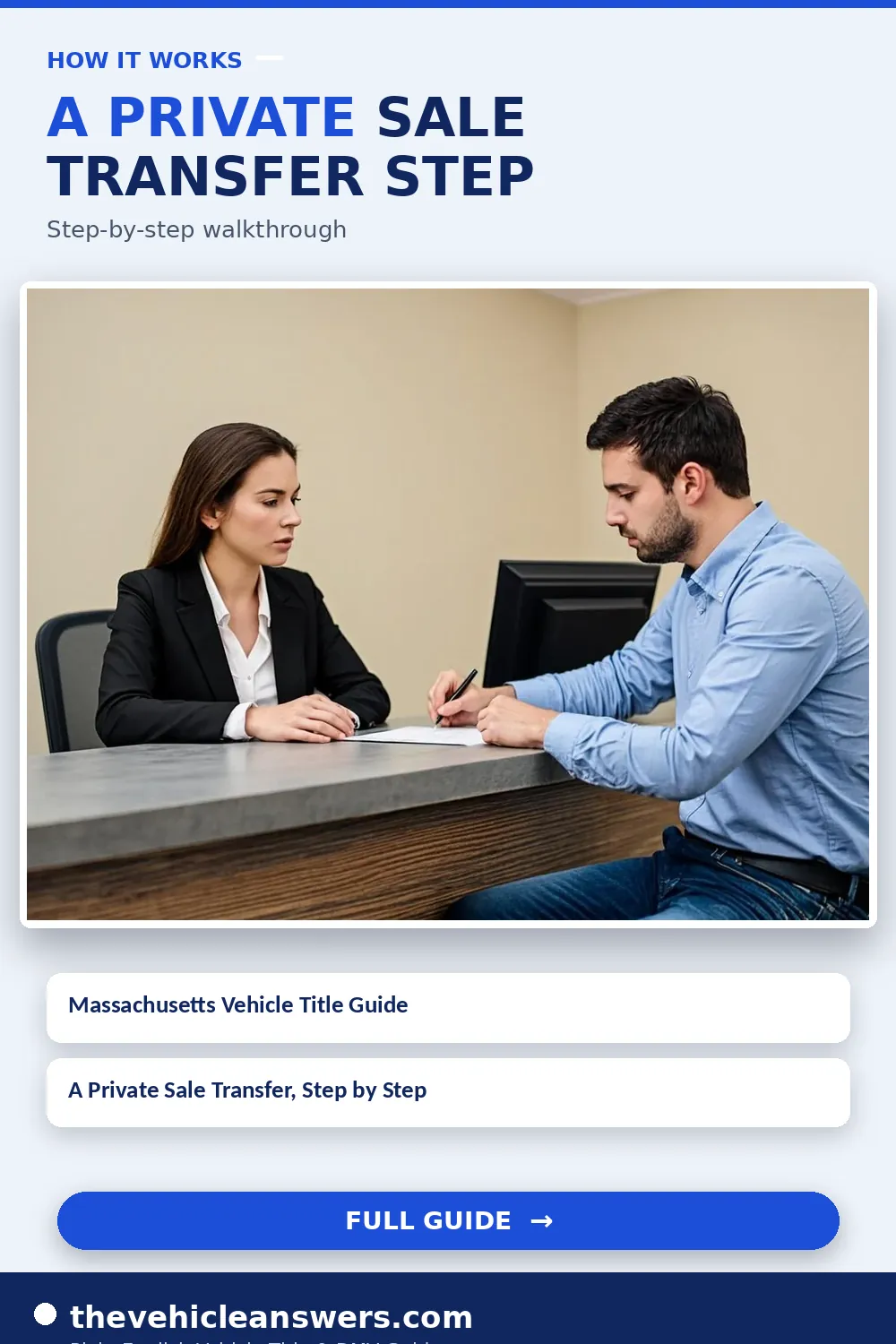
- Seller signs the title assignment. Buyer's name, sale price, odometer, date, and both signatures — every field, no blanks. A blank title is an open invitation to disputes.
- Seller keeps proof of the sale date. A copy of the signed title or bill of sale matters. Massachusetts plates stay with the seller, not the car. You want the record showing when your liability ended.
- Buyer binds insurance before filing. Massachusetts requires auto insurance to register, so the policy comes first, then the RMV paperwork.
- Buyer files title + registration. The RMV expects new owners to file promptly after taking possession. The working habit is within 10 days of the sale date. Bring the assigned title, insurance evidence, ID, and fees to an RMV service center. Some steps also complete through the portal where eligible.
- Both sides keep copies. The seller's copy ends toll disputes and excise questions. The buyer's copy is their ownership evidence until the new title mails.
If the seller's title has gone missing days before the deal, do not improvise with a bill of sale alone. Massachusetts buyers generally need the title itself. The seller orders the $25 duplicate, and an original that turns up afterward gets destroyed.
Our guide on sorting the title before a transfer covers this pre-sale cleanup in detail.
Moving to Massachusetts With a Vehicle
New arrivals convert their out-of-state paperwork promptly. The working rule is within 30 days of establishing residency, or as soon as your out-of-state registration lapses. Whichever comes first wins.
The conversion means a Massachusetts title ($75), Massachusetts registration, and Massachusetts insurance from a licensed carrier. Out-of-state policies do not satisfy the requirement. Then comes that first excise bill from your town.
Bring the out-of-state title, proof of insurance, ID, and the RMV-1 application. If a lienholder holds your title because the car is financed, the RMV records the lien.
You then apply with the registration and lender details instead. The lien transfers cleanly onto the new record.
One quirk to know: vehicles previously titled in another state may need the title verified against the vehicle. If your VIN record anywhere disagrees with the car, resolve it before filing. Our title application guide explains how verification fits the process.
The state guides hub covers the state you are leaving. That matters for cancelling plates and reclaiming any refund.
Massachusetts Edge Cases Worth Knowing
Antique vehicles carry their own plates and rules, and pre-1980 vehicles trade on bills of sale as noted above. Anything you plan to register for regular road use still needs the annual inspection, and Massachusetts inspects thoroughly.
Salvage and rebuilt vehicles run through the state's branded-title process with inspection requirements before they return to the road. Buyers of rebuilt cars should read the brand on the title before the price negotiation, not after.
Gifts between family members skip the 6.25 percent tax with the proper affidavit. Inherited vehicles follow the estate paperwork path — our guide on titles for inherited vehicles walks the executor's steps.
Insurance deserves its own paragraph in the Massachusetts context, because the state's system differs structurally from most. Coverage is sold through private insurers, but rates and rules run under state oversight. The insurance certificate is a prerequisite for registration rather than an afterthought.
Newcomers from loosely-coupled states discover the difference fast. Massachusetts wants the coverage bound before the RMV touches the file. The insurance call comes before the counter visit, every time.
The inspection sticker closes the loop. Massachusetts requires the annual safety and emissions inspection within seven days of registering a newly acquired vehicle. The $35 check happens at licensed stations statewide rather than at the RMV.
Used-car buyers should confirm the vehicle can actually pass before the sale. A car that fails inspection transfers the repair burden with the title. Massachusetts inspection failures for frame or emissions problems turn a good price into an expensive lesson.
The Excise Abatement Most Sellers Miss
One more fee-adjacent note that saves Massachusetts sellers real money: the excise tax abatement. Sell or move the vehicle out of state partway through the year, and the town's excise bill can shrink. The reduction reflects the months you no longer owned the vehicle.
It only happens if you file the abatement request with the local assessors. The bill does not correct itself.
Owners who ignore it pay a full year of excise on a car they sold in March. The receipt from the sale is the document the abatement runs on.
This guide has repeatedly told you to keep that receipt. Here is one more place the habit pays.
For the county-by-county service center details and current forms, the official source is the RMV itself at mass.gov/rmv. For the neighboring paperwork, Connecticut's guide lives in our Connecticut title guide. It is handy for the western suburbs where DMV lines run across the border.
Snowbirds, Students, and the Garage-State Question
The last practical note belongs to two groups Massachusetts paperwork catches every year. Snowbirds and college families both create the same situation. The vehicle's garage state and its registered state diverge.
A student taking a family car to another state is the classic version. A retiree wintering elsewhere is the other.
Massachusetts registration follows residency rules, not intention. The RMV's guidance on students and seasonal residents is worth reading before the semester or the departure.
The penalty for getting it wrong is the classic out-of-state-ticket mess. In this case it arrives in reverse, with Massachusetts chasing a car that lives elsewhere.
Massachusetts Titling, Layer by Layer
The honest summary of Massachusetts titling is that the state's rules are older than its systems. The excise tax predates the portal. The inspection cycle predates the excise reform debates, and the RMV's digital front end sits on decades of statutory scaffolding.
None of that makes the process hard. It makes it layered.
The owner who handles the layers in order finds Massachusetts predictable: insurance, then title, then registration, then inspection, then excise. The owner who skips the order meets all five at once.
Usually it happens in a renewal notice that reads like a ransom note.
Frequently Asked Questions
How much does a duplicate title cost in Massachusetts?
The RMV charges $25 for a replacement title, ordered online through myRMV or at a service center. The new title arrives by mail in roughly 7 to 10 business days, so order early if a sale or refinance deadline is approaching.
How long do I have to transfer a title after buying a car in Massachusetts?
The RMV expects new owners to file promptly, and the working habit is within 10 days of the sale date. Since Massachusetts requires auto insurance before registration, bind the policy first, then file the title and registration paperwork together.
Does Massachusetts charge sales tax on private car sales?
Yes — 6.25 percent on the purchase price, and the RMV can tax based on book value if a declared price looks unreasonably low. Family gifts and certain transfers are exempt, but only if you file the proper exemption paperwork with the title application.