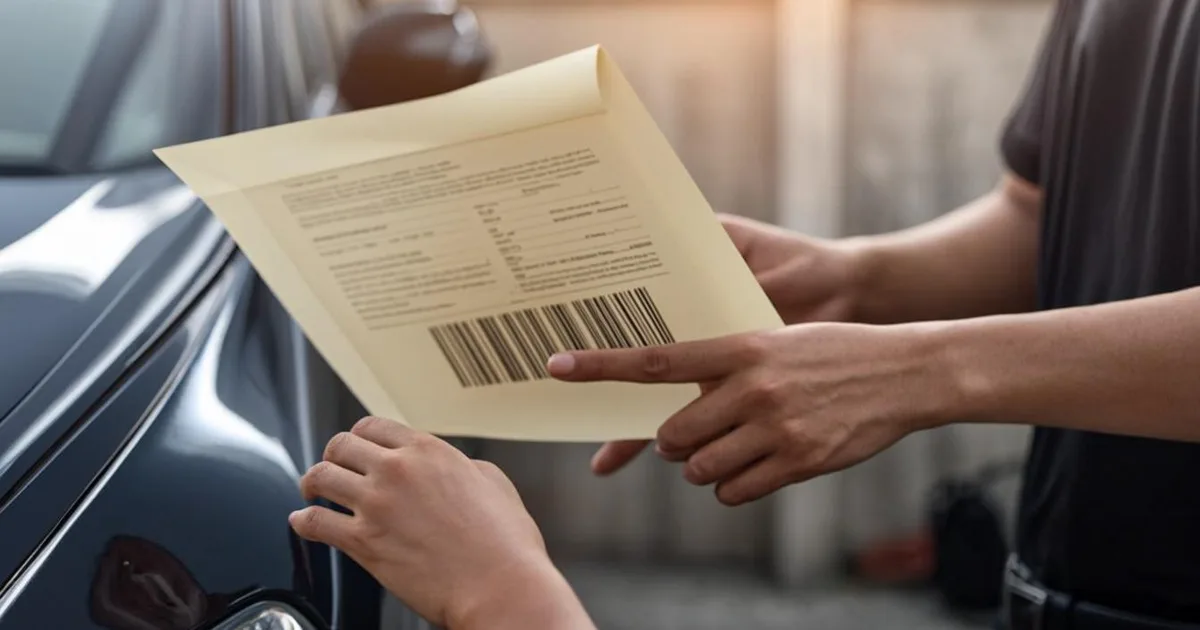

The rejection notice says the application failed because the lien release is missing. That sentence produces a genuinely uncomfortable moment. You were told the loan was paid off years ago.
Or you bought the car believing the seller's assurance that everything was settled. A missing-lien-release rejection means the DMV's records still show a lender holding a security interest. Paperwork cannot proceed until that interest formally disappears.
This guide covers the three situations the rejection actually occurs in. Your own paid-off loan whose release never landed is the first. A purchased vehicle with a stale lien the seller left behind is the second.
The third is the genuinely mysterious lien that nobody can explain. Each has a different fix, and all of them start with the same diagnostic step. None of them resolve by filing the same packet again.
Table of Contents
- First: What Exactly Does the Record Show?
- Case One: Your Own Paid-Off Loan
- Case Two: You Bought the Car With the Stale Lien On It
- Documents That Clear Each Rejection Reason
- Case Three: The Lien Nobody Can Explain
- The Defunct-Lender Version
- Resubmitting With the Release in Hand
- Cheaper to Prevent Than to Fix
- The Weight a Rejection Carries
- Keep a Copy of the Winning Paperwork
- When the Lien Was Never Real
First: What Exactly Does the Record Show?
Before any fix, establish the facts of the lien. The phrase "missing release" describes at least four different realities. Pull the title record through your state's online portal or a counter printout.
Note the lienholder of record, including its exact name as the state shows it. Then note the lien's status on the record. The four possibilities below, each with its own owner of the fix, come from that status.
An active lien comes from a genuinely unpaid or recently paid loan. The fix belongs to the lender's release process, underway or not. A paid-off loan whose release transmission or paper release never reached the state is the second.
The third: a lien marked released on the state's records but attached to a title document that was never reissued. Your application for the clean title fixes that one, and often it is just a fee. The fourth is a lien from a lender that no longer exists under that name.
That version needs succession tracing, covered below. Knowing which of the four you hold converts a vague rejection into a task with a name.
Case One: Your Own Paid-Off Loan
The most common version: you paid the loan off, life moved on, and the release never completed. The lender confirmed the payoff verbally, or the auto-pay simply stopped. Either way, the state's record never got its update.

The fix runs through the lender, with your payoff evidence attached. That evidence means the final statement, canceled checks, and the paid-in-full letter if it exists. Demand in writing that they transmit or mail the release now.
Lenders respond to written requests with attached evidence far faster than to phone calls. The letter creates a record their compliance staff tracks.
Give them a deadline—two weeks is standard. If the deadline passes, escalate.
The CFPB complaint portal at consumerfinance.gov handles national servicers, and the state banking regulator handles local lenders. Some states also run a supervised lien-clearing process where the DMV notifies the lender directly.
Ask the DMV title desk about it in parallel. It sometimes clears the record while the paper release is still in the mail. And if the certificate itself is the thing that never showed up, our title never came in the mail guide takes over from there.
The full follow-up ladder is in our guide on closing the loop after payoff. The letter that makes lenders move is specified in our lien release letter requirements guide.
Once the release lands—paper or electronic—your title application proceeds with it attached. Resubmit with the release document or the ELT confirmation number, the rejection reference noted, and nothing else changed.
The second pass clears what the first could not.
Case Two: You Bought the Car With the Stale Lien On It
The harder version: the seller sold you the car with a lien still on the record. Sometimes that was disclosed as "nearly cleared." Sometimes you discovered it only at your own filing.
The legal fact is uncomfortable: the seller's lien problem is now your title problem. The state will not issue you a clean title until the record clears. The seller's cooperation is the cheapest path to that clearance.
Start by putting the burden in writing. Send a dated letter stating the lien on record and enclosing the rejection notice. Request that they obtain and deliver the release within ten to fourteen days.
Sellers who genuinely paid off the loan can often produce the release with one call. Keep every reply, since that documentation supports recovery or the title work later.
If the seller cooperates, the release arrives and your application resubmits with it. If the seller stalls, your options sharpen.
Small claims court enforces title-delivery obligations in most states. You can also pursue the release yourself through the lender, with your purchase evidence attached. And when the seller is unreachable, the bonded title route exists.
A bonded title uses a surety bond valued at roughly one to one-and-a-half times the vehicle's worth. That bond backs a clean title through the state's bond period. Buyers should know the cost is recoverable in small claims in many states.
Keep the receipts either way.
Documents That Clear Each Rejection Reason
Use this table to pair the rejection reason printed on your notice with the document that cures it. A complete resubmission clears the first time, and an incomplete one earns a second rejection.
| Rejection Reason | Document That Fixes It |
|---|---|
| Missing lien release | Lender satisfaction or release letter on company letterhead |
| Lienholder name mismatch | Lender name-change affidavit or DMV record update letter |
| VIN discrepancy | Completed VIN verification form plus registration and insurance copy |
| Signature problems | Fresh ink signature, notarized where the state requires it |
| Fee shortfall | Fee schedule printout with payment of the exact balance |
| Wrong form version | Current-year form downloaded fresh from the state DMV site |
Case Three: The Lien Nobody Can Explain
The rarest version deserves its own caution. A lien sits on the record that you never agreed to and cannot trace. It names a lender you never dealt with, for a loan you never had.
Do not file paperwork around it, and do not ignore it. Unexplained liens are either state record errors or identity-theft artifacts.
Both deserve a live conversation with the DMV title desk plus a pull of your credit reports. The credit pull checks for loans opened in your name. Record errors get corrected with evidence and the DMV's own correction process.
Bring your ownership documents and a statement that you never contracted with the named lender. Identity-theft liens involve a police report and the lender's fraud department. The sooner both start, the shorter the untangling.
Either way, the mystery lien blocks every transaction it touches until resolved. It does not age out.
The Defunct-Lender Version
Where the lienholder of record no longer exists, the release path runs through succession. The lender may have merged into another bank, failed, or dissolved. The successor institution legally owes the release.
The FDIC's failed-bank records trace who inherited the book of a failed lender. Your state banking regulator's files cover the rest. When no successor exists at all, the state's fallback is the DMV-supervised clearing process or the bonded route.
The full tracing sequence lives in our guide on liens and the lender trail. It includes the documentation that bridges old names to new ones at the counter.
Resubmitting With the Release in Hand
Whichever path produced the release, the resubmission follows the standard second-pass discipline. Fix the named defect only, attach the release document or ELT confirmation, and reference the rejection number. File inside your transfer window if one applies.
Do not let the release letter sit in a drawer while you get everything else in order. Release letters carry validity windows in many states, commonly 30 to 90 days. A stale letter needs reissuing, which means starting the lender conversation again.
If the release arrived in electronic form only, ask the DMV whether they can see it. ELT releases often post to the state system without any paper reaching you. The counter can confirm receipt in minutes.
The filing mechanics are on our application guide. The full rejection landscape is in our rejection reasons guide. The underlying document logic—why liens and titles are joined at the hip—is covered in our title explainer.
State-by-state fees and processes stay current on the guides hub. Check yours before the resubmission so the fee line matches.
Cheaper to Prevent Than to Fix
Every version of this rejection is cheaper to prevent than to fix. Buyers run the title lookup and the lien check before the money moves. That is two minutes at the curb against two months at the counter.
Sellers chase their own lien releases to completion at payoff. The lender's records are fresh then, and the servicing team still knows the loan. Owners who inherit a stale lien with a vehicle resolve it before the next transaction needs the record.
Liens compound: a stale lien on a vehicle you are buying is one problem. The same lien discovered while selling to someone else is a problem wearing your name.
The lookup tools are free, and the release requests are letters. The only expensive version of this rejection is the one a buyer walks into with eyes closed.
The Weight a Rejection Carries
A closing note about the emotional layer, because lien rejections carry one. Discovering that the record still shows a lender can feel like the past refusing to stay paid. For owners who financed through a hard period of life, the letter can land with weight.
The feeling is common and the facts are boring. The record is a database entry, the database updates on documents, and the documents are obtainable. Nothing in this process judges you.
The state has no opinion, and the lender has no memory. The counter clerk processes stale liens the way bakers process flour. The owner who treats the release as an errand with steps finishes it in the time the steps actually take.
Keep a Copy of the Winning Paperwork
Whatever combination of documents finally clears your lien—release letter, ELT confirmation, successor's statement—copy it into the vehicle's permanent file. Do it before the packet goes to the counter.
The release that clears the record today answers the buyer's lender five years from now. It also answers the new state's DMV after a move, and the insurer's audit after a claim. Owners who surrender the only copy at the counter rebuild it from a bank that has since merged twice.
The scan costs thirty seconds. It is the difference between a footnote and a rerun.
When the Lien Was Never Real
The last word belongs to the version of this story that ends best: the lien that was never real. Every so often the escalation produces a discovery instead of a release. The record shows a lender whose loan was never yours—a data-entry ghost, a satisfied interest the state simply never processed.
Those cases close fastest of all, because the payoff proof is a formality. The correction is the state's own housekeeping. Either way, the pathway is identical: documents, dates, and the counter.
The record is a story the state tells itself from its files. The owner with better files rewrites it.