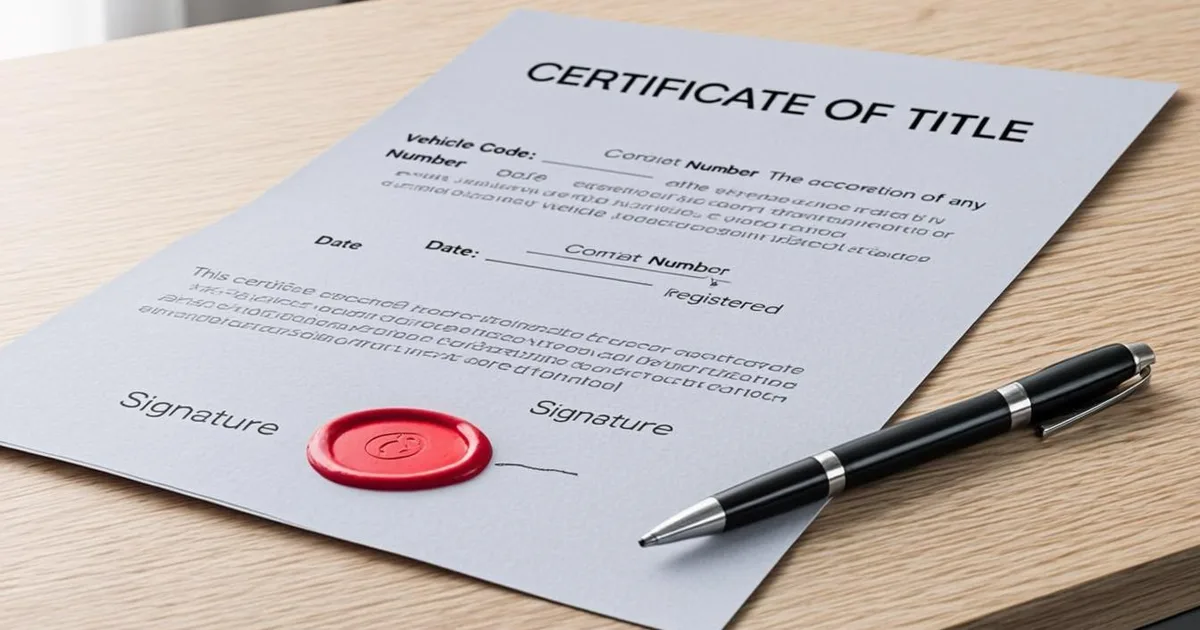

You paid the loan off. The money left your account, and the lender confirmed it in writing. Yet the title still shows a lien that no longer exists.
Weeks pass, sometimes months, and the paper or electronic record never moves. This is one of the most common ownership problems in the country.
The mistake most owners make is calling the bank once, getting a vague answer, and waiting. Waiting almost never works, because the release task sits in a queue nobody monitors. This guide walks the pressure points that actually move a stubborn lienholder.
The sequence is proof, formal demand, regulator complaints, and the bonded title route. The last one covers a lender that has vanished. Before anything else, understand what a lien actually is on the state's records.
The lienholder's name sits on the face of the title or inside an electronic lien and title system. Only an authorized release removes it: a signed paper, an ELT transmission, or a court order. Our explainer on what a car title actually is covers how liens attach and detach on the document itself.
Table of Contents
- Why Lenders Sit on Releases
- Step 1: Build a Payoff Paper Trail the DMV Will Accept
- Step 2: Send a Formal Release Demand
- Step 3: Escalate to the Regulators Who Actually Get Results
- Filing Complaints in Parallel: Sequencing and Detail
- When the Lender Merged, Sold, or Vanished
- The Bonded Title Route When Escalation Fails
- After the Release Lands: Close the Loop Yourself
Why Lenders Sit on Releases
Most slow releases are not personal. Payoff checks sit unprocessed in a servicing department. Sometimes the loan was sold and the file never migrated, or the release letter went to an old address.
Electronic lien and title systems add a newer failure mode. The lender marks the loan paid, but the electronic release to the state never fires.
Servicing transfers are the single biggest culprit I see. When banks merge or sell loans, the successor inherits the lien record. It often lacks the staff discipline to clear it.
An owner of a loan sold three times can spend a year finding who holds the file. Meanwhile, the state record still shows the original lender from a decade ago. That mismatch blocks every downstream fix.
There is also a darker version. The lender disputes the payoff amount, claims fees or penalties, and holds the release hostage. That moves the problem from paperwork into a legal dispute, and the strategy changes.
Later sections cover both paths.
Step 1: Build a Payoff Paper Trail the DMV Will Accept
Every escalation path starts with the same evidence package. Without it, a regulator will simply forward your complaint to the lender and mark it resolved. With it, you become the one party in the conversation with documents.
- The payoff quote or statement showing the exact payoff amount and good-through date
- Proof of payment: canceled check, ACH confirmation, wire receipt, or the final auto-pay debit
- The lender's own confirmation — a paid-in-full letter, a closing statement, or an email confirming zero balance
- Your current title copy or registration showing the lien of record exactly as the state lists it
- A short timeline: one paragraph stating dates — loan opened, paid off, release requested, what the lender said
Keep names and reference numbers from every call. A note reading "spoke to Marcus, ref 88412, March 3, release mailed" outvalues an hour of frustration. Regulators and courts both lean on dated, specific records.
Step 2: Send a Formal Release Demand
A phone call is a conversation; a demand letter is a record. Write a one-page letter stating the loan was paid on a specific date. Attach the proof and set a deadline — 14 days is standard and reasonable.
State the consequence plainly. If the release is not provided, you will file complaints with the state banking regulator, the DMV, and the CFPB. Then follow through.
Send it so it can be tracked: certified mail with return receipt. Add an email copy to the lender's general and customer-service addresses. Keep the green card or tracking screenshot.
That single receipt transforms your next phone call. The lender's compliance staff now knows you document everything. Most reputable lenders release within this window once a tracked demand arrives.
Servicing departments triage mail by consequence, and a certified letter citing regulators jumps the queue. If the letter alone clears the release, you are done in two weeks.
Step 3: Escalate to the Regulators Who Actually Get Results
If the demand window passes, file complaints in parallel — not sequentially. Each agency has a different lever, and lenders respond differently to each. Filing two or three at once costs you an hour and multiplies the pressure.
| Where to complain | What it triggers | Best for |
|---|---|---|
| State DMV lien desk | Some states contact the lender directly; several allow the owner to start a DMV-supervised release or bond process | Any state; fastest practical route in ELT states |
| State banking / financial regulator | Formal inquiry the lender must answer in writing within a set period | State-chartered banks and credit unions |
| CFPB (consumerfinance.gov) | Federal complaint the servicer must respond to within 15 days | National banks and loan servicers |
| OCC or FDIC | Applies pressure through the bank's federal regulator | National banks (OCC) when other routes stall |
The CFPB route deserves emphasis because of its clock. Servicers must respond within 15 days and close the complaint within 60. The response becomes part of a federal record the bank cares about.
I once watched a lien sit for five months. It released 11 days after a CFPB complaint number appeared in the owner's emails.
Several states add their own teeth. A handful fine lenders per day for late ELT transmissions. Some allow the DMV to issue a clean title based on the owner's payoff proof after notice to the lender.
Ask your DMV specifically about this. The answer varies by state, but every state has a process. Desk clerks rarely volunteer it unless you ask.
Ask verbatim: "What is this state's process when a lienholder will not release?"
Filing Complaints in Parallel: Sequencing and Detail
A note on sequencing: file the DMV route first when your state offers a supervised clearing process. It can run in the background while the other complaints work. The banking regulator and the CFPB can be filed the same day.
They ask overlapping questions but operate independently. A lender that answers one sometimes discovers it cannot answer the other consistently. Do not wait for one agency to finish before trying the next.
These processes are slow by design. Running them in parallel is how owners finish in two months instead of six.
The federal complaint portals are free and take twenty minutes. The CFPB accepts vehicle loan complaints directly at consumerfinance.gov. The complaint narrative you write there should be three paragraphs.
Paragraph one: the loan and payoff facts with dates. Paragraph two: the release request history with the lender's responses. Paragraph three: the specific relief you are requesting.
Attach your evidence as PDFs. The OCC handles national banks through occ.gov for cases the CFPB route somehow leaves cold.
When the Lender Merged, Sold, or Vanished
If the lender no longer exists under its old name, the release path runs through its successor. Bank mergers transfer obligations to the acquiring institution. A defunct lender's lien usually belongs to whoever bought its loan book.
Our guide to handling titles with an active loan explains how servicing transfers appear on records. It also shows who to contact when the servicer changes mid-loan.
Track the successor in this order. Check the FDIC's failed-bank list for closed institutions. Check the acquiring bank's servicing department for mergers, then the state banking regulator when nobody responds.
Bring your evidence package to whoever you find. Successors release old liens readily once the payoff proof is in front of them. Their exposure is reputational rather than financial.
The harder case is a small lender that dissolved without a clear successor. Some states handle this through a surety bond on the title, which brings us to the alternative route.
The Bonded Title Route When Escalation Fails
Nearly every state offers a bonded title path for exactly this situation. Ownership is real and provable, but a lienholder will not or cannot clear the record. The owner posts a surety bond, commonly valued at one to one-and-a-half times the vehicle's worth.
The state issues a clean title that becomes fully mature after the bond period, typically three to five years. The bond protects any party who later proves the lien was theirs.
In practice, lenders almost never claim against these bonds, because the payoff proof is already documented. The premium usually runs from roughly one to low-double-digit percent of the bond value. The paperwork is a state application plus a bond from a licensed surety company.
Choose this route when the lender is unreachable or formally refuses. It also applies when your state's DMV-supervised release path does not exist. Our walkthrough of proving ownership before a transfer covers when bonds fit alongside other evidence documents.
After the Release Lands: Close the Loop Yourself
Getting the release is not the finish line. In paper-title states, the release must be physically attached to the title or submitted with a new-title application. A lender's letter in your email does not clear the state record.
Take the release, the title, and your ID to the DMV. Apply for the updated document while you are there.
In ELT states, confirm the lien actually disappeared from the state system before celebrating. Ask the DMV to print the current record or check the online portal. A lender that marked the loan paid internally may still show as an active lienholder.
That means the electronic release failed, and the escalation cycle starts again. This time the fix is narrower.
Finally, keep the paid-in-full letter for the life of the vehicle. When you sell, the buyer's lender and the buyer's state will both want proof the lien was released. A ten-year-old letter is easier to find than a ten-year-old phone call.
One more consequence worth understanding: the stale lien follows the vehicle, not the paperwork in your drawer. Insurance renewals, title transfers, and even some employment screening read the record. An owner who resolves a six-year-old lien in six weeks has closed the gap permanently.
An owner who waits until the vehicle must be sold pays for those years in one compressed month. Resolve it now, not at the closing table.
If the original title itself is lost on top of all this, the duplicate process still works. Our guide on replacing a lost car title covers it step by step. The state-by-state guides hub lists fees and forms for every state.